

The Central Weather Administration (CWA) and National Cheng Kung University have developed an artificial intelligence (AI)-powered system to predict rogue waves, which is expected to be rolled out nationwide by the end of the year, the agency said yesterday.
Rogue waves, also known as “freak waves,” are large, unpredictable surface waves that can pose a serious safety risk.
Many factors can cause rogue waves, although the precise mechanisms of their development, timing and locations are under-researched, university Department of Hydraulic and Ocean Engineering professor Doong Dong-jiing (董東璟) said.
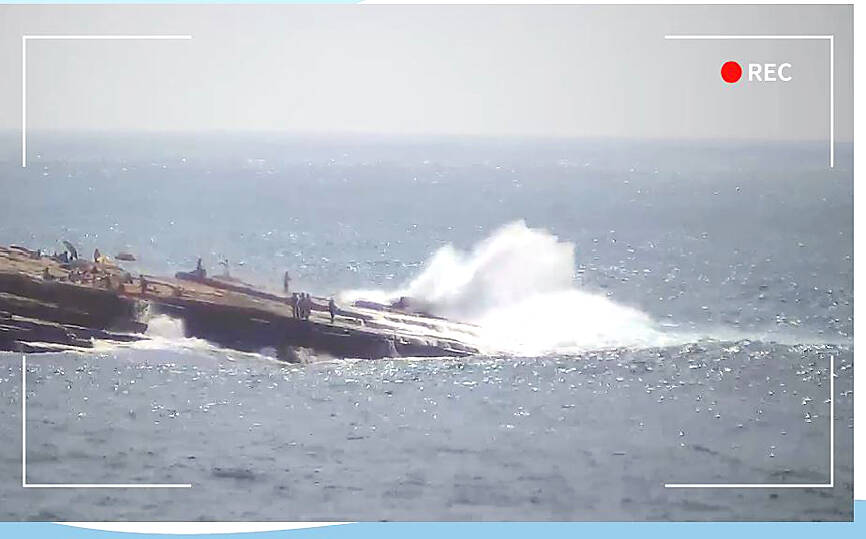
Photo courtesy of the Central Weather Administration
The system, the first of its kind in Taiwan, is a pioneering technology, he added.
The system is being used in New Taipei City and national scenic areas along the north and northeast under the Tourism Administration’s jurisdiction, CWA Deputy Administrator Fong Chin-tzu (馮欽賜) said.
Over the past 25 years, Taiwan has experienced an average of 17 rogue waves annually, sweeping an average of 30 people per year out to sea, CWA data showed.
The agency began the project by monitoring the occurrence of rogue waves and building a database, which was used to train an AI model to give more accurate predictions of their formation, Fong said.
The system, which began development in 2017, uses cameras to monitor the coast and identify abnormal waves, combining information with data provided by the CWA’s wave models and an AI prediction model to assess the likelihood of a rogue wave occurring within 24 hours.
As one of the main causes of rogue waves are swells, swell data is also incorporated into the machine learning, CWA Marine Meteorology and Climate Division head Pan Chi (潘琦) said.
The agency has established at least one abnormal wave monitoring station in 15 coastal cities and counties across Taiwan, and expects to add another by the end of the year, he said.
If an area needs additional monitoring systems, it can request assistance from the CWA, he said.
The New Taipei City Fire Department and the Rueifang District (瑞芳) Office have already budgeted for an additional warning system at Bianfudong (蝙蝠洞), or the “bat cave,” in Rueifang, an area prone to rogue waves, Pan said.
If a dangerous wave is detected, the system would immediately notify disaster prevention personnel to safely evacuate visitors from the area, he said.
The agency has not yet decided on whether to send cellphone alerts of rogue waves, which would require following the Disaster Prevention and Protection Act (災害防救法), he said.
The CWA currently provides forecasting information, while on-site responses are handled by local authorities and relevant agencies, he added.
Early warning information is to be made available on the CWA Web site and weather app, Pan said.

A Straits Exchange Foundation official today warned that yielding to political pressure in exchange for access to China’s entertainment industry rarely ends well, amid rumors that China is seeking to lure Taiwanese K-pop star Chou Tzu-yu (周子瑜). Chou, more commonly known as Tzuyu, is the only Taiwanese member of the girl group Twice. Her contract with JYP Entertainment is set to expire at the end of this year, and there have been widespread reports that she would not renew it. She is reportedly planning to pursue solo activities under her parents’ agency, Yu Hai Entertainment (瑜海娛樂), although China has also reportedly offered
A tropical depression near Hainan that was once Typhoon Saudel may once again strengthen into a tropical storm, the Central Weather Administration (CWA) said yesterday, but a sea warning for waters around Taiwan is unlikely. CWA forecaster Huang En-hung (黃恩鴻) said that Saudel would return to being a weak tropical storm by late yesterday or early this morning. However, as the storm is to gradually weaken again and would head toward China’s Guangdong Province away from Taiwan, the chances that it would affect Taiwan enough for the CWA to issue a sea warning are relatively low,
China has revised its National Defense Mobilization Law to prepare for a rapid transition to wartime, with an official today saying the measures are aimed at helping Chinese President Xi Jinping (習近平) fulfill his “historic mission of national unification.” The revised version of the mobilization law is to take effect on Oct. 1, marking the first major revision since the law was enacted in 2010. The amendments define national defense mobilization as measures taken in response to threats to national sovereignty, unification, territorial integrity, security and development interests, including efforts to ensure rapid transition between peacetime and wartime and convert economic and

Yielding to political pressure in exchange for access to China’s entertainment industry rarely ends well, a Straits Exchange Foundation official said yesterday amid rumors that China is seeking to lure Taiwanese K-pop star Chou Tzu-yu (周子瑜). Chou, who goes by Tzuyu, is the only Taiwanese member of the girl group Twice. Her contract with JYP Entertainment is set to expire at the end of this year, and there have been widespread rumors that she would not renew it. She is reportedly planning to pursue a solo career under her parents’ agency, Yu Hai Entertainment, although China has also reportedly offered to help Tzuyu


 RSS
RSS