


Hamas yesterday was reviewing US President Donald Trump’s plan for Gaza, while Israeli Prime Minister Benjamin Netanyahu said the military would stay in most of the territory after he gave the US president his backing.
The plan calls for a ceasefire, release of hostages by Hamas within 72 hours, disarmament of Hamas and a gradual Israeli withdrawal from Gaza, followed by a post-war transitional authority headed by Trump.
“Hamas has begun a series of consultations within its political and military leaderships, both inside Palestine and abroad,” a Palestinian source said on condition of anonymity. “The discussions could take several days due to the complexities.”
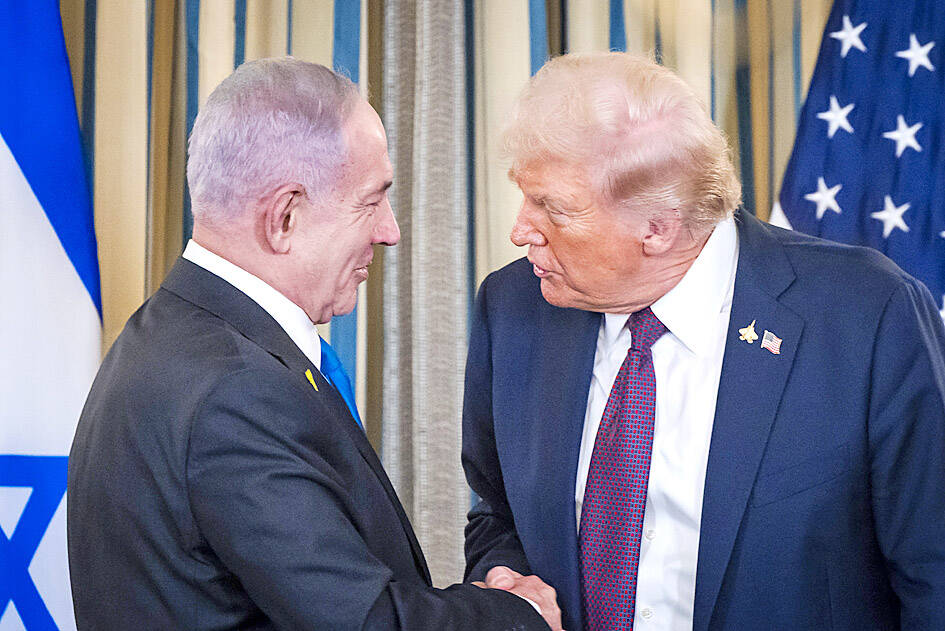
Photo: EPA
Qatar, which hosts Hamas’ exiled leadership, said the group had promised to study the proposal “responsibly,” and also said it would hold a meeting on the plan with Hamas and Turkey later yesterday.
“It is still too early to speak about responses, but we are truly optimistic that this plan, as we said, is a comprehensive one,” Qatari Ministry of Foreign Affairs spokesman Majed al-Ansari said.
In Washington on Monday Trump described the announcement of the plan as a “beautiful day — potentially one of the greatest days ever in civilization.”
The deal would demand Hamas militants fully disarm and be excluded from future roles in the government, but those who agreed to “peaceful coexistence” would be given amnesty.
It would also see a phased Israeli withdrawal from Gaza, after nearly two years of war sparked by Hamas’ unprecedented attack on Israel on Oct. 7, 2023.
However, in a video statement posted on his Telegram channel after his joint news conference with Trump, Netanyahu said the military would stay in most of Gaza, and also said he did not agree to a Palestinian state during his talks in Washington.
“We will recover all our hostages, alive and well, while the [Israeli military] will remain in most of the Gaza Strip,” he said.
Israeli Minister of Finance Bezalel Smotrich criticized the plan as a “resounding diplomatic failure.”
“In my estimation, it will also end in tears. Our children will be forced to fight in Gaza again,” Smotrich said.
Trump’s plan includes the deployment of a “temporary international stabilization force” and the creation of a transitional authority headed by Trump himself and including former British prime minister Tony Blair.
Blair, still widely hated in the Middle East for his role in the 2003 Iraq war, hailed the “bold and intelligent” plan.
During his news conference with Trump, Netanyahu cast doubt on whether the Palestinian Authority, which nominally runs Palestinian population centers in the occupied West Bank, would be allowed a role in Gaza’s governance.
Trump said that during their meeting Netanyahu had strongly opposed any Palestinian statehood — something that the US plan leaves room for.
“I support your plan to end the war in Gaza which achieves our war aims,” Netanyahu said. “If Hamas rejects your plan, Mr President, or if they supposedly accept it and then basically do everything to counter it, then Israel will finish the job by itself.”
Trump said that Israel would have his “full backing” to do so if Hamas did not accept the deal.
In Gaza, people were skeptical.
“It’s clear that this plan is unrealistic,” 39-year-old Ibrahim Joudeh said from his shelter in the so-called humanitarian zone of al-Mawasi in southern Gaza.
“It’s drafted with conditions that the US and Israel know Hamas will never accept. For us, that means the war and the suffering will continue,” said the computer programmer, originally from the southern city of Rafah, devastated by a military offensive that began in May.

A signaling system malfunction disrupted high-speed rail (HSR) services beginning at 8am today, with trains temporarily reduced to three northbound and three southbound trains per hour as authorities conduct inspections. The malfunction occurred on a section of track in Miaoli County during pre-operation checks early this morning, forcing northbound and southbound trains to use a single track, the HSR operator said. The regular schedule has been replaced with three hourly trains offering only nonreserved seating in each direction, stopping at every station, it said, adding that business class cars would still have reserved seating. Departures from terminal stations are scheduled at the top

Taiwan is still in the process of assessing the possibility of recruiting workers from Eswatini, the Ministry of Foreign Affairs said yesterday, adding that its goal is to help Eswatini upgrade its vocational training centers. If there are plans to recruit workers from Eswatini, safeguarding national security, protecting public health and ensuring the employment rights of Taiwanese would be prerequisites, Department of West Asian and African Affairs Director-General Yen Chia-liang (顏嘉良) told a news conference. Key considerations would also include filling labor shortages in specific industries, and fostering bilateral professional and technical exchanges, he said. Yen was asked about the progress of labor

VERBOSE VESSELS: A CGA cutter and a China Coast Guard exchanged verbal barbs for more than a day in Taiwanese-controlled waters before the Chinese vessel left The Taiwanese and Chinese coast guards had a standoff near the strategically located Pratas Islands (Dongsha Islands, 東沙群島) in the north of the South China Sea, the Coast Guard Administration (CGA) said yesterday. The two sides engaged in intense radio exchanges over sovereignty claims during the 33-hour standoff. China Coast Guard vessel 3501 eventually left the restricted waters, 26.6 nautical miles (49.2km) west of the Pratas Islands, at 5pm yesterday, the CGA said. Lying approximately between southern Taiwan and Hong Kong, the Taiwan-controlled Pratas are seen by some security experts as vulnerable to Chinese attack due to their distance — more than

A US uncrewed surface vessel (USV) encountered multiple Chinese warships during an autonomous transit of the Taiwan Strait, US defense company Seasats said in a statement on Wednesday. Seasats announced that a Lightfish USV had completed the first autonomous transit of the Taiwan Strait. Over five days, the USV traversed the entire length of the Strait while constantly monitoring surface vessel traffic, the company said. The Lightfish encountered multiple Chinese warships, one of which was a Chinese People’s Liberation Army Navy (PLAN) Type 056 corvette, it said. The Chinese vessels were operating “well within Taiwan’s exclusive economic zone without transmitting their identity via the


 RSS
RSS