


Digital affairs authorities are to review other nations’ regulation of TikTok to decide whether its download by the public should be restricted, Executive Yuan spokeswoman Michelle Lee (李慧芝) said yesterday.
Lee made the remarks following an investigative report on TikTok published by the Control Yuan last month, which said that the US Congress’ passage of a bill last year requiring TikTok’s US operations to be sold or face a shutdown showed the global alarm over the platform’s risks to national security and children.
The video-sharing platform negatively affects children’s and teenagers’ mental and physical development, especially as it allows harmful “challenges” to spread unchecked to boost viewership, and which have caused more than 100 deaths worldwide, the report said.
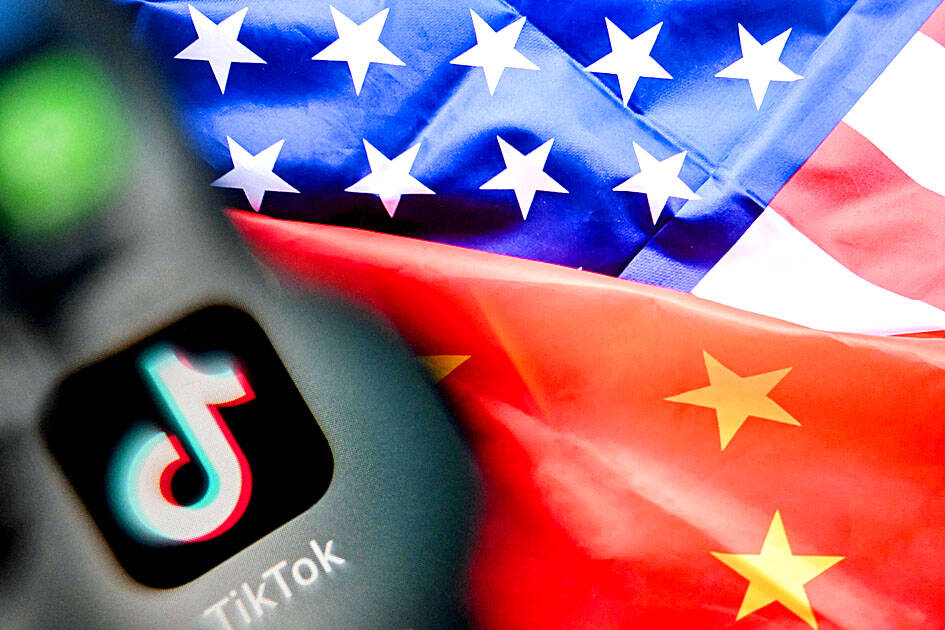
Photo: AFP
TikTok also seriously threatens Taiwan’s national security, as it collects users’ personal data and stores it in China, including those of minors, and it has been abused by the Chinese Communist Party to spread disinformation in Taiwan, it said, urging the Executive Yuan to coordinate improvements.
Lee yesterday said that the Executive Yuan has restricted the use of information and communications equipment by the public sector in accordance with the Rules for Restricting Governmental Agencies’ Use of Products That Endanger National Cybersecurity (各機關對危害國家資通安全產品限制使用原則), implemented in 2019.
The Ministry of Digital Affairs is responsible for managing such equipment for national security and regulating how the public sector uses products of cybersecurity concern, including mobile apps, so that user data or information would not be leaked by such products and compromise cybersecurity at the national level, she said.
While public servants’ mobile devices for private use and ordinary people are not regulated, digital affairs authorities would research what steps other nations have taken, as well as evaluate the legality and feasibility, to decide whether the public’s access to such products should be restricted, she said.
Regarding illegal or inappropriate content published on online platforms, Lee said penalties should be given by responsible authorities in accordance with applicable statutes.
The Executive Yuan has been exploring ways of counteracting disinformation circulated on TikTok, she said.
As required by current regulations, government agencies cannot install or use TikTok, while schools’ e-learning network access to TikTok is restricted, Lee said.
However, overly strict regulation by the government could interfere with people’s lives, she said.
The government has adopted digital fraud prevention measures under the Fraud Crime Hazard Prevention Act (詐欺犯罪危害防制條例) to govern online advertising platforms, including TikTok, Lee said.
That could curb scam advertisements and disinformation threatening the private sector and protect people’s welfare, she said.
The governance of digital platforms involves a wide range of issues such as fair competition, gender equity, national security, personal data protection, child and youth protection, as well as combating fraud, she added.
For example, illegal content spotted on online platforms could contravene the National Security Act (國家安全法), the Social Order Maintenance Act (社會秩序維護法) or the Protection of Children and Youths Welfare and Rights Act (兒童及少年福利與權益保障法), and the authorities would define and handle the legality based on the respective laws, with punishments handed out if need be, Lee said.
The government is aware of almost all the risks posed by TikTok and would discipline criminals as required by law, she said, calling on people to use the app cautiously.
Separately yesterday, an official on condition of anonymity commented on US President Donald Trump last week announcing that the proposed framework agreement for a group of US investors to buy TikTok’s US operations met the requirements of a ban-or-sale law enforced last year.
According to the planned deal unveiled by the White House, Oracle cofounder Larry Ellison and other investors would set up a joint venture in the US to run TikTok’s US business, and handle local data security.
The joint venture would have a more than 80 percent stake in the business, leaving TikTok’s parent company, ByteDance (字節跳動), with less than 20 percent.
The operation of TikTok’s algorithms, code and content moderation would all fall under the control of the joint venture, the White House said.
The official in Taipei yesterday said that given that TikTok’s legal status is supposed to change after its US assets are mostly sold to US investors, banning the use of the short video app by the public sector in Taiwan would require reconsideration.
“If TikTok changes from a Chinese company to a company owned by Americans, should it continue to be banned based on national security concerns?” the official asked.
Additional reporting by Fang Wei-li

CREDIT-GRABBER: China said its coast guard rescued the crew of a fishing vessel that caught fire, who were actually rescued by a nearby Taiwanese boat and the CGA Maritime search and rescue operations do not have borders, and China should not use a shipwreck to infringe upon Taiwanese sovereignty, the Coast Guard Administration (CGA) said yesterday. The coast guard made the statement in response to the China Coast Guard (CCG) saying it saved a Taiwanese fishing boat. The Chuan Yu No. 6 (全漁6號), a fishing vessel registered in Keelung, on Thursday caught fire and sank in waters northeast of Diaoyutai Islands (釣魚台). The vessel left Keelung’s Badouzih Fishing Harbor (八斗子漁港) at 3:35pm on Sunday last week, with seven people on board — a 62-year-old Taiwanese captain surnamed Chang (張) and six
RISKY BUSINESS: The ‘incentives’ include initiatives that get suspended for no reason, creating uncertainty and resulting in considerable losses for Taiwanese, the MAC said China’s “incentives” failed to sway sentiment in Taiwan, as willingness to work in China hit a record low of 1.6 percent, a Ministry of Labor survey showed. The Directorate-General of Budget, Accounting and Statistics (DGBAS) also reported that the number of Taiwanese workers in China has nearly halved from a peak of 430,000 in 2012 to an estimated 231,000 in 2024. That marked a new low in the proportion of Taiwanese going abroad to work. The ministry’s annual survey on “Labor Life and Employment Status” includes questions respondents’ willingness to seek employment overseas. Willingness to work in China has steadily declined from

The Legislative Yuan’s Finance Committee yesterday approved proposed amendments to the Amusement Tax Act (娛樂稅法) that would abolish taxes on films, cultural activities and competitive sporting events, retaining the fee only for dance halls and golf courses. The proposed changes would set the maximum tax rate for dance halls and golf courses at 50 and 20 percent respectively, with local governments authorized to suspend the levies. Article 2 of the act says that “amusement tax shall be levied on tickets sold or fees charged by amusement places, facilities or activities” in six categories: “Cinema; professional singing, story-telling, dancing, circus, magic show, acrobatics

INFLATION UP? The IMF said CPI would increase to 1.5 percent this year, while the DGBAS projected it would rise to 1.68 percent, with GDP per capita of US$44,181 The IMF projected Taiwan’s real GDP would grow 5.2 percent this year, up from its 2.1 percent outlook in January, despite fears of global economic disruptions sparked by the US-Iran conflict. Taiwan’s consumer price index (CPI) is projected to increase to 1.5 percent, while unemployment would be 3.4 percent, roughly in line with estimates for Asia as a whole, the international body wrote in its Global Economic Outlook Report published in the US on Monday. The figures are comparatively better than the IMF outlook for the rest of the world, which pegged real GDP growth at 3.1 percent, down from 3.3 percent


 RSS
RSS