


The leaders of Palau and Eswatini spoke out against China’s distortion of UN Resolution 2758 at the UN General Assembly on Thursday, saying the resolution does not preclude Taiwan’s participation in the global body.
The remarks come the day after the leaders of Paraguay, the Marshall Islands and the Czech Republic mentioned Taiwan in their addresses at the assembly, which began on Tuesday and runs through Monday in New York.
Taiwan’s inclusion is an “urgent issue,” with the voices of 23 million people left unheard, Palauan President Surangel Whipps Jr said.
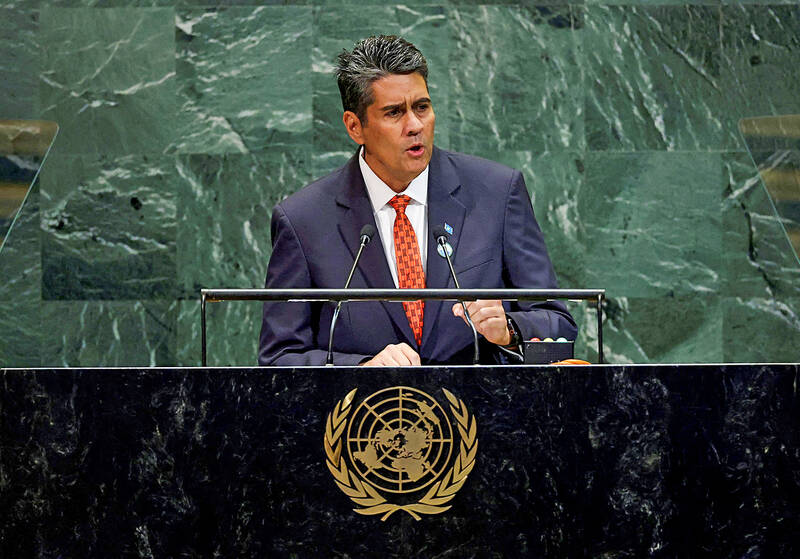
Photo: Reuters
Taiwan remains unable to fully participate in the UN system or contribute to the world, he said.
UN Resolution 2758, passed in 1971, recognized the government of the People’s Republic of China (PRC) as the only legitimate representative of China at the UN, a move that enabled the PRC to replace Taiwan as a permanent member of the UN Security Council. It did not address the question of Taiwan’s sovereignty or representation at the UN.
China has willfully misinterpreted the resolution for many years now, using it to claim Taiwan as part of the PRC’s territory, Whipps said.
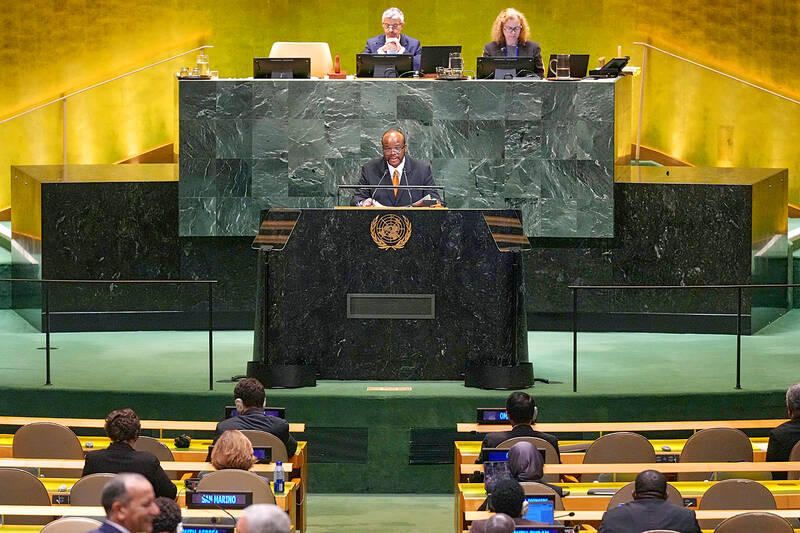
Photo: AP
“Palau believes that inclusivity strengthens the United Nations, and that no community should be barred from contributing to the solutions our world so desperately needs,” he said.
Palau and Taiwan have had official diplomatic relations since 1999, with exchanges dating back to 1980.
King Mswati III of Eswatini also referenced UN Resolution 2758, saying that it “did not address the issue of Taiwan’s representation in the United Nations, and it does not preclude their participation in the UN system.”
Eswatini and the Marshall Islands also called for Taiwan’s inclusion to help realize the UN’s Sustainable Development Goals (SDGs).
Taiwan is an “important partner to the Marshall Islands and the world in the SDGs,” Marshallese President Hilda Heine said, while King Mswati III said that the UN should “seek suitable ways of including Taiwan in efforts to realize the SDGs.”
On Wednesday, Paraguayan President Santiago Pena said that Taiwan’s exclusion from the UN system “is an affront that weakens the legitimacy of our institutions.”
Paraguay has proudly maintained relations with Taiwan for 67 years, showing that “cooperation between nations can be based on more than mere interest,” he said.
“It is time to uproot this tree of injustice that has been growing for decades, and give China and Taiwan a place in the UN,” he added.
Meanwhile, US Deputy Secretary of State Christopher Landau met with Chinese Vice Minister of Foreign Affairs Ma Zhaoxu (馬朝旭) on the sidelines of the UN General Assembly on Thursday, during which they discussed Taiwan.
Among the “range of regional and global matters” discussed were threats to peace and stability in the Taiwan Strait, US Department of State principal deputy spokesperson Tommy Pigott said in a news release.

SILENCING CRITICS: In addition to blocking Taiwan, China aimed to prevent rights activists from speaking out against authoritarian states, a Cabinet department said The Ministry of Foreign Affairs (MOFA) yesterday condemned transnational repression by Beijing after RightsCon, a major digital human rights conference scheduled to be held in Zambia this week, was abruptly canceled due to Chinese pressure over Taiwanese participation. This year’s RightsCon, the world’s largest conference discussing issues “at the intersection of human rights and technology,” was scheduled to take place from tomorrow to Friday in Lusaka, and expected to draw 2,600 in-person attendees from 150 countries, along with 1,100 online participants. However, organizers were forced to cancel the event due to behind-the-scenes pressure from China, the ministry said, expressing its “strongest condemnation”
Taiwan’s economy grew far faster than expected in the first quarter, as booming demand for artificial intelligence (AI) applications drove a surge in exports, spilling over into investment and consumption, the Directorate-General of Budget, Accounting and Statistics (DGBAS) said yesterday. GDP growth was 13.69 percent year-on-year during the January-to-March period, beating the DGBAS’ February forecast by 2.23 percentage points and marking the most robust growth in nearly four decades, DGBAS senior official Chiang Hsin-yi (江心怡) told a news conference in Taipei. The result was powered by exports, which remain the backbone of Taiwan’s economy, Chiang said. Outbound shipments jumped 51.12 percent year-on-year to
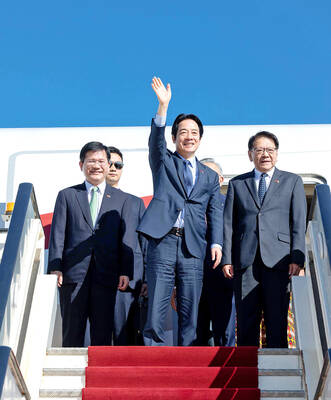
DELAYED BUT DETERMINED: The president’s visit highlights Taiwan’s right to international engagement amid regional pressure from China President Willaim Lai (賴清德) yesterday arrived in Eswatini, more than a week after his planned visit to Taiwan’s sole African ally was suspended because of revoked overflight permits. “The visit, originally scheduled for April 22, was postponed due to unforeseen external factors,” Lai wrote on social media. “After several days of careful arrangements by our diplomatic and national security teams, we successfully arrived today.” Lai said he looked forward to further deepening Taiwan-Eswatini relations through closer cooperation in the economy, agriculture, culture and education, as well as advancing the nation’s international partnerships. The president was initially scheduled to arrive in time to celebrate
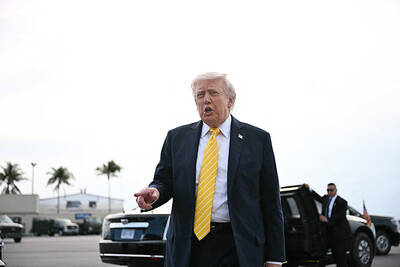
Iran’s Islamic Revolutionary Guard Corp (IRGC) yesterday said the US faced a choice between an “impossible” military operation or a “bad deal” with Tehran, after US President Donald Trump disparaged Iran’s latest peace proposal. Negotiations between the two countries have been deadlocked since a ceasefire came into effect on April 8, with only one round of direct peace talks held so far. Iran’s Tasnim and Fars news agencies reported that Tehran had submitted a 14-point proposal to mediator Pakistan, but Trump was quick to cast doubt on it. “I will soon be reviewing the plan that Iran has just sent to us, but


 RSS
RSS