


The Ministry of Foreign Affairs (MOFA) yesterday said it has asked the Ministry of Economic Affairs to suspend issuing a public notice of an impending export control on shipping chips to South Africa, after Pretoria agreed to talks over a year-long dispute regarding Taiwan’s office in the country.
The economics ministry on Tuesday announced that it would implement new export controls requiring prior approval for 47 products — including ICs and chips — shipped to South Africa, to be effective from late November.
It must submit the notice to be published on the Cabinet’s online gazette system two months before the export controls take effect.
Photo: Ritchie B. Tong, EPA
The restrictions were meant as a countermeasure following South Africa’s repeated downgrading and renaming of Taiwan’s representative offices in the country, actions that Taipei believes were taken amid Chinese pressure.
However, the economics ministry yesterday said the notice was only being put on its own bulletin system, and it would not submit it to the Cabinet’s online gazette system for the time being after consulting with the foreign affairs ministry.
MOFA in a separate statement said that it asked the economics ministry to suspend submitting the notice to the Cabinet’s system, after the South African government told it that it wished to engage in talks with Taiwan over the office dispute.
The South African government last year began a unilateral push to categorize Taiwan’s representative office, officially named the Taipei Liaison Office in the Republic of South Africa, as a “trade office” and move it from Pretoria, its administrative capital, to the commercial capital, Johannesburg.
It initially set a deadline of October last year before extending it to the end of March.
MOFA protested the move, calling for talks, but Pretoria has yet to respond to Taipei’s demands.
The South African side in early March unilaterally changed the name of the Taipei office on its Department of International Relations and Cooperation Web site from the “Taipei Liaison Office” to the “Taipei Commercial Office.”
On July 21, the department announced the renaming and downgrading of Taiwan’s main representative office in Pretoria and a branch office in Cape Town.
South Africa changed the main office name to the “Taipei Commercial Office in Johannesburg” and the branch office name to “Taipei Commercial Office in Cape Town,” and began referring to them as “international organizations” instead of “a foreign representation in South Africa.”
Despite the South African government’s unilateral decisions, Taiwan’s representative office in South Africa is maintaining normal operations in Pretoria and continues to provide necessary services to its nationals.
Taiwan has said that China was behind Pretoria’s decision to ask the Taipei office to relocate and rename, citing UN Resolution 2758 and Beijing’s “one China” principle.
Resolution 2758, adopted by the UN General Assembly in 1971, recognized the People’s Republic of China as “the only lawful representatives of China” to the international body, and expelled “the representatives of Chiang Kai-shek” (蔣介石) from the UN. It does not mention Taiwan.

‘NO SECURITY RISK’: The Railway Bureau reassured the public that the technicians’ activities were limited to technical guidance and did not involve sensitive systems The Railway Bureau yesterday said it had invited eight Chinese technicians to assist with an airport MRT construction project. The bureau issued the confirmation after an Internet user said Chinese nationals had entered the construction zone of Taiwan Taoyuan International Airport’s Terminal 3 project. They asked why “individuals from an enemy state” were allowed access to such a major national infrastructure project, which raised serious concerns over Taiwan’s industrial safety, sensitive systems and information security. The bureau’s Northern Region Engineering Branch Office said subcontractor Taiwan Handle Industrial Co (台灣手把工業) of the Taoyuan airport MRT’s “Contract No. CU05 Project A14 Station Civil, MEP &

A US uncrewed surface vessel (USV) encountered multiple Chinese warships during an autonomous transit of the Taiwan Strait, US defense company Seasats said in a statement on Wednesday. Seasats announced that a Lightfish USV had completed the first autonomous transit of the Taiwan Strait. Over five days, the USV traversed the entire length of the Strait while constantly monitoring surface vessel traffic, the company said. The Lightfish encountered multiple Chinese warships, one of which was a Chinese People’s Liberation Army Navy (PLAN) Type 056 corvette, it said. The Chinese vessels were operating “well within Taiwan’s exclusive economic zone without transmitting their identity via the

Taiwan is still in the process of assessing the possibility of recruiting workers from Eswatini, the Ministry of Foreign Affairs said yesterday, adding that its goal is to help Eswatini upgrade its vocational training centers. If there are plans to recruit workers from Eswatini, safeguarding national security, protecting public health and ensuring the employment rights of Taiwanese would be prerequisites, Department of West Asian and African Affairs Director-General Yen Chia-liang (顏嘉良) told a news conference. Key considerations would also include filling labor shortages in specific industries, and fostering bilateral professional and technical exchanges, he said. Yen was asked about the progress of labor
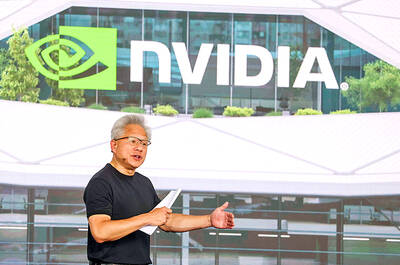
‘BOOMING’: ’ The number of partners we have here is incredible. You can see from their stock prices. They’re doing so well, they’re so happy,’ Jensen Huang said Nvidia Corp’s spending in Taiwan has ballooned to about US$150 billion a year, 10 times the US$10 billion to US$15 billion the company spent five years ago, Nvidia chief executive officer Jensen Huang (黃仁勳) said yesterday, suggesting Taiwan’s strategic importance in the global artificial intelligence (AI) supply chain. “Taiwan is the epicenter of the AI revolution. This is where the chips come, packaging comes. This is where the systems are made. This is where AI supercomputers were created,” Huang said at a meeting for the company’s employees in Beitou-Shilin Technology Park (北投士林科技園區) in Taipei, the planned site of Nvidia’s Taipei headquarters. “Taiwan


 RSS
RSS