


Taiwanese and Czech officials gathered at the National Museum of the Czech Republic in Prague yesterday for the opening of a National Palace Museum (NPM) exhibition.
Minister of Foreign Affairs Lin Chia-lung (林佳龍), Minister of Culture Li Yuan (李遠), NPM director Hsiao Tsung-huang (蕭宗煌) and a delegation of lawmakers led by Deputy Legislative Speaker Johnny Chiang (江啟臣) were joined by dignitaries of the Czech Republic, including Czech Chamber of Deputies President Marketa Pekarova Adamova, Czech Senate President Milos Vystrcil, Czech Senate First Vice President Jiri Drahos, Czech Deputy Minister of Culture David Kaspar, Czech Deputy Minister of the Environment Eduard Levy and Czech National Museum director General Michal Lukes at the 100 Treasures, 100 Stories exhibition opening at the Czech Republic’s National Museum.
A total of 131 iconic artifacts are being showcased from Thursday to Dec. 31, including one of the museum’s most popular items, the Jadeite Cabbage With Insects (翠玉白菜), and Along the River During the Qingming Festival (清明上河圖).
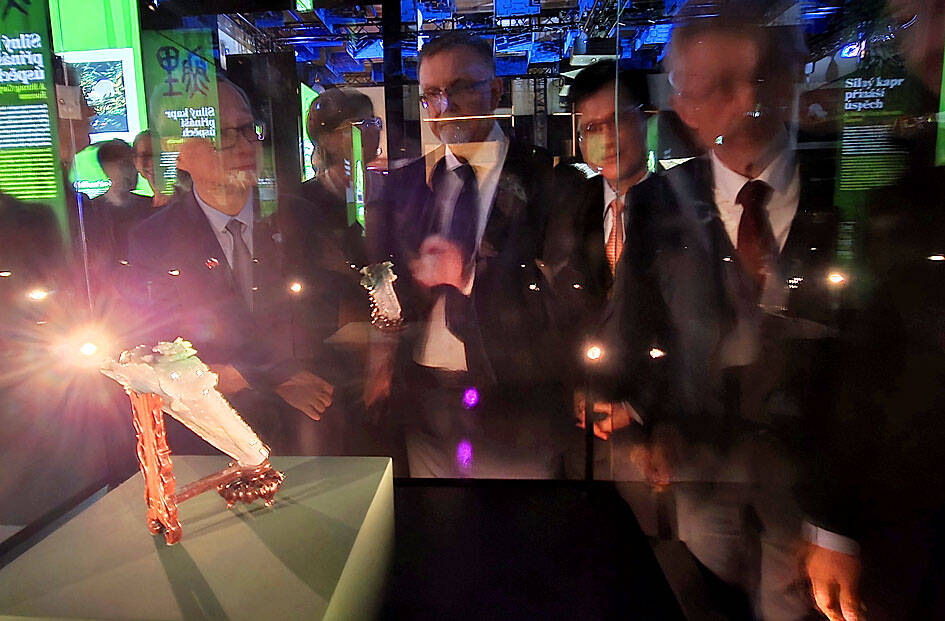
Photo: Ling Mei-hsueh, Taipei Times
Speaking at the opening ceremony, Lukes said he had dreamed about one day displaying the national treasures of the NPM in the Czech Republic since he first visited the museum in Taipei in 2003.
After a 20-year wait, the jadeite cabbage has made its long-anticipated European debut, he said, adding that it is a milestone that reflects the “trusting relationship” between the two countries.
“The NPM would not lend their priceless treasures to untrue friends,” he said, thanking authorities and curators from both countries for helping realize the dream.
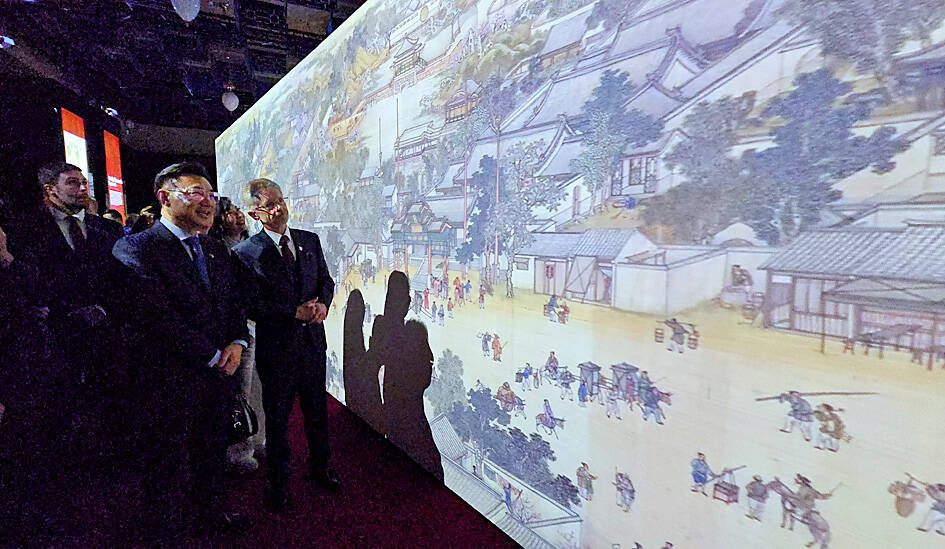
Photo: Ling Mei-hsueh, Taipei Times
Adamova said she “had it complete” upon finally seeing the jadeite cabbage, having admired the Meat-Shaped Stone during a visit to Taiwan in 2023. She described the jade carving as “a really beautiful piece.”
“We have such great partners in Taiwan who trust us to care for these valuable works,” she added.
Hsiao said the exhibition was the result of close collaboration between the two countries that deepened Taiwan-Czech ties and reflected the mutual understanding shared by democratic societies.

Photo: CNA
The power of culture lies in its ability to cross language and geographical barriers, helping people understand each other and themselves, Hsiao said.
The Czech Republic, which does not formally recognize Taipei, has grown increasingly close to Taiwan, seeing parallels between the threat Europe faces from Russia and the threat Taiwan faces from China.
The Ministry of Foreign Affairs said Lin’s trip to Europe was to promote the Taiwan Culture in Europe Year — a series of Taiwanese cultural events on the continent — “as a bridge connecting European and Taiwanese values, while fostering exchanges and interactions with European partners.”
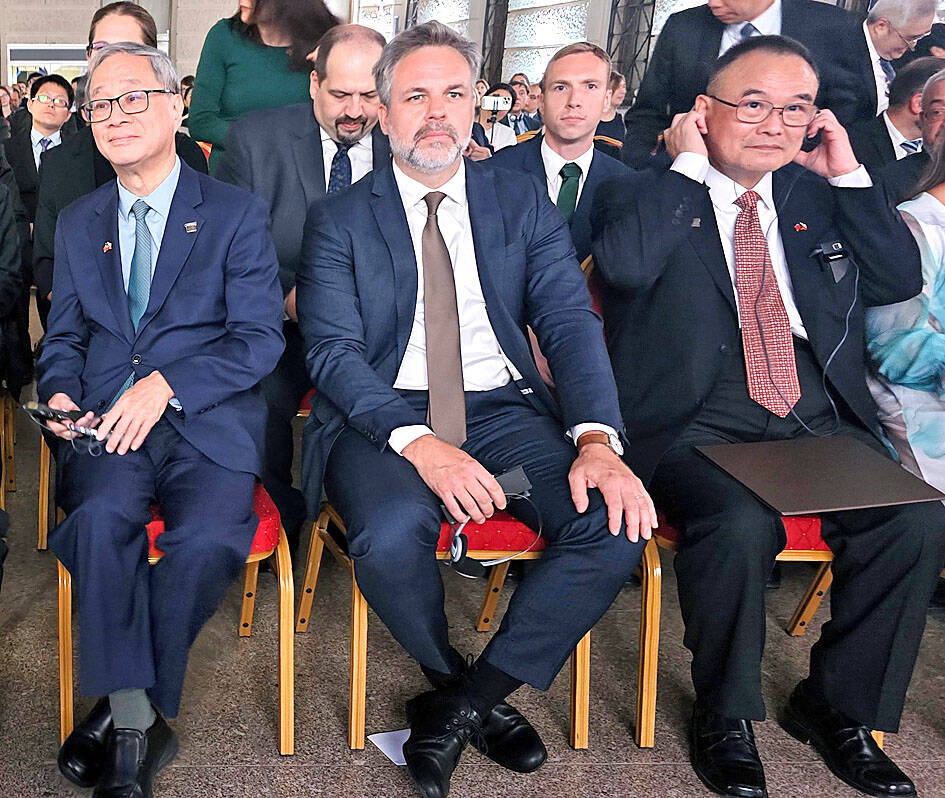
Photo: Ling Mei-hsueh, Taipei Times
Lin’s visit to Europe this week coincided with that of Chinese Minister of Foreign Affairs Wang Yi (王毅), a rare overlap of schedules in the same region despite Beijing’s efforts to block Taipei from diplomatic engagements.
Wang yesterday began a three-nation tour to Austria, Slovenia and Poland.
Chinese Ministry of Foreign Affairs spokesman Lin Jian (林劍) said Beijing strongly opposes any official exchanges with Taiwan, referring to Lin as “merely a local foreign affairs official in China.”
“We firmly oppose any country that has diplomatic relations with China engaging in any form of official interaction with the Taiwan region. We strongly oppose providing a platform for ‘Taiwan independence’ separatist activities,” he said, adding that China has lodged a protest with “the relevant country.”
In Taipei, the Ministry of Foreign Affairs said in a statement that Taiwan, as a member of the international community, “certainly has the right to engage naturally with other like-minded countries on the global stage.”
China has no right to interfere, nor does it have the authority to intervene in the sovereign actions of other countries — its actions merely underscore its hegemonic mindset, it added.
The Czech Ministry of Foreign Affairs declined to comment.

DRONE CENTRAL: Taiwan aims to become Asia’s democratic hub for drones, with most exports focused on high-quality military-grade models, an official said Taiwan’s drone industry is expected to expand significantly by 2030, producing 100,000 units per month and exporting half of them, the Ministry of Economic Affairs said yesterday. Current drone production capacity is about 15,000 units per month, but the industry can quickly scale up as demand increases, Industrial Development Administration Director-General Chiou Chyou-huey (邱求慧) told a news conference in Taipei. Taiwan’s drone output grew 2.5-fold last year to NT$12.9 billion (US$408.3 million) under a government program to develop the uncrewed vehicle sector, he said. The Executive Yuan in October last year approved plans to invest NT$44.2 billion into domestic production of uncrewed aerial
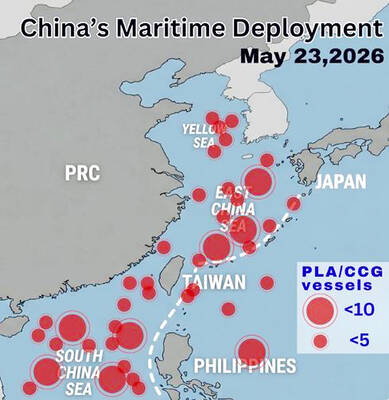
WARNING: China should stop engaging in actions that undermine regional peace and stability, as it would only build resentment among people across the Strait, the CGA said China has deployed more than 100 navy, coast guard and other vessels in waters from the Yellow Sea to the South China Sea and the western Pacific since US President Donald Trump and Chinese President Xi Jinping (習近平) met in Beijing, National Security Council Secretary-General Joseph Wu (吳釗燮) said yesterday. “In this part of the world, #China is the one & only PROBLEM wrecking the #StatusQuo & threatening regional peace & stability,” Wu wrote on X. In a separate post, he said Beijing was coercing Taiwan’s maritime domain, calling it illegal and provocative, after the Coast Guard Administration (CGA) expelled a

VERBOSE VESSELS: A CGA cutter and a China Coast Guard exchanged verbal barbs for more than a day in Taiwanese-controlled waters before the Chinese vessel left The Taiwanese and Chinese coast guards had a standoff near the strategically located Pratas Islands (Dongsha Islands, 東沙群島) in the north of the South China Sea, the Coast Guard Administration (CGA) said yesterday. The two sides engaged in intense radio exchanges over sovereignty claims during the 33-hour standoff. China Coast Guard vessel 3501 eventually left the restricted waters, 26.6 nautical miles (49.2km) west of the Pratas Islands, at 5pm yesterday, the CGA said. Lying approximately between southern Taiwan and Hong Kong, the Taiwan-controlled Pratas are seen by some security experts as vulnerable to Chinese attack due to their distance — more than
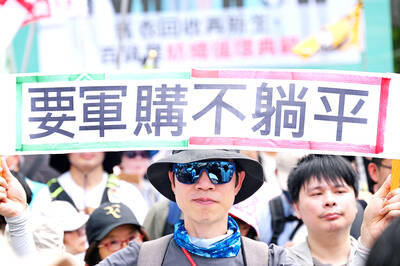
More than 8,000 people took part in a rally in Taipei yesterday to express support for more defense spending, after the opposition slashed the Cabinet’s proposed NT$1.25 trillion (US$39.6 billion) special defense budget and capped it at NT$780 billion. The demonstrators urged the Cabinet to propose another bill. Taiwan Economic Democracy Union convener Lai Chung-chiang (賴中強) said the main problem of the passed budget plan is the removal of funding for critical items, not just that the total amount is smaller. Critical budget items included purchasing or developing uncrewed vehicles, Strong Bow (強弓) missile systems, additional ammunition, artificial intelligence-powered combat systems and Taiwan-US


 RSS
RSS