


The Ministry of Foreign Affairs yesterday expressed gratitude to bipartisan US Congress members for condemning China’s unilateral third extension of the M503 flight route in the Taiwan Strait.
A letter signed by four US lawmakers was sent to International Civil Aviation Organization (ICAO) Secretary-General Juan Carlos Salazar on Thursday last week, telling him that China’s “brazen” action “provokes regional instability in the Indo-Pacific and clearly demonstrates a disregard for international order and the potential dangerous civilian consequences of this decision.”
The letter was signed by Republican Senator Marsha Blackburn, Republican Representative John Moolenaar, who heads the House Select Committee on China, Democratic Senator Gary Peters and Democratic Representative Raja Krishnamoorthi.
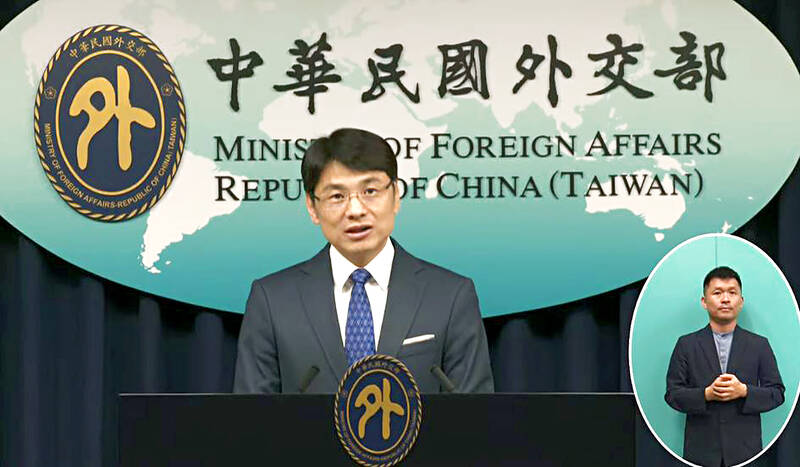
Photo: Screen grab from a Ministry of Foreign Affairs livestream
They also urged the ICAO to clarify its opposition to unilateral changes in international flight routes, and to ensure Taiwan’s meaningful participation in the upcoming 42nd ICAO Assembly, and in appropriate ICAO technical meetings.
PIF MEETING
In other developments, the ministry yesterday said it is regrettable that Taiwan has not been invited to participate in this year’s Pacific Islands Forum (PIF) in the Solomon Islands, calling on the host to honor a 1992 agreement that grants all PIF partners, including Taiwan, the right to attend the annual forum.
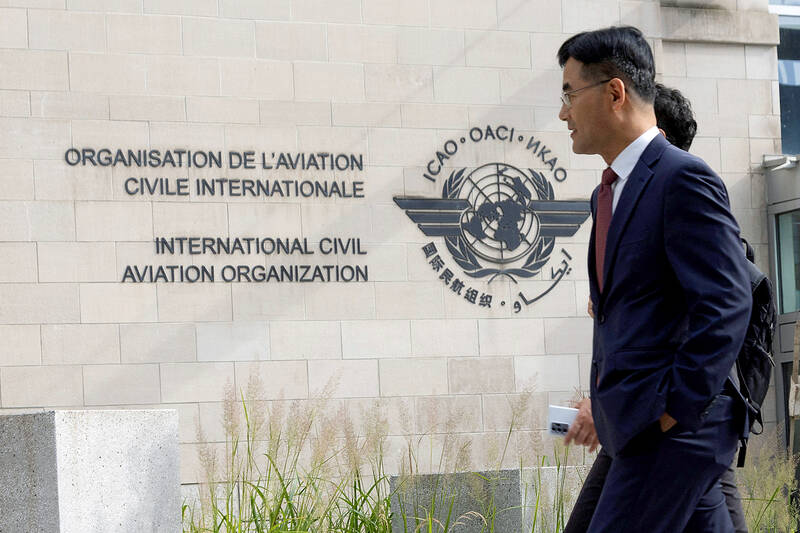
Photo: Reuters
Earlier this month, Solomon Islands Prime Minister Jeremiah Manele said only the 18 PIF members would attend the 54th PIF Leaders’ Meeting this year, while 21 donor countries, including Taiwan, the US and China, would not be invited.
Reuters on Aug. 7 reported that Solomon Islands opposition politician Peter Kenilorea Jr told parliament that the decision “is all about China and Taiwan.”
Minister of Foreign Affairs Lin Chia-lung (林佳龍), in an interview with the Australian daily newspaper last week, called China a regional “troublemaker,” saying he believed pressure from Beijing was behind the decision to exclude all dialogue and development partners from the meeting this year.
In Taipei yesterday, the ministry was asked to elaborate on what Lin meant in the interview about participating or contributing through other channels.
Ministry spokesman Hsiao Kuang-wei (蕭光偉) thanked the many countries that have expressed their support for Taiwan’s participation in the PIF this year, and that it “can understand, but expresses regret” over the Solomon Islands’ decision not to invite all PIF partners this year.
“At the same time, we want to again urge the Solomon Islands and future PIF hosting members to honor the agreement of the 1992 PIF Joint Communique, as well as the ‘Pacific Way’ framework, which embodies a spirit of inclusivity and diversity, and ensures the right of participation for all partners,” he said.
Regarding “other channels or methods” of participation or contributions, Hsiao said Taiwan and its allies in the Pacific Islands, as well as its other partners, place great emphasis on the development, sustainable environment and ecology of the region as it confronts climate change.
Although Taiwan would not be able to attend the leaders’ meeting this year, it would continue to exchange ideas with individual countries on issues of concern and seek opportunities for cooperation, he said.
For example, through PIF’s multilateral mechanisms, Taiwan has been providing regional development aid for many years, including the Taiwan/ROC-Pacific Islands Forum Scholarship, to help the nation’s allies and non-allies in the Pacific Islands, and the results are obvious to everyone, Hsiao said.
MARSHALL ISLANDS
Separately, Lin expressed his condolences to the Marshall Islands, an ally of Taiwan, after a fire destroyed the Pacific Island nation’s national parliament.
The Marshall Islands Fire Department yesterday said that half of the parliament building, known as the Nitijela, had been burnt down in a fire that broke out overnight.
Taiwan will remain in communication with the Marshall Islands’ government and “provide necessary assistance in a timely manner,” the ministry added in a statement, without elaborating.
Additional reporting by Reuters

A signaling system malfunction disrupted high-speed rail (HSR) services beginning at 8am today, with trains temporarily reduced to three northbound and three southbound trains per hour as authorities conduct inspections. The malfunction occurred on a section of track in Miaoli County during pre-operation checks early this morning, forcing northbound and southbound trains to use a single track, the HSR operator said. The regular schedule has been replaced with three hourly trains offering only nonreserved seating in each direction, stopping at every station, it said, adding that business class cars would still have reserved seating. Departures from terminal stations are scheduled at the top

Taiwan is still in the process of assessing the possibility of recruiting workers from Eswatini, the Ministry of Foreign Affairs said yesterday, adding that its goal is to help Eswatini upgrade its vocational training centers. If there are plans to recruit workers from Eswatini, safeguarding national security, protecting public health and ensuring the employment rights of Taiwanese would be prerequisites, Department of West Asian and African Affairs Director-General Yen Chia-liang (顏嘉良) told a news conference. Key considerations would also include filling labor shortages in specific industries, and fostering bilateral professional and technical exchanges, he said. Yen was asked about the progress of labor
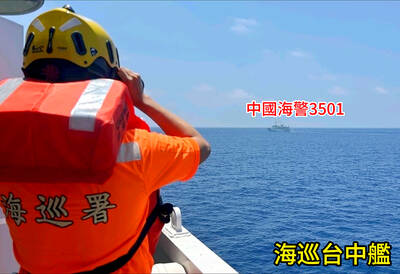
VERBOSE VESSELS: A CGA cutter and a China Coast Guard exchanged verbal barbs for more than a day in Taiwanese-controlled waters before the Chinese vessel left The Taiwanese and Chinese coast guards had a standoff near the strategically located Pratas Islands (Dongsha Islands, 東沙群島) in the north of the South China Sea, the Coast Guard Administration (CGA) said yesterday. The two sides engaged in intense radio exchanges over sovereignty claims during the 33-hour standoff. China Coast Guard vessel 3501 eventually left the restricted waters, 26.6 nautical miles (49.2km) west of the Pratas Islands, at 5pm yesterday, the CGA said. Lying approximately between southern Taiwan and Hong Kong, the Taiwan-controlled Pratas are seen by some security experts as vulnerable to Chinese attack due to their distance — more than

A US uncrewed surface vessel (USV) encountered multiple Chinese warships during an autonomous transit of the Taiwan Strait, US defense company Seasats said in a statement on Wednesday. Seasats announced that a Lightfish USV had completed the first autonomous transit of the Taiwan Strait. Over five days, the USV traversed the entire length of the Strait while constantly monitoring surface vessel traffic, the company said. The Lightfish encountered multiple Chinese warships, one of which was a Chinese People’s Liberation Army Navy (PLAN) Type 056 corvette, it said. The Chinese vessels were operating “well within Taiwan’s exclusive economic zone without transmitting their identity via the


 RSS
RSS