


A Japanese lawmaker who leads the populist Sanseito party has voiced support for the concept “a Taiwan contingency is a Japan contingency,” and called for preventing a conflict in the Taiwan Strait and stepping up Taiwan-Japan security collaborations.
During an interview published yesterday by the Central News Agency, Japanese House of Councillors member Sohei Kamiya, who is also the founder and secretary-general of Sanseito, said he agreed with the phrase “a Taiwan contingency is a Japan contingency,” coined in 2021 by the late former Japanese prime minister Shinzo Abe.
“I absolutely agree ... any conflict involving Taiwan will result in the severance of maritime travel routes, which is a life-or-death issue for Japan. We should dedicate efforts to prevent conflict, instead of inciting it,” he said.
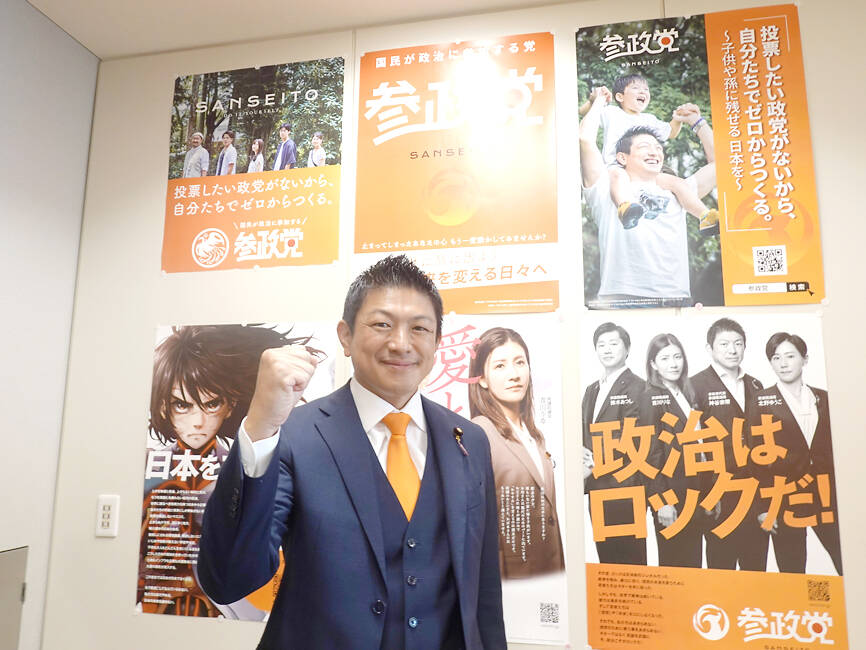
Photo: CNA
Commenting on the lack of high-level dialogue between Taipei and Tokyo and formal diplomatic relations, Kamiya said that Sanseito hoped to increase Taiwan-Japan interaction through the Japan-ROC Diet Members’ Consultative Council, which he and all Sanseito members were a part of.
The party would continue to promote civilian and local collaborations between Taiwan and Japan, he said, urging more Japanese lawmakers to participate.
The party hopes to organize a delegation to Taiwan including all 18 members who currently hold seats in the upper house, he said.
Sanseito issued a formal protest with the Nagasaki City Council when it initially failed to invite Taiwan to attend the ceremony to mark the 80th anniversary of the city’s atomic bombing, calling it an “act of unfairness,” Kamiya said.
The party, which was founded on YouTube, has faced criticism for calling for limiting immigration and foreign capital, and its opposition to globalism and “radical” gender policies.
Kamiya said that the party was a target of criticism from traditional media, but on social media it has been received positively.
The party is focused on achieving a balance of observing national interests and maintaining international harmony, he said, adding that it is not anti-globalism, but opposes capitalist monopolies that are a result of globalism.
In a report on the July 30 Japanese House of Concillors election, the Chinese-language, state-run Global Times portrayed Sanseito as aiming to turn Japan into a military and political powerhouse.
Kamiya said that Tokyo should be alert to how China is infiltrating Japan, citing the increased number of Chinese who have received Japanese citizenship and have become active in politics.
The party, was founded in 2020 with a focus on an anti-vaccine and anti-masking policies, won its first seat in the upper house in 2022. In last month’s elections, Sanseito ran on a “Japanese First” campaign, winning 14 seats.

The National Chungshan Institute of Science and Technology yesterday showcased its locally developed variants of the Vision 60 robotic patrol dog, which it plans to deploy on the nation’s outlying territories in the South China Sea. The variants were produced under the Joint Lab project — created by the institute and domestic companies — and assembled with domestically produced motors, lenses and artificial intelligence (AI) systems alongside licensed tech from the US, Missile and Rocket Systems Research Division deputy director Jen Kuo-kang (任國光) told the media event at a military base in Taipei’s Dazhi (大直) area. Taiwan has built up its strengths

RIGHT DIRECTION: Taiwan’s efforts to prevent forced labor include a proposal to ‘fully prohibit’ employers from withholding workers’ documents, an official said Taiwan is to establish a mechanism to restrict imports of goods linked to forced labor, the Executive Yuan said yesterday, after the US proposed imposing additional tariffs on Taiwanese goods over labor concerns. “The Ministry of Labor and the Ministry of Economic Affairs are to establish an interministerial review procedure,” Executive Yuan spokesperson Michelle Lee (李慧芝) said at a news briefing in Taipei. “The government is to use the Foreign Trade Act [貿易法] as the legal basis to restrict imports of goods produced with forced labor” and bring its supply chain governance more in line with international standards on human rights, resilience

NOT IMMEDIATE: Taiwan has a chance to appeal the proposed 10 percent tariff before it starts, while other countries face a 12.5 percent tariff from the trade office Taiwan is among 60 economies determined by the US to have failed to impose or enforce a ban on the importation of goods produced with forced labor, according to a notice released on Tuesday by the Office of the US Trade Representative (USTR), which proposed imposing an additional 10 percent or more tariff on them. The USTR in a statement said that following an investigation, it had determined under Section 301 of the Trade Act of 1974 that the failure of the 60 economies to impose and effectively enforce a prohibition on the importation of goods produced with forced labor is

TIT-FOR-TAT: The US allegedly revoked the visa of a Chinese national working at Xinhua News Agency in the US in response to Beijing’s expulsion of Vivian Wang The Presidential Office yesterday condemned China for expelling a New York Times correspondent from Beijing following the newspaper’s interview with President William Lai (賴清德), saying the move highlighted Beijing’s suppression of press freedom and its threat to international news media. Taiwan has noted a series of recent incidents in which Beijing used similar tactics to “threaten and pressure international media outlets and journalists,” Presidential Office spokeswoman Karen Kuo (郭雅慧) said in a statement. “This concerns not only press freedom and freedom of expression, but also the safety of journalists, and Taiwan and relevant partners are paying close attention to the situation,” she


 RSS
RSS