


Taiwan would soon unveil new rules banning Taiwanese residents of China from reclaiming their citizenship if they participated in Beijing’s propaganda activities, the Ministry of the Interior said on Monday.
The measures were drafted following President William Lai’s (賴清德) March 13 directive that the government counter China’s espionage and influence campaigns aimed at undermining Taiwan’s sovereignty, the ministry said in a preview of the rules.
The changes would affect Taiwanese who lost their citizenship after becoming permanent residents of China or obtaining passports issued by China, it said.
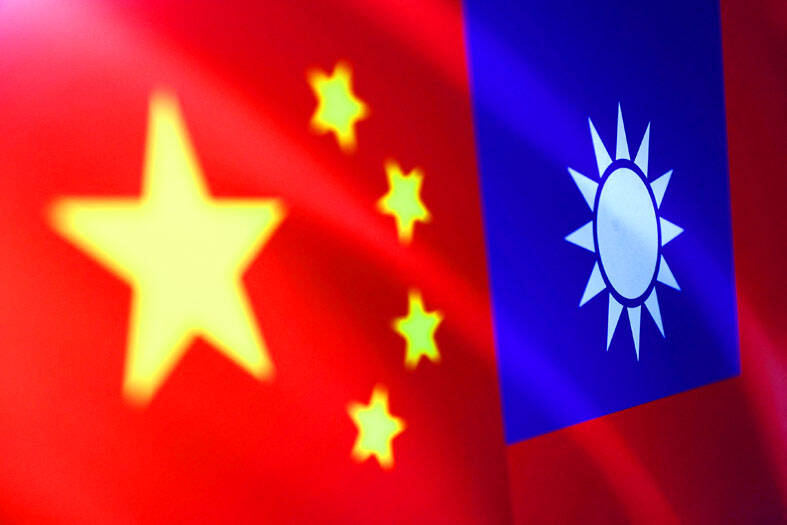
Photo: Reuters
Under the measures, former Taiwanese nationals living in China who had made statements denying the nation’s sovereignty or right to exist, committed acts of espionage, or betrayed national security secrets or critical intellectual properties could be stripped of their right to reclaim citizenship, it said.
The ban would apply to those who represented Chinese commercial entities illegally operating in Taiwan, contravened rules governing movements across national borders, sabotaged critical infrastructure or fomented social unrest, it said.
The proposed rules would allow former Taiwanese nationals living in China to reclaim their citizenship only if they have made a significant contribution to Taiwan’s military defense, global image or social stability, it said.
Some Taiwanese residing in China might be allowed to reclaim their citizenship based on humanitarian concerns, the ministry said.
People eligible for the exemption include those who emigrated to China as children by the act of their legal guardians, have close familial ties in Taiwan or are in poor health, it said.
Reclaiming Taiwanese citizenship requires applicants to renounce their residency in China or surrender their Chinese passport with certifications issued by an appropriate authority, it said.
Adult applicants seeking to reclaim citizenship must also provide documentation certified by a Taiwanese representative office showing that they did not commit a serious criminal offense abroad.
Those who invoke humanitarian concerns must prove their claims by presenting documentation or other evidence, the ministry said.
The National Immigration Agency would be responsible of approving requests for restoring Taiwanese citizenship in collaboration with other government entities, it said.
Chinese nationals who previously had Taiwanese citizenship and then returned to China would not be affected by the new measures, it said.
Separately, the Ministry of Culture has launched two investigations into Taiwanese celebrities and influencers suspected of spreading pro-China propaganda on Beijing’s behalf, an official said, speaking on condition of anonymity.
Last year, about 20 celebrities, including high-profile musician and performer Ouyang Nana (歐陽娜娜), shared a social media post of the Chinese People’s Liberation Army (PLA) that read: “Taiwan has been a part of China since ancient times and there is only one China.”
At the time, the PLA was conducting its “Joint Sword-2024B” military exercises around Taiwan.
In March, Ouyang again joined influencers and celebrities in reposting a comment by Beijing-run China Central Television saying that Taiwan’s unification with China is “inevitable.”
The investigations center on whether the celebrities had collaborated with Chinese officials, and whether they voluntarily reposted the comments or were pressured by their agents or managers, the official said.
Conducting political activities in cooperation with Chinese officials is punishable by a fine of NT$100,000 to NT$500,000 under the Act Governing Relations Between the People of the Taiwan Area and the Mainland Area (臺灣地區與大陸地區人民關係條例), they said.
Most celebrities under investigation had responded in writing to renounce knowledge of the posts, deny agreement with the content or plead that they were ignorant of the law, the official said.

A signaling system malfunction disrupted high-speed rail (HSR) services beginning at 8am today, with trains temporarily reduced to three northbound and three southbound trains per hour as authorities conduct inspections. The malfunction occurred on a section of track in Miaoli County during pre-operation checks early this morning, forcing northbound and southbound trains to use a single track, the HSR operator said. The regular schedule has been replaced with three hourly trains offering only nonreserved seating in each direction, stopping at every station, it said, adding that business class cars would still have reserved seating. Departures from terminal stations are scheduled at the top
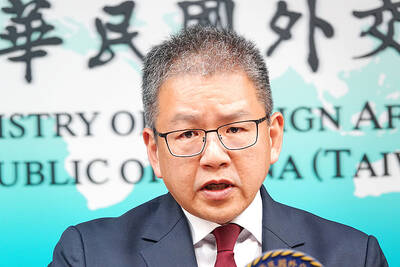
Taiwan is still in the process of assessing the possibility of recruiting workers from Eswatini, the Ministry of Foreign Affairs said yesterday, adding that its goal is to help Eswatini upgrade its vocational training centers. If there are plans to recruit workers from Eswatini, safeguarding national security, protecting public health and ensuring the employment rights of Taiwanese would be prerequisites, Department of West Asian and African Affairs Director-General Yen Chia-liang (顏嘉良) told a news conference. Key considerations would also include filling labor shortages in specific industries, and fostering bilateral professional and technical exchanges, he said. Yen was asked about the progress of labor
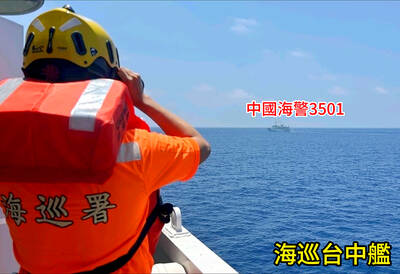
VERBOSE VESSELS: A CGA cutter and a China Coast Guard exchanged verbal barbs for more than a day in Taiwanese-controlled waters before the Chinese vessel left The Taiwanese and Chinese coast guards had a standoff near the strategically located Pratas Islands (Dongsha Islands, 東沙群島) in the north of the South China Sea, the Coast Guard Administration (CGA) said yesterday. The two sides engaged in intense radio exchanges over sovereignty claims during the 33-hour standoff. China Coast Guard vessel 3501 eventually left the restricted waters, 26.6 nautical miles (49.2km) west of the Pratas Islands, at 5pm yesterday, the CGA said. Lying approximately between southern Taiwan and Hong Kong, the Taiwan-controlled Pratas are seen by some security experts as vulnerable to Chinese attack due to their distance — more than

A US uncrewed surface vessel (USV) encountered multiple Chinese warships during an autonomous transit of the Taiwan Strait, US defense company Seasats said in a statement on Wednesday. Seasats announced that a Lightfish USV had completed the first autonomous transit of the Taiwan Strait. Over five days, the USV traversed the entire length of the Strait while constantly monitoring surface vessel traffic, the company said. The Lightfish encountered multiple Chinese warships, one of which was a Chinese People’s Liberation Army Navy (PLAN) Type 056 corvette, it said. The Chinese vessels were operating “well within Taiwan’s exclusive economic zone without transmitting their identity via the


 RSS
RSS