


Chinese Premier Li Qiang (李強) yesterday warned that artificial intelligence (AI) development must be weighed against the security risks, saying global consensus was urgently needed even as the tech race between Beijing and Washington shows no sign of abating.
Opening the World AI Conference (WAIC) in Shanghai yesterday, Li emphasized the need for governance and open-source development, announcing the establishment of a Chinese-led body for international AI cooperation.
“The risks and challenges brought by AI have drawn widespread attention... How to find a balance between development and security urgently requires further consensus from the entire society,” Li said.
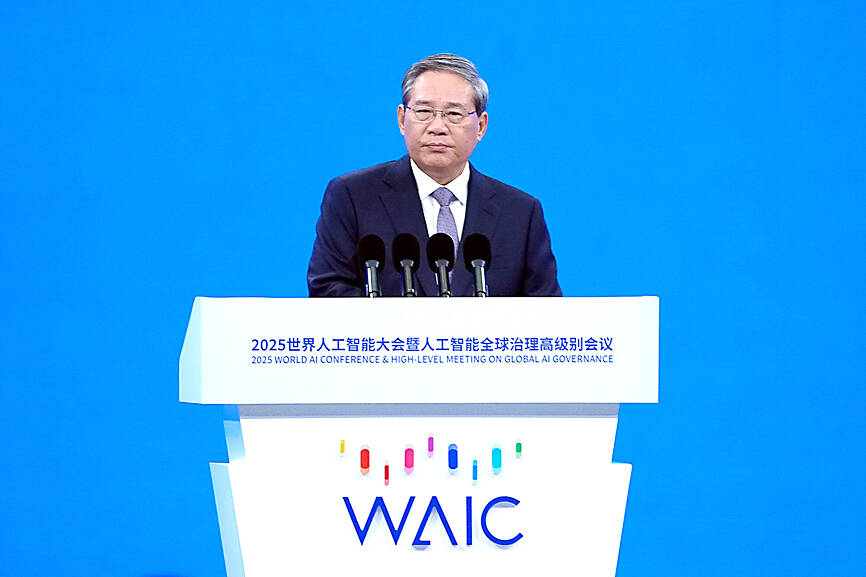
Photo: Bloomberg
The organization would “promote global governance featuring extensive consultation, joint contribution and shared benefits,” Chinese state news agency Xinhua reported, without elaborating on its set-up or mechanisms.
At a time when AI is being integrated across virtually all industries, its uses have raised major questions, including about the spread of misinformation, its impact on employment and the potential loss of technological control.
In a speech at WAIC, Nobel Prize-winning physicist Geoffrey Hinton compared the situation to keeping “a very cute tiger cub as a pet.”
To survive, you need to ensure you can train it not to kill you when it grows up, he said.
The enormous strides AI technology has made over the past few years have seen it move to the forefront of the US-China rivalry.
Li said China would promote the development of open-source AI, and that Beijing was willing to share advances with other countries, particularly developing ones.
“If we engage in technological monopolies, controls and blockage, artificial intelligence will become the preserve of a few countries and a few enterprises,” he said.
Chinese Vice Minister of Foreign Affairs Ma Zhaoxu (馬朝旭) warned against “unilateralism and protectionism” at a later meeting.
Washington has expanded its efforts to curb exports of state-of-the-art chips to China, concerned that they coukd be used to advance Beijing’s military systems and erode US tech dominance.
Li highlighted “insufficient supply of computing power and chips” as a bottleneck to AI progress.
China has made AI a pillar of its plans for technological self-reliance, with the government pledging a raft of measures to boost the sector.
UN Secretary-General Antonio Guterres in a message played at the WAIC opening ceremony said AI governance would be “a defining test of international cooperation.”
The ceremony saw the French president’s AI envoy Anne Bouverot underscore “an urgent need” for global action and for the UN to play a “leading role.”
Bouverot called for a framework “that is open, transparent and effective, giving each and everyone an opportunity to have their views taken into account.”
Li’s speech “posed a clear contrast to US President Donald Trump’s administration’s ‘America First’ view on AI” and the US measures announced this week, said WAIC attendee George Chen, a partner at Washington-based policy consultancy The Asia Group.
“The world is now clearly divided into at least three camps: the US and its allies, China [and perhaps many Belt and Road or Global South countries] and the EU — which prefers regulating AI through legislation, such as the EU AI Act,” Chen said.
At an AI summit in Paris in February, 58 countries, including China, France, India, the EU and the African Union Commission, called for enhanced coordination on AI governance.
However, the US warned against “excessive regulation,” and alongside the UK, refused to sign the summit’s appeal for an “open,” “inclusive” and “ethical” AI.
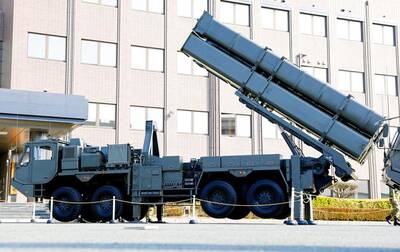
Japan has deployed long-range missiles in a southwestern region near China, the Japanese defense minister said yesterday, at a time when ties with Beijing are at their lowest in recent years. The missiles were installed in Kumamoto in the southern region of Kyushu, as Japan is attempting to shore up its military capacity as China steps up naval activity in the East China Sea. “Standoff defense capabilities enable us to counter the threat of enemy forces attempting to invade our country ... while ensuring the safety of our personnel,” Japanese Minister of Defense Shinjiro Koizumi said. “This is an extremely important initiative for
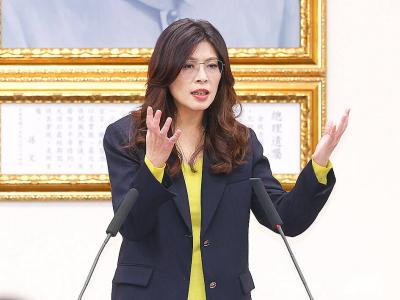
Chinese Nationalist Party (KMT) Chairwoman Cheng Li-wun (鄭麗文) today accepted an invitation from Chinese President Xi Jinping (習近平) to lead a delegation to China next month, saying she hopes to promote the peaceful development of cross-strait relations and bring stability to the Taiwan Strait. “I am grateful and happy to accept this invitation,” Cheng said in a statement from the KMT chairperson’s office. Cheng said she hopes both sides can work together to promote the peaceful development of cross-strait relations, enhance exchange and cooperation, bring stability to the Taiwan Strait and improve people’s livelihoods. At today's news conference, Cheng said any efforts to
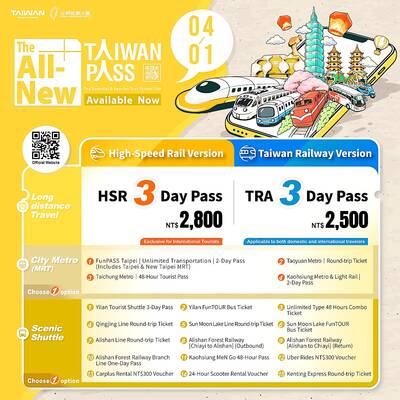
MORE POPULAR: Taiwan Pass sales increased by 59 percent during the first quarter compared with the same period last year, the Tourism Administration said The Tourism Administration yesterday said that it has streamlined the Taiwan Pass, with two versions available for purchase beginning today. The tourism agency has made the pass available to international tourists since 2024, allowing them to access the high-speed rail, Taiwan Railway Corp services, four MRT systems and four Taiwan Tourist Shuttles. Previously, five types of Taiwan Pass were available, but some tourists have said that the offerings were too complicated. The agency said only two types of Taiwan Pass would be available, starting from a three-day pass with the high-speed rail and a three-day pass with Taiwan Railway Corp. The former costs NT$2,800
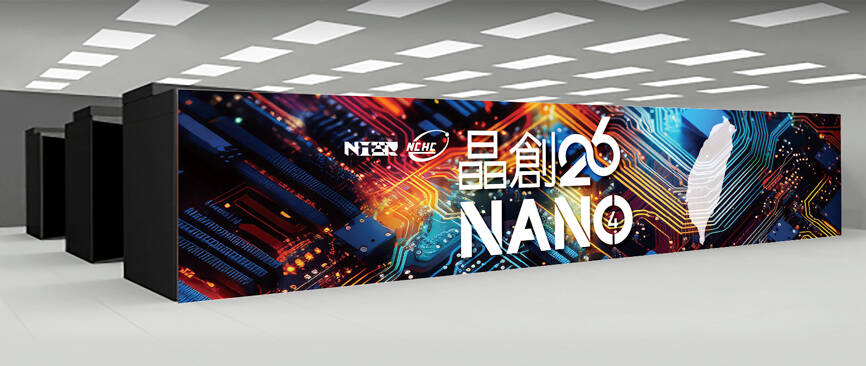
The nation’s fastest supercomputer, Nano 4 (晶創26), is scheduled to be launched in the third quarter, and would be used to train large language models in finance and national defense sectors, the National Center for High-Performance Computing (NCHC) said. The supercomputer, which would operate at about 86.05 petaflops, is being tested at a new cloud computing center in the Southern Taiwan Science Park in Tainan. The exterior of the server cabinet features chip circuitry patterns overlaid with a map of Taiwan, highlighting the nation’s central position in the semiconductor industry. The center also houses Taiwania 2, Taiwania 3, Forerunner 1 and


 RSS
RSS