


The draft National Defense Authorization Act (NDAA) for the fiscal year 2026, which was passed by the US Senate Committee on Armed Services on Wednesday, addresses various global security challenges and includes provisions to bolster Taiwan’s security and defense capabilities.
The NDAA is an annual policy bill that authorizes funding levels and provides authorities for the US military.
It ensures that US forces have the necessary resources to carry out their missions, and is closely watched by weapons makers such as Lockheed Martin Corp and Boeing Co.

Screengrap from https://www.armed-services.senate.gov/
The NDAA, passed by the committee with a 26-1 vote, includes a provision to extend the Ukraine Security Assistance Initiative through 2028, increasing authorized funding to US$500 million from US$300 million this year.
The NDAA supports a total of US$925 billion in funding for national defense, with US$878.7 billion allocated for the US Department of Defense and US$35.2 billion to the US Department of Energy. The bill also allows for up to US$6 billion in general transfer authority for unforeseen higher-priority needs.
The NDAA also addresses various global security challenges, including threats from China, Iran and North Korea.
It emphasizes the need for technological advancements in areas such as artificial intelligence, uncrewed technology and hypersonic weapons to maintain US military superiority.
In the drafted bill, provisions for the Indo-Pacific region include an initiative to bolster security cooperation across the defense industrial bases of US allies and partners in the Indo-Pacific region.
Half of the highlighted directives listed for region are associated with Taiwan, and includes “directs the Department of Defense [DOD] to engage with Taiwan to develop a joint program to codevelop and coproduce uncrewed and counter-uncrewed capabilities.”
It also includes: “requires the DOD to consult with the Department of State and the American Institute of Taiwan [AIT] to develop contracting processes to support entities that are not part of AIT” and “directs DOD to assess Taiwan’s critical digital infrastructure and identify potential actions to help strengthen it.”
It authorizes US$1 billion for the Taiwan Security Cooperation Initiative and expands the authority to expand its use for combat casualty care and medical equipment, and strongly encourages the US Secretary of Defense to invite the naval forces of Taiwan to the Rim of the Pacific exercises and requires a notification and justification if the secretary chooses not to do so.
The draft of the bill is to make its way through the legislative process in the coming months.
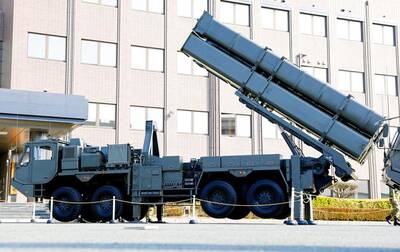
Japan has deployed long-range missiles in a southwestern region near China, the Japanese defense minister said yesterday, at a time when ties with Beijing are at their lowest in recent years. The missiles were installed in Kumamoto in the southern region of Kyushu, as Japan is attempting to shore up its military capacity as China steps up naval activity in the East China Sea. “Standoff defense capabilities enable us to counter the threat of enemy forces attempting to invade our country ... while ensuring the safety of our personnel,” Japanese Minister of Defense Shinjiro Koizumi said. “This is an extremely important initiative for

Chinese Nationalist Party (KMT) Chairwoman Cheng Li-wun (鄭麗文) today accepted an invitation from Chinese President Xi Jinping (習近平) to lead a delegation to China next month, saying she hopes to promote the peaceful development of cross-strait relations and bring stability to the Taiwan Strait. “I am grateful and happy to accept this invitation,” Cheng said in a statement from the KMT chairperson’s office. Cheng said she hopes both sides can work together to promote the peaceful development of cross-strait relations, enhance exchange and cooperation, bring stability to the Taiwan Strait and improve people’s livelihoods. At today's news conference, Cheng said any efforts to
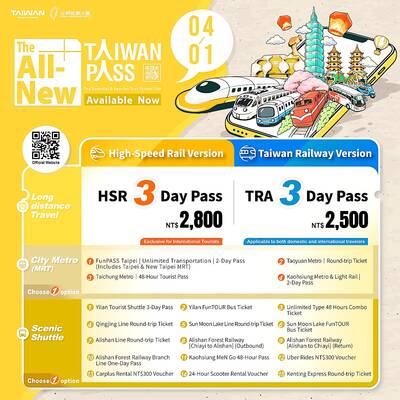
MORE POPULAR: Taiwan Pass sales increased by 59 percent during the first quarter compared with the same period last year, the Tourism Administration said The Tourism Administration yesterday said that it has streamlined the Taiwan Pass, with two versions available for purchase beginning today. The tourism agency has made the pass available to international tourists since 2024, allowing them to access the high-speed rail, Taiwan Railway Corp services, four MRT systems and four Taiwan Tourist Shuttles. Previously, five types of Taiwan Pass were available, but some tourists have said that the offerings were too complicated. The agency said only two types of Taiwan Pass would be available, starting from a three-day pass with the high-speed rail and a three-day pass with Taiwan Railway Corp. The former costs NT$2,800

The nation’s fastest supercomputer, Nano 4 (晶創26), is scheduled to be launched in the third quarter, and would be used to train large language models in finance and national defense sectors, the National Center for High-Performance Computing (NCHC) said. The supercomputer, which would operate at about 86.05 petaflops, is being tested at a new cloud computing center in the Southern Taiwan Science Park in Tainan. The exterior of the server cabinet features chip circuitry patterns overlaid with a map of Taiwan, highlighting the nation’s central position in the semiconductor industry. The center also houses Taiwania 2, Taiwania 3, Forerunner 1 and


 RSS
RSS