


The legislature yesterday passed the third reading of the government’s special relief package, including approving a NT$10,000 (US$342) cash handout proposed by the Chinese Nationalist Party (KMT), which raised the package’s total ceiling from NT$410 billion to NT$545 billion.
The Special Act for Strengthening Economic, Social and National Security Resilience in Response to International Circumstances (因應國際情勢強化經濟社會及國土安全韌性特別條例) was proposed in April to counter the impacts of US President Donald Trump’s tariffs.
The special budget includes NT$93 billion for economic resilience, NT$150 billion for whole-of-society defense resilience and NT$167 billion for social support, which includes a NT$100 billion subsidy for Taiwan Power Co (台電, Taipower), and NT$20 billion and NT$10 billion to subsidize national health insurance and labor insurance respectively.
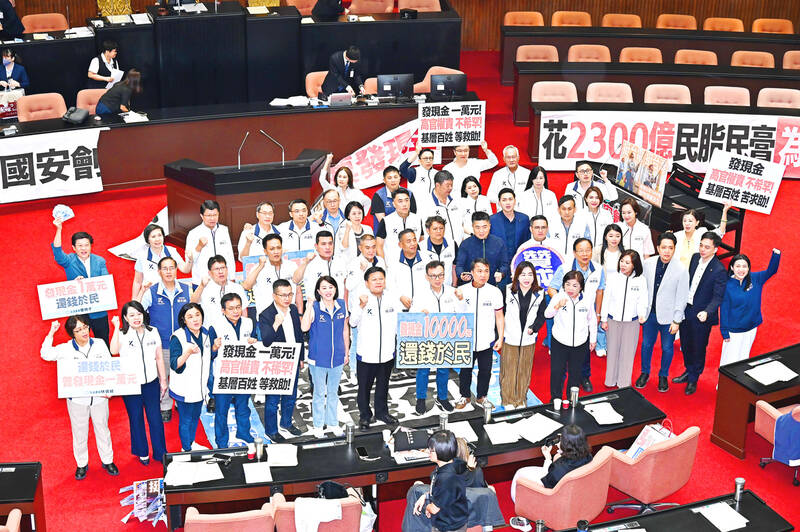
Photo: Tu Chien-jung, Taipei Times
The KMT was originally against the NT$150 billion budget for whole-of-society defense resilience and the NT$100 billion subsidy for Taipower. It had proposed its own version of the special budget bill, which included NT$10,000 cash handouts.
The opposition parties did not submit a joint proposal for amendments to the bill, as the KMT and the Taiwan People’s Party (TPP) failed to reach a consensus on the value of the cash handouts.
The TPP wanted to allocate NT$140 billion for the cash handouts, or NT$6,000 to every Taiwanese. It also proposed slashing the Taipower subsidy.
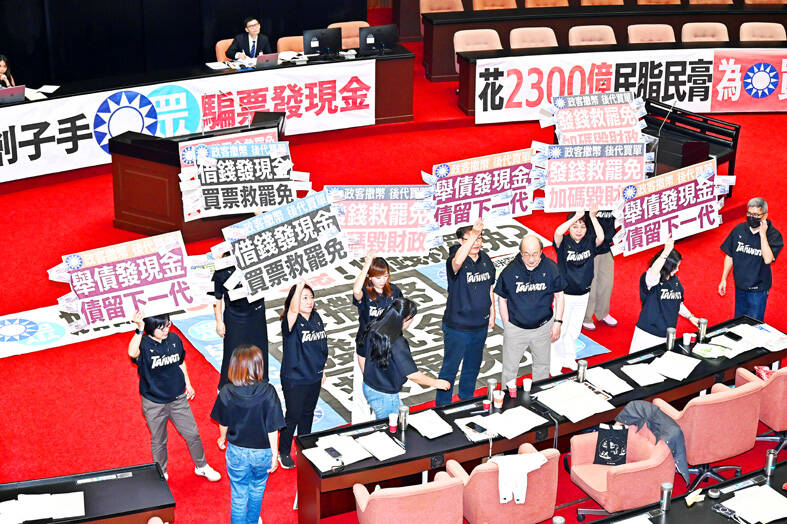
Photo: Tu Chien-jung, Taipei Times
The KMT legislative caucus yesterday endorsed the NT$150 billion whole-of-society defense budget, saying that it was a necessary expense for the nation’s defense. It stood its ground on scrapping the NT$100 billion subsidy for Taipower and allocating NT$235 billion for a universal NT$10,000 cash handout.
All subsequent whole-of-society defense budgets under the special fund would be closely scrutinized to ensure that the public is aware of where taxpayer money is being spent, it said.
KMT caucus whip Fu Kun-chi (傅崑萁) said that the Democratic Progressive Party (DPP) government owed the public cash handouts, as it had raised more than NT$1.87 trillion in tax surpluses over the past four years, adding that the money could give disadvantaged families money for groceries for several weeks.
Although the KMT version was not fully supported by the TPP, it received eight TPP votes for a total of 60 votes. That exceeded the DPP’s 44 opposing votes. Six DPP lawmakers did not vote.
KMT Legislator Hsieh Lung-chieh (謝龍介) said giving money back to the public is reasonable when the nation enjoys good fiscal health.
KMT caucus secretary-general Wang Hung-wei (王鴻薇) said cuts to Taipower’s subsidies should be of no concern, since the Ministry of Economic Affairs already said that electricity prices would go up.
TPP Chairman Huang Kuo-chang (黃國昌) said the DPP’s use of renewable energy for corruption is why the formerly profitable Taipower is struggling.
The DPP had no problem doling out stimulus checks to people during the 2008 recession, he said.
TPP Legislator Lin Kuo-cheng (林國成) said the party’s budget stance is not a bid to pander to voters, but to give Taiwanese a needed boost to face high tariffs, fluctuation in currency markets and increasing strain on small and medium-sized enterprises.
DPP chief executive Rosalia Wu (吳思瑤) said the KMT’s cash handout plan, which would cost NT$235 billion, is an attempt to bribe voters ahead of the recall elections.
The KMT would not have backtracked on blocking the whole-of-society defense resilience budget if not for the DPP’s resistance and the threat of the recalls, she added.
The third reading stated that the funds allocated by the package could be used until December 2027, while funding for the cash handouts must be used before Oct. 31.
The act and related funding can be extended.
Executive Yuan spokesperson Michelle Lee (李慧芝) yesterday said the Executive Yuan thanks the legislature for supporting the whole-of-society defense resilience plan, but that raising national debt for future generations to pay for the cash handout was inappropriate.
Cutting the subsidy for Taipower would also leave it in a tight financial situation, and the electricity price review committee might have to raise electricity prices, impacting industries and people’s livelihoods, she said.
Additional reporting by Lin Hsin-han, Hollie Younger,
Fion Khan and Lery Hiciano
Japan has deployed long-range missiles in a southwestern region near China, the Japanese defense minister said yesterday, at a time when ties with Beijing are at their lowest in recent years. The missiles were installed in Kumamoto in the southern region of Kyushu, as Japan is attempting to shore up its military capacity as China steps up naval activity in the East China Sea. “Standoff defense capabilities enable us to counter the threat of enemy forces attempting to invade our country ... while ensuring the safety of our personnel,” Japanese Minister of Defense Shinjiro Koizumi said. “This is an extremely important initiative for
Chinese Nationalist Party (KMT) Chairwoman Cheng Li-wun (鄭麗文) today accepted an invitation from Chinese President Xi Jinping (習近平) to lead a delegation to China next month, saying she hopes to promote the peaceful development of cross-strait relations and bring stability to the Taiwan Strait. “I am grateful and happy to accept this invitation,” Cheng said in a statement from the KMT chairperson’s office. Cheng said she hopes both sides can work together to promote the peaceful development of cross-strait relations, enhance exchange and cooperation, bring stability to the Taiwan Strait and improve people’s livelihoods. At today's news conference, Cheng said any efforts to
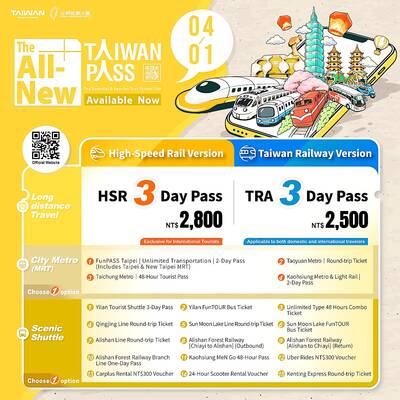
MORE POPULAR: Taiwan Pass sales increased by 59 percent during the first quarter compared with the same period last year, the Tourism Administration said The Tourism Administration yesterday said that it has streamlined the Taiwan Pass, with two versions available for purchase beginning today. The tourism agency has made the pass available to international tourists since 2024, allowing them to access the high-speed rail, Taiwan Railway Corp services, four MRT systems and four Taiwan Tourist Shuttles. Previously, five types of Taiwan Pass were available, but some tourists have said that the offerings were too complicated. The agency said only two types of Taiwan Pass would be available, starting from a three-day pass with the high-speed rail and a three-day pass with Taiwan Railway Corp. The former costs NT$2,800

The nation’s fastest supercomputer, Nano 4 (晶創26), is scheduled to be launched in the third quarter, and would be used to train large language models in finance and national defense sectors, the National Center for High-Performance Computing (NCHC) said. The supercomputer, which would operate at about 86.05 petaflops, is being tested at a new cloud computing center in the Southern Taiwan Science Park in Tainan. The exterior of the server cabinet features chip circuitry patterns overlaid with a map of Taiwan, highlighting the nation’s central position in the semiconductor industry. The center also houses Taiwania 2, Taiwania 3, Forerunner 1 and


 RSS
RSS