


The Executive Yuan yesterday approved a plan to develop central Taiwan as a core manufacturing region for smart technologies and uncrewed aerial vehicles (UAVs) centered around a proposed national center for precision and innovative technologies.
With Aerospace Industrial Development Corp (AIDC, 漢翔航空工業) headquartered in Taichung and Boise, Idaho-based Micron Technology active in the region, as well as the plans Taiwan Semiconductor Manufacturing Co (TSMC, 台積電) has to expand there, Taichung would become a manufacturing hub for precision machinery and smart technology, Changhua County would develop into a manufacturing cluster for metal-based products and automotive components, Nantou County would focus on smart agriculture and Yunlin County would concentrate on applying smart technology to husbandry and aquaculture, the National Development Council (NDC) said.
The Executive Yuan has forwarded the plan to Premier Cho Jung-tai (卓榮泰).
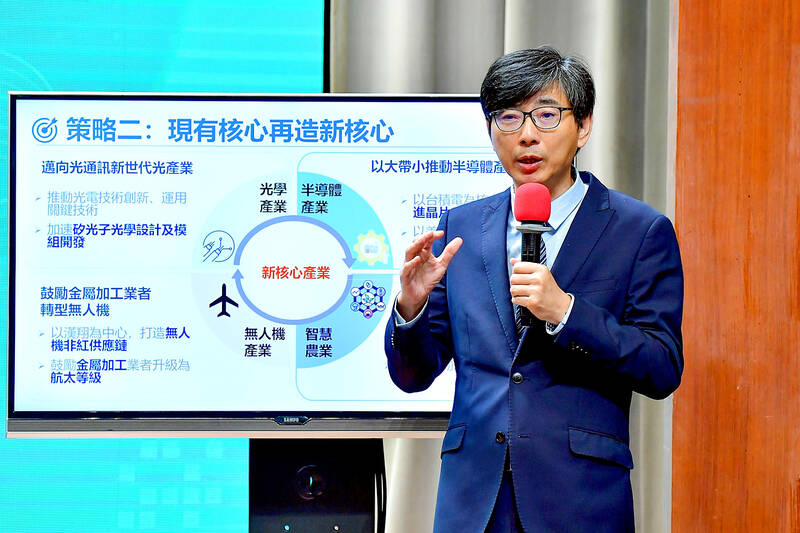
Photo courtesy of the Executive Yuan
The government’s goal is to increase the output value of manufacturers in the region by 5 percent, NDC Minister Paul Liu (劉鏡清) said.
To achieve that, the government plans to introduce a model that combines the work of the proposed center with the manufacturing operations in the region, Liu said.
The Ministry of Economic Affairs said it hopes that the presence of the manufacturing facilities of TSMC and Micron would help establish an advanced chip manufacturing cluster.
Hopefully more entities in the region would drive innovation by expediting research and development, and fostering greater capabilities for test manufacturing, the ministry said, adding that the plan is to develop core manufacturing operations by incorporating digitization and low-carbon concepts, or the biaxial model.
The plan is to have AIDC’s headquarters be a locus for UAV manufacturing supply chains that exclude Chinese involvement, it said.
Asked about what crossover there would be between the proposed center and the Asia UAV Artificial Intelligence Innovation Application Research and Development Center (亞洲無人機AI創新應用研發中心) in Chiayi County, Deputy Minister of Economic Affairs Ho Chin-tsang (何晉滄) said that the work of the two entities would not overlap, but would help concentrate UAV research and development.
Department of Industrial Technology Director-General Chiou Chyou-huey (邱求慧) said that the proposed center is a government measure to encourage the manufacturing industry to become more involved in UAV supply chains.
Firms in the industry have said that the government must resolve tax issues if it wants holding companies to be formed and the ministry is considering amendments to the Business Mergers and Acquisition Act (企業併購法) to provide incentives, Ho said.
The government would focus on providing utilities, transportation, medical services, cultural and arts amenities, shopping, waste disposal, and implementing net zero concepts to make the area more attractive, the ministry said.

A signaling system malfunction disrupted high-speed rail (HSR) services beginning at 8am today, with trains temporarily reduced to three northbound and three southbound trains per hour as authorities conduct inspections. The malfunction occurred on a section of track in Miaoli County during pre-operation checks early this morning, forcing northbound and southbound trains to use a single track, the HSR operator said. The regular schedule has been replaced with three hourly trains offering only nonreserved seating in each direction, stopping at every station, it said, adding that business class cars would still have reserved seating. Departures from terminal stations are scheduled at the top
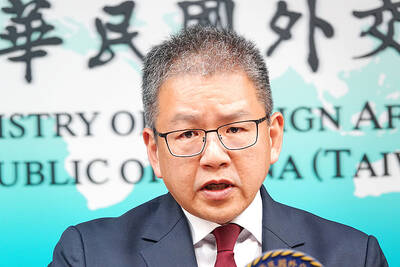
Taiwan is still in the process of assessing the possibility of recruiting workers from Eswatini, the Ministry of Foreign Affairs said yesterday, adding that its goal is to help Eswatini upgrade its vocational training centers. If there are plans to recruit workers from Eswatini, safeguarding national security, protecting public health and ensuring the employment rights of Taiwanese would be prerequisites, Department of West Asian and African Affairs Director-General Yen Chia-liang (顏嘉良) told a news conference. Key considerations would also include filling labor shortages in specific industries, and fostering bilateral professional and technical exchanges, he said. Yen was asked about the progress of labor

A US uncrewed surface vessel (USV) encountered multiple Chinese warships during an autonomous transit of the Taiwan Strait, US defense company Seasats said in a statement on Wednesday. Seasats announced that a Lightfish USV had completed the first autonomous transit of the Taiwan Strait. Over five days, the USV traversed the entire length of the Strait while constantly monitoring surface vessel traffic, the company said. The Lightfish encountered multiple Chinese warships, one of which was a Chinese People’s Liberation Army Navy (PLAN) Type 056 corvette, it said. The Chinese vessels were operating “well within Taiwan’s exclusive economic zone without transmitting their identity via the

VERBOSE VESSELS: A CGA cutter and a China Coast Guard exchanged verbal barbs for more than a day in Taiwanese-controlled waters before the Chinese vessel left The Taiwanese and Chinese coast guards had a standoff near the strategically located Pratas Islands (Dongsha Islands, 東沙群島) in the north of the South China Sea, the Coast Guard Administration (CGA) said yesterday. The two sides engaged in intense radio exchanges over sovereignty claims during the 33-hour standoff. China Coast Guard vessel 3501 eventually left the restricted waters, 26.6 nautical miles (49.2km) west of the Pratas Islands, at 5pm yesterday, the CGA said. Lying approximately between southern Taiwan and Hong Kong, the Taiwan-controlled Pratas are seen by some security experts as vulnerable to Chinese attack due to their distance — more than


 RSS
RSS