


New Taipei City Mayor Hou You-yi (侯友宜) and Taiwan People’s Party (TPP) Chairman Ko Wen-je (柯文哲), both candidates in next year’s presidential election, yesterday made a rare appearance together at the premiere of a documentary in Taipei.
The arrival of Hou and Ko in quick succession to an already crowded screening room caused a commotion as reporters scrambled to take photographs of them sitting together and shaking hands.
Their appearance temporarily disrupted the event and overshadowed the premiere of Taiwanese, Forward (台灣人前進), a documentary about democracy pioneer Chiang Wei-shui (蔣渭水) and his resistance movement in the 1920s against Japanese rule of Taiwan.
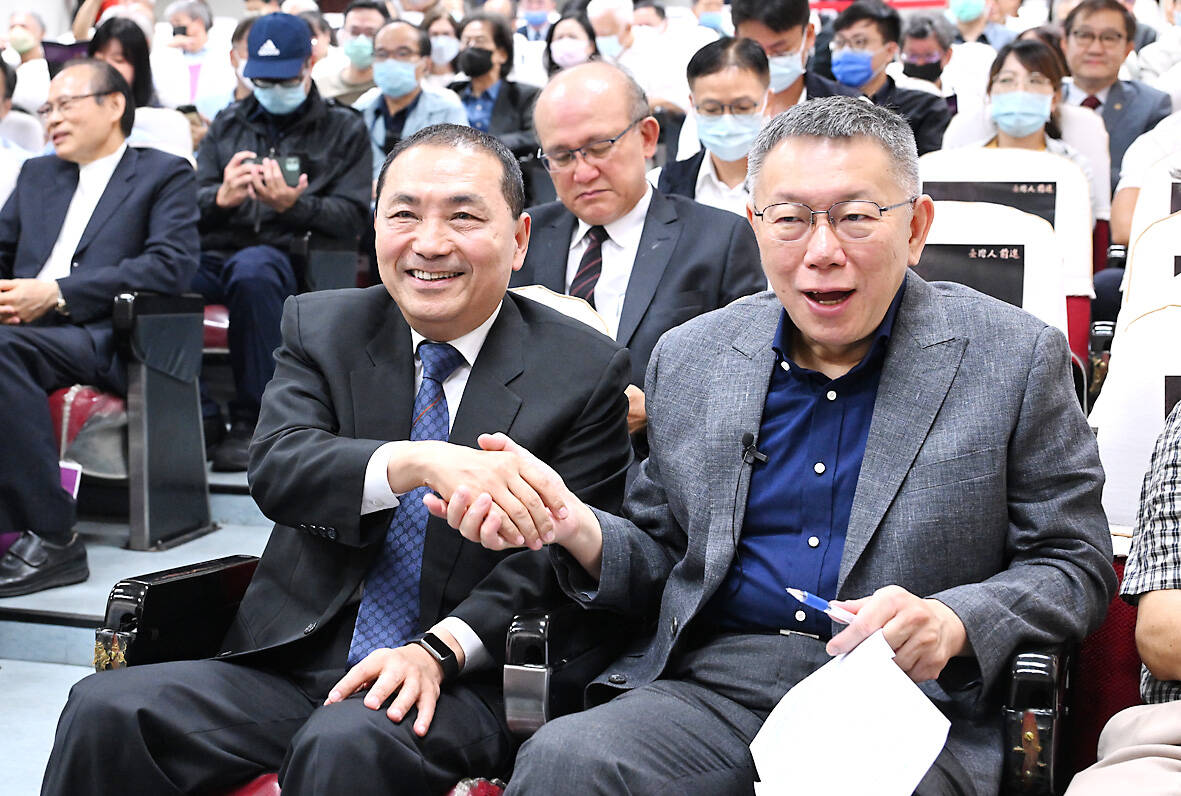
Photo: Liu Hsin-de, Taipei Times
Following the screening, Hou, the Chinese Nationalist Party’s (KMT) presidential nominee, said he was “touched” by Chiang’s efforts to pursue democracy in Taiwan.
“We are all born here in Taiwan and are nurtured by this land,” he said, adding that it was important for Taiwanese to set aside their differences and work together for a better future.
“It is my dream to unite Taiwan,” he said.
Ko — who has on more than one occasion expressed his admiration for Chiang and named his party after Chiang’s Taiwanese People’s Party, despite opposition from Chiang’s descendants — said he would “inherit” Chiang’s unfinished work.
“I was thinking about the goals Chiang Wei-shui was unable to achieve 100 years ago... We can now take on the challenge and strive to [fulfill them],” he said, without specifying what those goals were.
The 51-minute documentary chronicles the legacy of Chiang and the Taiwanese Cultural Association, an organization founded by Chiang and others calling for greater autonomy for Taiwanese living under Japanese rule.
Established in 1921, the association was dedicated to cultivating cultural and political thinking among Taiwanese through lectures, theater and movie screenings, at a time when only affluent families could afford higher education.
Chiang, who had trained as a doctor, devoted much of his life to politics and is widely remembered as one of the earliest democracy activists in Taiwan.
The premiere was held on the campus of the Blessed Imelda’s School in Taipei, where the cultural association was headquartered more than a century ago.

FUKUOKA SITUATION: Japanese media reported that the pathogen is expected to be identified by the summer, while the CDC downplayed the idea that it was hMPV A “mysterious cold-like illness” reported in Japan’s Fukuoka Prefecture does not seem to be a new disease, but Japanese authorities have been asked about the situation, the Centers for Disease Control (CDC) said yesterday. The Fukuoka Prefectural Medical Association on Wednesday told a news conference that a “mystery cold” that has become a hot topic on social media is “highly likely to be caused by some kind of viral infection,” Japan’s KBC News reported. “Many people are experiencing symptoms starting with a sore throat, followed by a runny nose, phlegm and a severe cough,” KBC News reported, citing association officials. Health authorities are

Nvidia Corp CEO Jensen Huang (黃仁勳) arrived in Taiwan yesterday ahead of upcoming AI and technology events, saying he plans to meet with clients and Taiwan Semiconductor Manufacturing Co Chairman C.C. Wei (魏哲家) during his visit. After landing at Taipei Songshan Airport, Huang posed for photos with fans and handed out Yakult drinks to reporters and supporters waiting at the scene, saying he has “a lot to do” during the trip. Asked about reports that Nvidia’s planned headquarters site in Taipei’s Beitou Shilin Technology Park could break ground on May 27, Huang said that if the company holds an event, he would

Carrefour Taiwan is to begin using a new name from the start of July, but it cannot divulge the name until then, the chairman of the supermarket chain's parent company said today. President Chain Store Co chairman Lo Chih-hsien (羅智先) was asked by reporters after a shareholders' meeting to confirm whether the company has settled on a new name for the supermarket brand. In March, the government-registered name of two Carrefour Taiwan branches was quietly changed to "Le Chia Kang" (樂家康) in Chinese, raising speculation that has been selected as the name. Lo said that because of local regulations and contractual obligations, the
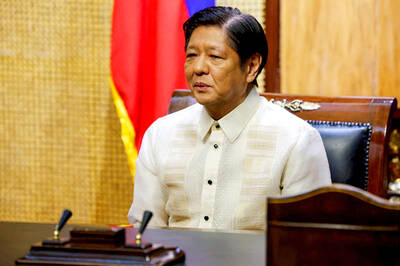
The Philippines would likely be involved in any conflict over Taiwan due to its proximity to the democracy claimed by China, President Ferdinand Marcos Jr said, reiterating a stance that risks angering Beijing. “In the Philippines, we do not have a choice because Taiwan is so close to the Philippines and we have almost 200,000 Filipino nationals living and working in Taiwan,” Marcos said in an interview with Japanese media in Manila on Monday. The Philippine leader’s comments come ahead of a state visit to Japan next week, where he is to meet with Japanese Prime Minister Sanae Takaichi to discuss security


 RSS
RSS