


Six of the G7 leaders were trying on the final day of their summit yesterday to show that the wealthy nations’ club still has the clout to shape world events, despite the early departure of US President Donald Trump.
Canadian Prime Minister Mark Carney and his counterparts from the UK, France, Germany, Italy and Japan were to be joined by Ukrainian President Volodymyr Zelenskiy and NATO Secretary-General Mark Rutte to discuss Russia’s relentless war on its neighbor.
World leaders had gathered in Canada with the specific goal of helping to defuse a series of pressure points, only to be disrupted by a showdown over Iran’s nuclear program that could escalate in dangerous and uncontrollable ways. Israel launched an aerial bombardment campaign against Iran on Friday, and Iran has hit back with missiles and drones.
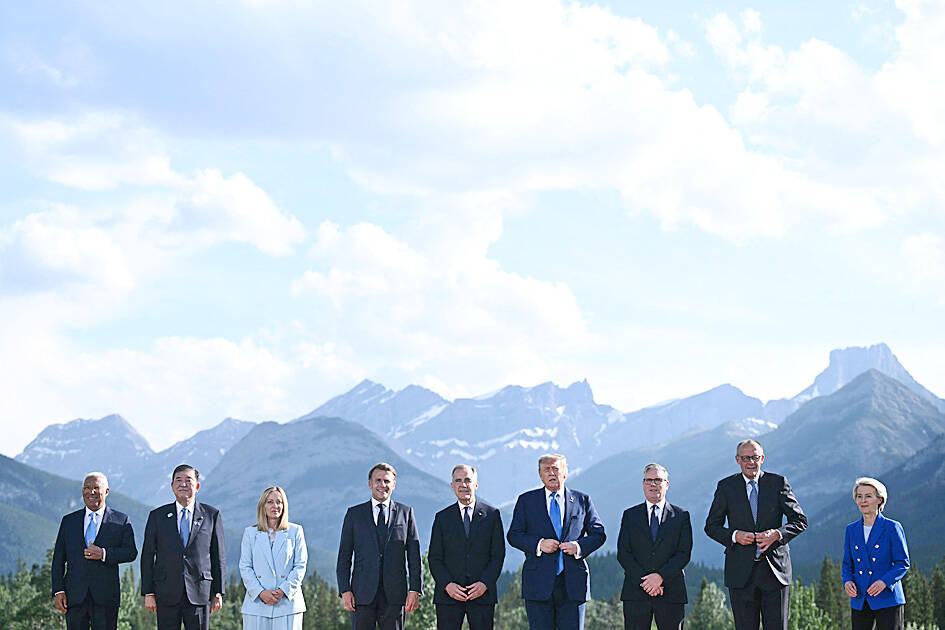
Photo: AFP
Trump left the summit in the Canadian Rocky Mountain resort of Kananaskis a day early late on Monday, saying: “I have to be back, very important.”
Before leaving, Trump joined the other leaders in issuing a statement saying Iran “can never have a nuclear weapon” and calling for a “de-escalation of hostilities in the Middle East, including a ceasefire in Gaza.”
Getting unanimity — even on a short and broadly worded statement — was a modest measure of success for the group.
Meanwhile, Trump’s stance on Ukraine put him fundamentally at odds with the other G7 leaders, who back Ukraine and are clear that Russia is the aggressor in the war.
Trump on Monday suggested there would have been no war if G7 members had not expelled Russian President Vladmir Putin from the organization in 2014 for annexing Crimea.
Trump demurred when asked if he supported Russia, saying: “I only care about saving lives.”
With talks on ending the war at an impasse, British Prime Minister Keir Starmer said the UK and other G7 members were slapping new tariffs on Russia in a bid to get it to the ceasefire negotiating table.
Zelenskiy was due to attend yesterday’s summit at Carney’s invitation, along with other leaders including Rutte and Indian Prime Minister Narendra Modi.
Trump declined to join in the sanctions on Russia, saying he would wait until Europe did so first.
Trump added that the EU had yet to offer a “fair deal” on trade, as Washington negotiates tariff agreements with friends and foes alike.
“We’re talking, but I don’t feel that they’re offering a fair deal yet,” Trump said of the EU, speaking to reporters on board Air Force One to Washington. “And we’re either going to make a good deal or they’ll just pay whatever we say they will pay.”
Additional reporting by AFP
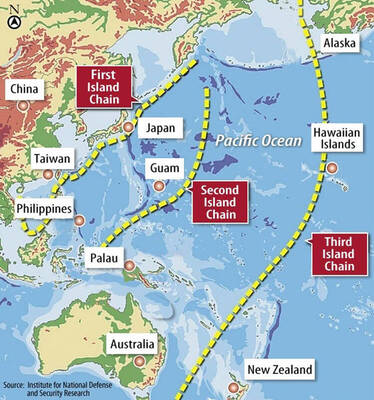
The US government has signed defense cooperation agreements with Japan and the Philippines to boost the deterrence capabilities of countries in the first island chain, a report by the National Security Bureau (NSB) showed. The main countries on the first island chain include the two nations and Taiwan. The bureau is to present the report at a meeting of the legislature’s Foreign Affairs and National Defense Committee tomorrow. The US military has deployed Typhon missile systems to Japan’s Yamaguchi Prefecture and Zambales province in the Philippines during their joint military exercises. It has also installed NMESIS anti-ship systems in Japan’s Okinawa
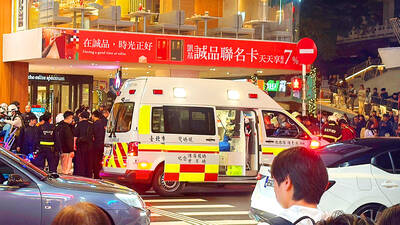
TRAGEDY STRIKES TAIPEI: The suspect died after falling off a building after he threw smoke grenades into Taipei Main Station and went on a killing spree in Zhongshan A 27-year-old suspect allegedly threw smoke grenades in Taipei Main Station and then proceeded to Zhongshan MRT Station in a random killing spree that resulted in the death of the suspect and two other civilians, and seven injured, including one in critical condition, as of press time last night. The suspect, identified as a man surnamed Chang Wen (張文), allegedly began the attack at Taipei Main Station, the Taipei Fire Department said, adding that it received a report at 5:24pm that smoke grenades had been thrown in the station. One man in his 50s was rushed to hospital after a cardiac arrest
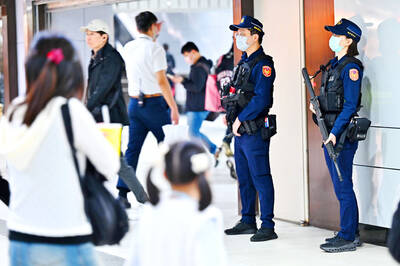
PUBLIC SAFETY: The premier said that security would be tightened in transport hubs, while President Lai commended the public for their bravery The government is to deploy more police, including rapid response units, in crowded public areas to ensure a swift response to any threats, President William Lai (賴清德) said yesterday after a knife attack killed three people and injured 11 in Taipei the previous day. Lai made the remarks following a briefing by the National Police Agency on the progress of the investigation, saying that the attack underscored the importance of cooperation in public security between the central and local governments. The attack unfolded in the early evening on Friday around Taipei Main Station’s M7 exit and later near the Taipei MRT’s Zhongshan
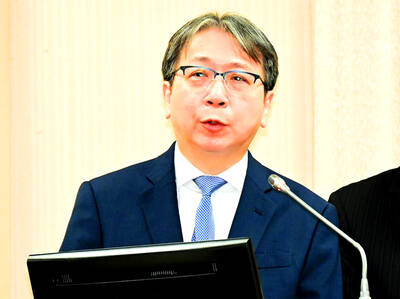
ON ALERT: Taiwan’s partners would issue warnings if China attempted to use Interpol to target Taiwanese, and the global body has mechanisms to prevent it, an official said China has stationed two to four people specializing in Taiwan affairs at its embassies in several democratic countries to monitor and harass Taiwanese, actions that the host nations would not tolerate, National Security Bureau (NSB) Director-General Tsai Ming-yen (蔡明彥) said yesterday. Tsai made the comments at a meeting of the legislature’s Foreign Affairs and National Defense Committee, which asked him and Minister of National Defense Wellington Koo (顧立雄) to report on potential conflicts in the Taiwan Strait and military preparedness. Democratic Progressive Party (DPP) Legislator Michelle Lin (林楚茵) expressed concern that Beijing has posted personnel from China’s Taiwan Affairs Office to its


 RSS
RSS