


US President Donald Trump yesterday ordered California National Guard troops to Los Angeles, a rare deployment against the state governor’s wishes after sometimes-violent protests against immigration enforcement raids.
Trump took federal control of California’s state military to push soldiers into the country’s second-biggest city, a decision deemed “purposefully inflammatory” by California Governor Gavin Newsom and of a kind not seen for decades, US media said.
The development came after two days of confrontations during which federal agents fired flash-bang grenades and tear gas toward crowds angry at the arrests of dozens of migrants in a city with a large Latino population.
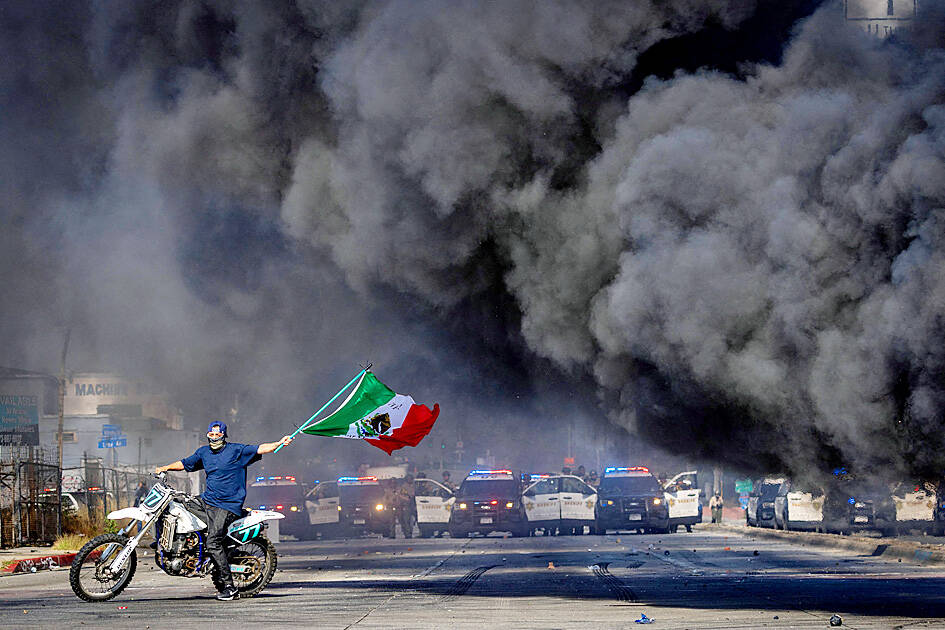
Photo: REUTERS
“It’s up to us to stand up for our people,” said a Los Angeles resident whose parents are immigrants, declining to give her name.
“Whether we get hurt, whether they gas us, whatever they’re throwing at us. They’re never going to stop us. All we have left is our voice,” she said as emergency services lights flashed in the distance.
Fires and fireworks lit up the streets during clashes, while a protester holding a Mexican flag stood in front of a burnt-out car that had been sprayed with a slogan against the US Immigration and Customs Enforcement (ICE) agency.
“President Trump has signed a Presidential Memorandum deploying 2,000 National Guardsmen to address the lawlessness that has been allowed to fester,” White House press secretary Karoline Leavitt said, blaming what she called California’s “feckless” Democratic Party leaders. “The Trump Administration has a zero tolerance policy for criminal behavior and violence, especially when that violence is aimed at law enforcement officers trying to do their jobs.”
Trump on social media congratulated the National Guard for “a job well done” shortly before midnight on Saturday.
However, Los Angeles Mayor Karen Bass wrote on social media that the troops had not yet been deployed.
Trump took a swipe at Bass and Newsom, saying in his post they were “unable to handle the task,” drawing a comparison with deadly fires that hit the city in January.
The National Guard — a reserve military — is frequently used in natural disasters and occasionally in instances of civil unrest, but almost always with the consent of local politicians.
California’s governor objected to the president’s decision, saying it was “purposefully inflammatory and will only escalate tensions.”
Federal authorities “want a spectacle. Don’t give them one. Never use violence. Speak out peacefully,” Newsom wrote on social media.
US Secretary of Defense Pete Hegseth threatened to involve nearby regular military forces.
“If violence continues, active duty Marines at Camp Pendleton will also be mobilized — they are on high alert,” he wrote on social media.
Law professor Jessica Levinson
said Hegseth’s intervention appeared symbolic because of the general legal restriction on the use of the US military as a domestic policing force in the absence of an insurrection.
Saturday’s standoff took place in the suburb of Paramount, where demonstrators converged on a reported federal facility that the local mayor said was being used as a staging post by ICE agents.
Masked and armed immigration agents carried out high-profile workplace raids in separate parts of Los Angeles on Friday, attracting angry crowds and setting off hours-long standoffs.

SILENCING CRITICS: In addition to blocking Taiwan, China aimed to prevent rights activists from speaking out against authoritarian states, a Cabinet department said The Ministry of Foreign Affairs (MOFA) yesterday condemned transnational repression by Beijing after RightsCon, a major digital human rights conference scheduled to be held in Zambia this week, was abruptly canceled due to Chinese pressure over Taiwanese participation. This year’s RightsCon, the world’s largest conference discussing issues “at the intersection of human rights and technology,” was scheduled to take place from tomorrow to Friday in Lusaka, and expected to draw 2,600 in-person attendees from 150 countries, along with 1,100 online participants. However, organizers were forced to cancel the event due to behind-the-scenes pressure from China, the ministry said, expressing its “strongest condemnation”
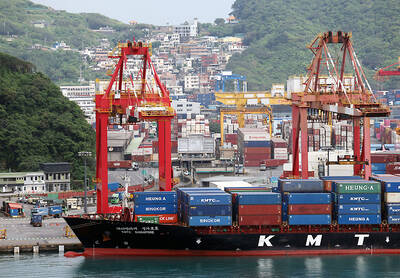
Taiwan’s economy grew far faster than expected in the first quarter, as booming demand for artificial intelligence (AI) applications drove a surge in exports, spilling over into investment and consumption, the Directorate-General of Budget, Accounting and Statistics (DGBAS) said yesterday. GDP growth was 13.69 percent year-on-year during the January-to-March period, beating the DGBAS’ February forecast by 2.23 percentage points and marking the most robust growth in nearly four decades, DGBAS senior official Chiang Hsin-yi (江心怡) told a news conference in Taipei. The result was powered by exports, which remain the backbone of Taiwan’s economy, Chiang said. Outbound shipments jumped 51.12 percent year-on-year to
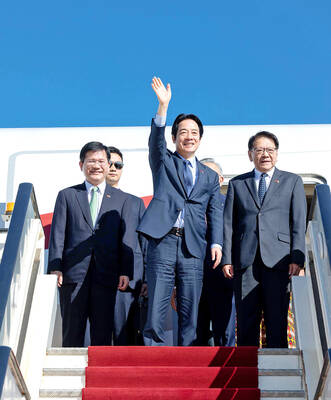
DELAYED BUT DETERMINED: The president’s visit highlights Taiwan’s right to international engagement amid regional pressure from China President Willaim Lai (賴清德) yesterday arrived in Eswatini, more than a week after his planned visit to Taiwan’s sole African ally was suspended because of revoked overflight permits. “The visit, originally scheduled for April 22, was postponed due to unforeseen external factors,” Lai wrote on social media. “After several days of careful arrangements by our diplomatic and national security teams, we successfully arrived today.” Lai said he looked forward to further deepening Taiwan-Eswatini relations through closer cooperation in the economy, agriculture, culture and education, as well as advancing the nation’s international partnerships. The president was initially scheduled to arrive in time to celebrate
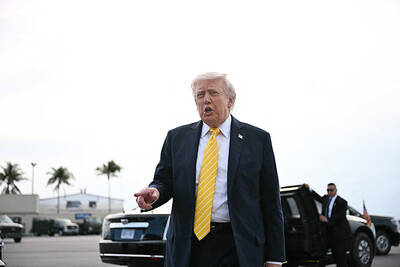
Iran’s Islamic Revolutionary Guard Corp (IRGC) yesterday said the US faced a choice between an “impossible” military operation or a “bad deal” with Tehran, after US President Donald Trump disparaged Iran’s latest peace proposal. Negotiations between the two countries have been deadlocked since a ceasefire came into effect on April 8, with only one round of direct peace talks held so far. Iran’s Tasnim and Fars news agencies reported that Tehran had submitted a 14-point proposal to mediator Pakistan, but Trump was quick to cast doubt on it. “I will soon be reviewing the plan that Iran has just sent to us, but


 RSS
RSS