


Former Philippine president Rodrigo Duterte was elected mayor of his home city by a landslide, official results showed yesterday, despite his detention by the International Criminal Court.
The Davao election board proclaimed Duterte won the race for Davao mayor, with the official tally showing that he garnered more than 660,000 votes, or eight times as many as his closest rival.
Elated supporters chanted “Duterte, Duterte” when the result was announced.
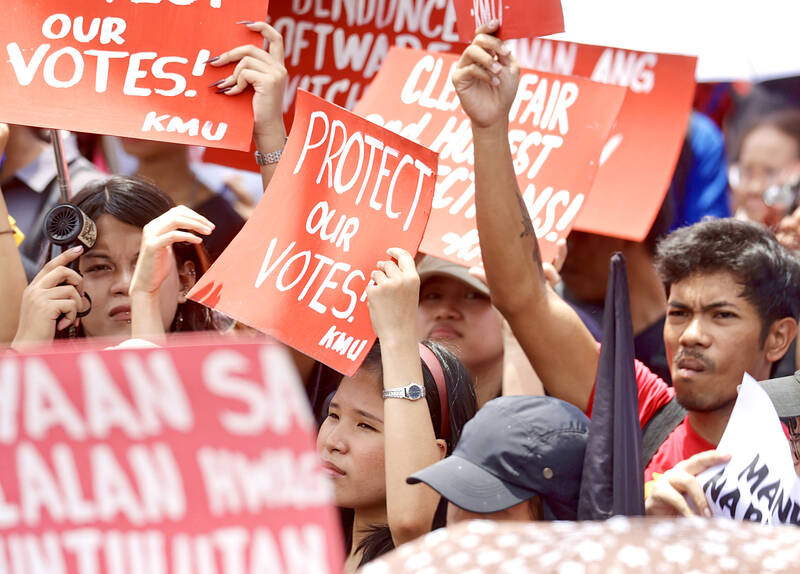
Photo: EPA-EFE
His youngest son, Sebastian, the incumbent mayor of Davao, was declared Davao vice mayor. His eldest son, Paolo, was re-elected as a member of the Philippine House of Representatives, and two grandsons won in local races, an indication of the family’s continued influence.
“Duterte landslide in Davao,” his youngest daughter Veronica wrote on social media.
Partial unofficial results showed at least five candidates backed by the Duterte family were also among those leading the race for 12 Senate positions, in a stronger-than-expected showing in Monday’s midterm elections. Pre-election surveys had indicated only two of them would emerge victorious.
The results come as a boost for Duterte’s daughter, Philippine Vice President Sara Duterte, ahead of an impeachment trial in the Senate in July over a raft of charges including alleged misuse of public funds and plotting to assassinate Philippine President Ferdinand Marcos Jr, his wife and the House speaker.
Sara Duterte is considered a strong contender for the 2028 presidential race, but if convicted by the Senate, she would lose her job and would be disqualified from holding public office forever. To be acquitted, she needs at least nine of the 24 senators to vote in her favor.
Results of the Senate race will be known in a week. Apart from the five Duterte-backed candidates, the others leading in the top 12 included five endorsed by Marcos and two opposition candidates.
While the senate race outcome was encouraging for Sara Duterte, the jury is still out on how the impeachment trial will go for her, said Jean Franco, a political science professor at the University of the Philippines.
If damning evidence were raised against her, Franco indicated that it could hurt her chances of an acquittal.
The Senate race unofficial results also showed that support for Marcos, whose approval rating fell last month, is dwindling and could turn up surprises in the 2028 elections, Franco added.
Marcos in a statement thanked Filipinos who voted, saying: “Our democracy has renewed itself — peacefully, orderly and with dignity.”
“We may not have won every seat, but our work and mission continue,” he said.
The impeachment and Rodrigo Duterte’s arrest and transfer to the tribunal in The Hague, Netherlands, came after Marcos and Sara Duterte’s ties unraveled over political differences and their competing ambitions.
Rodrigo Duterte’s supporters slammed the government for arresting and surrendering the former president to a court whose jurisdiction they dispute.
Nicknamed “the Punisher” and “Dirty Harry,” Rodrigo Duterte served as Davao’s mayor for two decades before becoming president. He has been in the custody of the International Criminal Court in The Hague since March, awaiting trial for crimes against humanity over a brutal war on illegal drugs that left thousands of suspects dead during his presidency.
Under Philippine law, candidates facing criminal charges, including those in detention, can run for office unless they have been convicted and have exhausted all appeals.

SILENCING CRITICS: In addition to blocking Taiwan, China aimed to prevent rights activists from speaking out against authoritarian states, a Cabinet department said The Ministry of Foreign Affairs (MOFA) yesterday condemned transnational repression by Beijing after RightsCon, a major digital human rights conference scheduled to be held in Zambia this week, was abruptly canceled due to Chinese pressure over Taiwanese participation. This year’s RightsCon, the world’s largest conference discussing issues “at the intersection of human rights and technology,” was scheduled to take place from tomorrow to Friday in Lusaka, and expected to draw 2,600 in-person attendees from 150 countries, along with 1,100 online participants. However, organizers were forced to cancel the event due to behind-the-scenes pressure from China, the ministry said, expressing its “strongest condemnation”
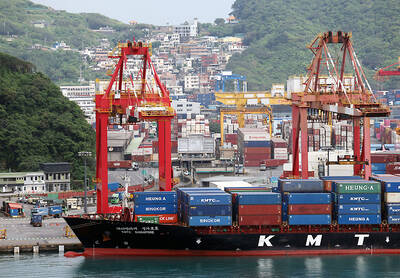
Taiwan’s economy grew far faster than expected in the first quarter, as booming demand for artificial intelligence (AI) applications drove a surge in exports, spilling over into investment and consumption, the Directorate-General of Budget, Accounting and Statistics (DGBAS) said yesterday. GDP growth was 13.69 percent year-on-year during the January-to-March period, beating the DGBAS’ February forecast by 2.23 percentage points and marking the most robust growth in nearly four decades, DGBAS senior official Chiang Hsin-yi (江心怡) told a news conference in Taipei. The result was powered by exports, which remain the backbone of Taiwan’s economy, Chiang said. Outbound shipments jumped 51.12 percent year-on-year to
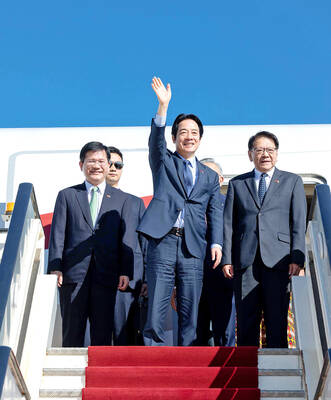
DELAYED BUT DETERMINED: The president’s visit highlights Taiwan’s right to international engagement amid regional pressure from China President Willaim Lai (賴清德) yesterday arrived in Eswatini, more than a week after his planned visit to Taiwan’s sole African ally was suspended because of revoked overflight permits. “The visit, originally scheduled for April 22, was postponed due to unforeseen external factors,” Lai wrote on social media. “After several days of careful arrangements by our diplomatic and national security teams, we successfully arrived today.” Lai said he looked forward to further deepening Taiwan-Eswatini relations through closer cooperation in the economy, agriculture, culture and education, as well as advancing the nation’s international partnerships. The president was initially scheduled to arrive in time to celebrate
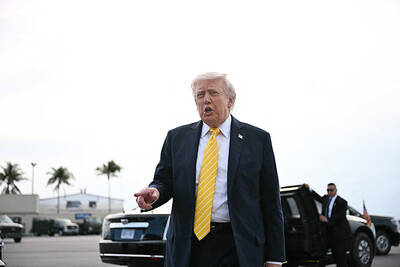
Iran’s Islamic Revolutionary Guard Corp (IRGC) yesterday said the US faced a choice between an “impossible” military operation or a “bad deal” with Tehran, after US President Donald Trump disparaged Iran’s latest peace proposal. Negotiations between the two countries have been deadlocked since a ceasefire came into effect on April 8, with only one round of direct peace talks held so far. Iran’s Tasnim and Fars news agencies reported that Tehran had submitted a 14-point proposal to mediator Pakistan, but Trump was quick to cast doubt on it. “I will soon be reviewing the plan that Iran has just sent to us, but


 RSS
RSS