


India and Pakistan yesterday exchanged heavy artillery fire along their contested frontier after New Delhi launched deadly missile strikes on its archrival, in the worst violence between the nuclear-armed neighbors in two decades.
At least 38 deaths were reported, with Islamabad saying 26 civilians were killed by the Indian strikes and firing along the border, and New Delhi adding at least 12 dead from Pakistani shelling.
The fighting came two weeks after New Delhi blamed Islamabad for backing an attack on the Indian-run side of disputed Kashmir.
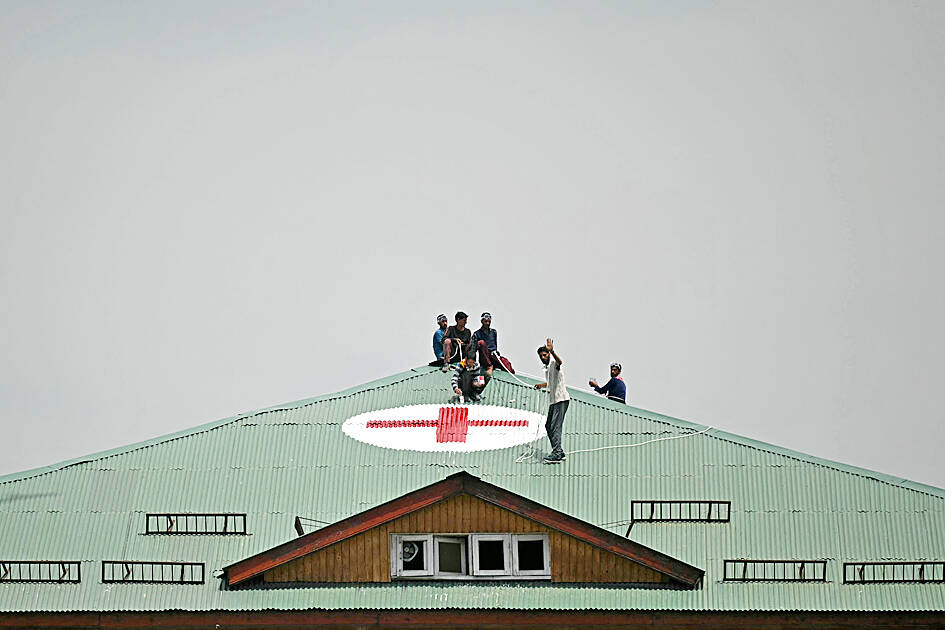
Photo: AFP
The South Asian neighbors have fought multiple wars over the divided territory since they were carved out of the subcontinent at the end of British rule in 1947.
The latest violence exceeds India’s strikes in 2019.
The Indian army said “justice is served,” reporting nine “terrorist camps” had been destroyed, with New Delhi adding that its actions “have been focused, measured and non-escalatory in nature.”
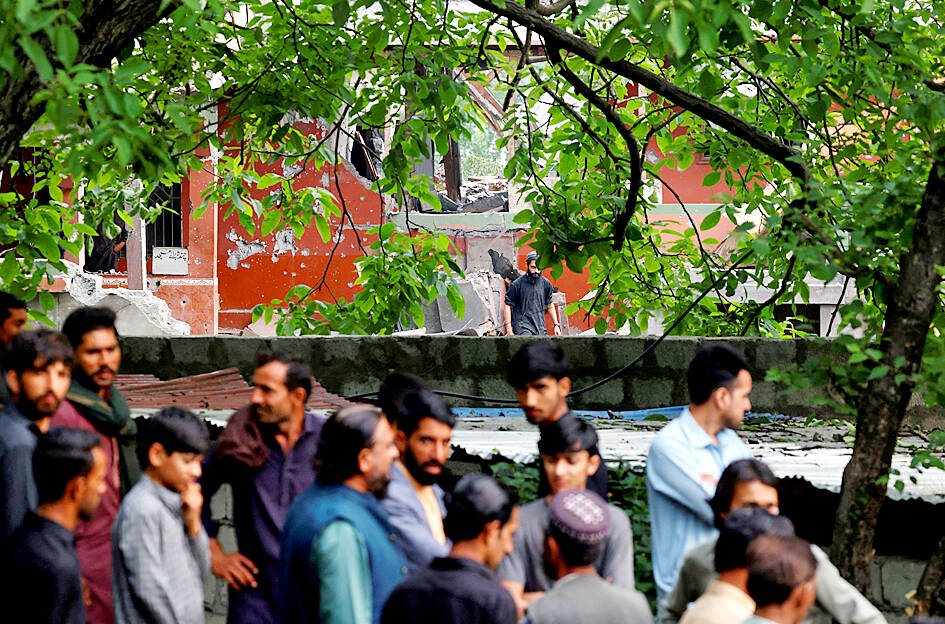
Photo: Reuters
Pakistani Minister of Defence Khawaja Muhammad Asif accused Indian Prime Minister Narendra Modi of launching the strikes to “shore up” his domestic popularity, adding that Islamabad “won’t take long to settle the score.”
Military spokesman Ahmed Sharif Chaudhry said five Indian jets had been downed across the border.
An Indian senior security source, who asked not to be named, said three of its fighter jets had crashed on home territory.
A hydropower plant in Kashmir was also targeted by India, damaging a dam structure, after India threatened to stop the flow of water on its side of the border, Pakistan said.
Pakistan had earlier warned that tampering with the rivers that flow into its territory would be an “act of war.”
World leaders have issued urgent calls for de-escalation, while Pakistan’s National Security Committee, which convened an emergency meeting led by Prime Minister Shehbaz Sharif and attended by Chief of Army Staff Asim Munir, called on the international community to hold India “accountable.”
In Muzaffarabad, the main city of Pakistan-administered Kashmir, troops cordoned off streets around a mosque Islamabad said was struck, with blast marks visible on the walls of several nearby homes.
The 70-year caretaker of the mosque was killed, and buried later yesterday at a funeral attended by about 600 people.
“There were terrible sounds during the night, there was panic among everyone,” said Muhammed Salman, who lives close to the mosque.
“We are moving to a safer place ... we are homeless now,” added 24-year-old Tariq Mir, who was hit in the leg by shrapnel.
UN military observers arrived yesterday afternoon to inspect the site, which was blown out on one side.
Pakistan said 21 civilians were killed in the strikes — including four children — while five were killed by gunfire at the border.
At least 12 people were killed and 29 others wounded in Poonch in Indian-administered Kashmir, local official Azhar Majid said.
“We woke up as we heard the sound of firing,” Farooq, a man in Poonch, told the Press Trust of India news agency from his hospital bed, his head wrapped in bandage. “I saw shelling raining down.”

A signaling system malfunction disrupted high-speed rail (HSR) services beginning at 8am today, with trains temporarily reduced to three northbound and three southbound trains per hour as authorities conduct inspections. The malfunction occurred on a section of track in Miaoli County during pre-operation checks early this morning, forcing northbound and southbound trains to use a single track, the HSR operator said. The regular schedule has been replaced with three hourly trains offering only nonreserved seating in each direction, stopping at every station, it said, adding that business class cars would still have reserved seating. Departures from terminal stations are scheduled at the top

Taiwan is still in the process of assessing the possibility of recruiting workers from Eswatini, the Ministry of Foreign Affairs said yesterday, adding that its goal is to help Eswatini upgrade its vocational training centers. If there are plans to recruit workers from Eswatini, safeguarding national security, protecting public health and ensuring the employment rights of Taiwanese would be prerequisites, Department of West Asian and African Affairs Director-General Yen Chia-liang (顏嘉良) told a news conference. Key considerations would also include filling labor shortages in specific industries, and fostering bilateral professional and technical exchanges, he said. Yen was asked about the progress of labor

VERBOSE VESSELS: A CGA cutter and a China Coast Guard exchanged verbal barbs for more than a day in Taiwanese-controlled waters before the Chinese vessel left The Taiwanese and Chinese coast guards had a standoff near the strategically located Pratas Islands (Dongsha Islands, 東沙群島) in the north of the South China Sea, the Coast Guard Administration (CGA) said yesterday. The two sides engaged in intense radio exchanges over sovereignty claims during the 33-hour standoff. China Coast Guard vessel 3501 eventually left the restricted waters, 26.6 nautical miles (49.2km) west of the Pratas Islands, at 5pm yesterday, the CGA said. Lying approximately between southern Taiwan and Hong Kong, the Taiwan-controlled Pratas are seen by some security experts as vulnerable to Chinese attack due to their distance — more than

A US uncrewed surface vessel (USV) encountered multiple Chinese warships during an autonomous transit of the Taiwan Strait, US defense company Seasats said in a statement on Wednesday. Seasats announced that a Lightfish USV had completed the first autonomous transit of the Taiwan Strait. Over five days, the USV traversed the entire length of the Strait while constantly monitoring surface vessel traffic, the company said. The Lightfish encountered multiple Chinese warships, one of which was a Chinese People’s Liberation Army Navy (PLAN) Type 056 corvette, it said. The Chinese vessels were operating “well within Taiwan’s exclusive economic zone without transmitting their identity via the


 RSS
RSS