


The Legislative Yuan’s Internal Administration Committee yesterday passed a preliminary review of proposed amendments to the Social Order Maintenance Act (社會秩序維護法) raising penalties for ticket scalping, noise disturbances and stalking offenses.
The maximum fine for unauthorized reselling of transportation or entertainment tickets not intended for personal use would be increased from NT$18,000 to NT$30,000, the draft amendment says.
The committee also approved a resolution calling on authorities to propose within two months amendments targeting the scalping of medical, hospitality, and other voucher-based products and services.
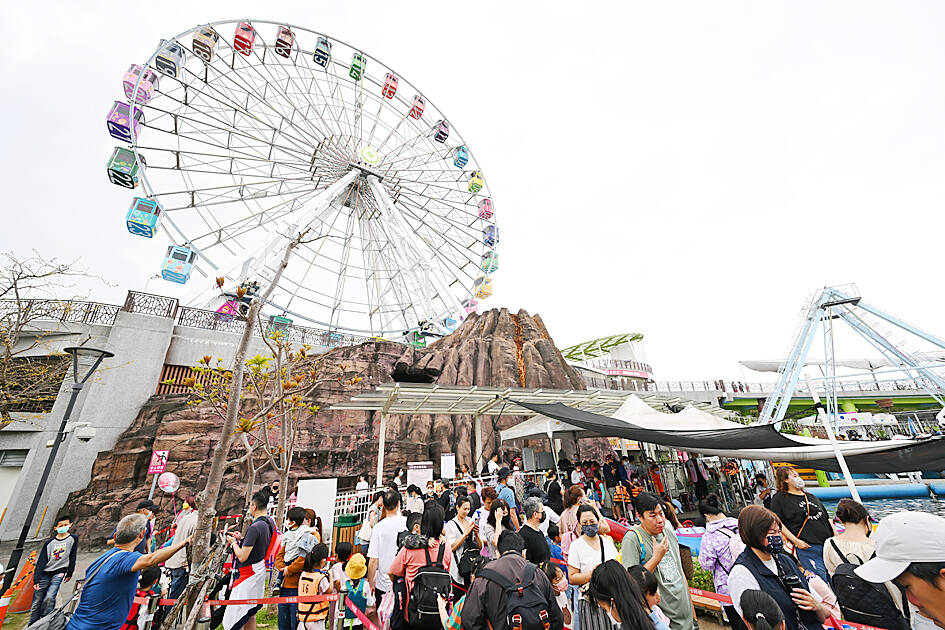
Photo: Tien Yu-hua, Taipei Times
The resolution states that while the act generally handles minor offenses through administrative penalties, scalping can involve “substantial illegal gains and seriously harm the interests of consumers.”
The changes were proposed by committee members Lo Ting-wei (羅廷瑋), Wang Hung-wei (王鴻薇) and Lin Szu-ming (林思銘) of the Chinese Nationalist Party (KMT) alongside independent Legislator May Chin (高金素梅).
Opposing the proposed changes, Minister of the Interior Liu Shyh-fang (劉世芳) told the meeting that legislation on the scalping of tickets for cultural and sports events is already covered under the Development of the Cultural and Creative Industries Act (文化創意產業發展法) and the Sport Industry Development Act (運動產業發展條例).
Illegally reselling medical and hospitality vouchers should be regulated under separate laws set by the Ministry of Health and Welfare and the Ministry of Transportation and Communications to “avoid excessive administrative discretion by police,” she added.
Liu also warned against listing multiple kinds of tickets in the law, saying it risked overlooking some categories.
Separately, the committee approved a clause raising the maximum fine for noise disturbances from NT$6,000 to NT$10,000.
The proposal was introduced by the Taiwan People’s Party (TPP) caucus and KMT Legislator Chiu Jo-hua (邱若華), who said that current fines are too low to be an effective deterrent.
In another amendment, KMT legislators Lu Ming-che (魯明哲) and Yen Kuan-heng (顏寬恒) proposed increasing fines for “stalking another person without justifiable reasons, despite having been dissuaded,” from NT$3,000 to NT$30,000.
The 14-member committee approved the proposed increases following cross-party discussions.

DRONE CENTRAL: Taiwan aims to become Asia’s democratic hub for drones, with most exports focused on high-quality military-grade models, an official said Taiwan’s drone industry is expected to expand significantly by 2030, producing 100,000 units per month and exporting half of them, the Ministry of Economic Affairs said yesterday. Current drone production capacity is about 15,000 units per month, but the industry can quickly scale up as demand increases, Industrial Development Administration Director-General Chiou Chyou-huey (邱求慧) told a news conference in Taipei. Taiwan’s drone output grew 2.5-fold last year to NT$12.9 billion (US$408.3 million) under a government program to develop the uncrewed vehicle sector, he said. The Executive Yuan in October last year approved plans to invest NT$44.2 billion into domestic production of uncrewed aerial

A signaling system malfunction disrupted high-speed rail (HSR) services beginning at 8am today, with trains temporarily reduced to three northbound and three southbound trains per hour as authorities conduct inspections. The malfunction occurred on a section of track in Miaoli County during pre-operation checks early this morning, forcing northbound and southbound trains to use a single track, the HSR operator said. The regular schedule has been replaced with three hourly trains offering only nonreserved seating in each direction, stopping at every station, it said, adding that business class cars would still have reserved seating. Departures from terminal stations are scheduled at the top
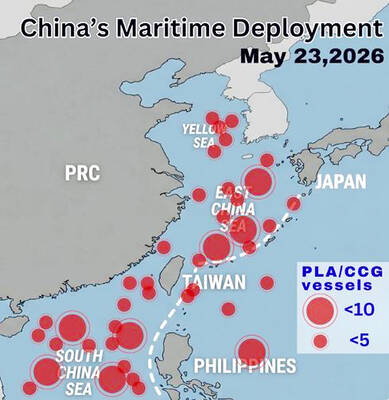
WARNING: China should stop engaging in actions that undermine regional peace and stability, as it would only build resentment among people across the Strait, the CGA said China has deployed more than 100 navy, coast guard and other vessels in waters from the Yellow Sea to the South China Sea and the western Pacific since US President Donald Trump and Chinese President Xi Jinping (習近平) met in Beijing, National Security Council Secretary-General Joseph Wu (吳釗燮) said yesterday. “In this part of the world, #China is the one & only PROBLEM wrecking the #StatusQuo & threatening regional peace & stability,” Wu wrote on X. In a separate post, he said Beijing was coercing Taiwan’s maritime domain, calling it illegal and provocative, after the Coast Guard Administration (CGA) expelled a

VERBOSE VESSELS: A CGA cutter and a China Coast Guard exchanged verbal barbs for more than a day in Taiwanese-controlled waters before the Chinese vessel left The Taiwanese and Chinese coast guards had a standoff near the strategically located Pratas Islands (Dongsha Islands, 東沙群島) in the north of the South China Sea, the Coast Guard Administration (CGA) said yesterday. The two sides engaged in intense radio exchanges over sovereignty claims during the 33-hour standoff. China Coast Guard vessel 3501 eventually left the restricted waters, 26.6 nautical miles (49.2km) west of the Pratas Islands, at 5pm yesterday, the CGA said. Lying approximately between southern Taiwan and Hong Kong, the Taiwan-controlled Pratas are seen by some security experts as vulnerable to Chinese attack due to their distance — more than


 RSS
RSS