


The Executive Yuan would ask the Legislative Yuan to unfreeze the NT$138.1 billion (US$4.25 billion) budget for 1,584 items that the latter has put on hold, Premier Cho Jung-tai (卓榮泰) said yesterday.
The Cabinet has instructed all ministries to submit their requests to the Legislative Yuan to unfreeze their respective budgets, Cho told reporters prior to a meeting at the legislature in Taipei.
Hopefully, the legislature would release the funds as soon as possible to allow government agencies to function normally, he said.
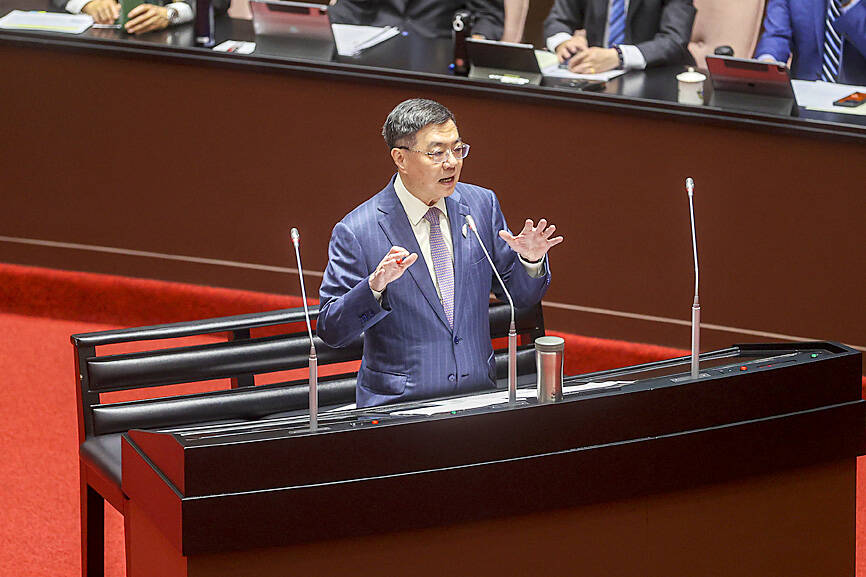
Photo: CNA
Budget freezes can be divided into three categories, he said.
The first category, covering 1,162 items totaling NT$15.4 billion, consists of spending categories whose funds can be instantly unlocked once a proposal is submitted, the premier said.
The second, with 373 items totaling NT$36.6 billion, requires the submission of a special report, and funds can only be released after the report has been reviewed by the legislature, he said.
The third category, covering 49 items estimated at NT$86.1 billion, are special frozen items with varying requirements for the funds to be unlocked, he said.
About 30 of these items require that a certain percentage of the budget be implemented before the frozen funds can be unlocked, while the requirements to unfreeze the budget for some other items are difficult to meet because they are illegal or unconstitutional, he said.
At the plenary session, Cho told lawmakers that the Executive Yuan would request constitutional interpretations for the general budget and the Act Governing the Allocation of Government Revenues and Expenditures (財政收支劃分法), as the legislature had rejected the Cabinet’s requests for reconsideration.
“We do not recognize these budget review procedures as legal or constitutional,” he said.
Asked about the 3 percent pay hike for civil servants, military personnel and public-school teachers, Cho said they would be issued starting next month.
The pay raise was delayed because the Cabinet believed it was inappropriate to allocate the funds before its effort to overturn the NT$3.1 trillion central government budget plan approved by the legislature was resolved, he said.
The Cabinet pushed for a reconsideration of the budget because of its many cuts and freezes, but the legislature on March 12 voted to uphold the budget it passed on Jan. 21.
Cho said a decision was finally made yesterday morning to start dispensing the 3 percent salary raise for civil servants starting next month, but he did not provide further details.
The wage hike for public servants was approved by the Executive Yuan in July last year.
Meanwhile, the Chinese Nationalist Party (KMT) caucus said that during the 80-plus days since the legislative session opened in February, the Executive Yuan has not communicated with the Legislative Yuan regarding the general budget or requested any items be unfrozen, but has instead been spreading rumors and playing the victim.
If there have been any obstacles to implementing the budget, the Executive Yuan and Democratic Progressive Party (DPP) bear the greatest responsibility, it said.
Cho’s sudden order to submit all 1,584 frozen budget items for review shows that the Executive Yuan’s previous inaction in this regard was a purposeful directive, it said.
It also shows that the DPP was using the national budget to manipulate public opinion and divide society, disregarding people’s livelihood and adding fuel to the fire, it said.
Additional reporting by Liu Wan-lin

SILENCING CRITICS: In addition to blocking Taiwan, China aimed to prevent rights activists from speaking out against authoritarian states, a Cabinet department said The Ministry of Foreign Affairs (MOFA) yesterday condemned transnational repression by Beijing after RightsCon, a major digital human rights conference scheduled to be held in Zambia this week, was abruptly canceled due to Chinese pressure over Taiwanese participation. This year’s RightsCon, the world’s largest conference discussing issues “at the intersection of human rights and technology,” was scheduled to take place from tomorrow to Friday in Lusaka, and expected to draw 2,600 in-person attendees from 150 countries, along with 1,100 online participants. However, organizers were forced to cancel the event due to behind-the-scenes pressure from China, the ministry said, expressing its “strongest condemnation”
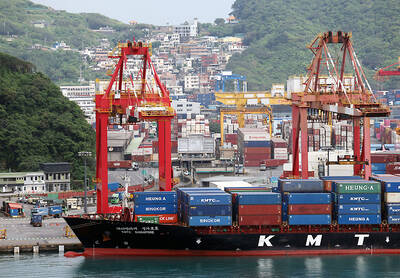
Taiwan’s economy grew far faster than expected in the first quarter, as booming demand for artificial intelligence (AI) applications drove a surge in exports, spilling over into investment and consumption, the Directorate-General of Budget, Accounting and Statistics (DGBAS) said yesterday. GDP growth was 13.69 percent year-on-year during the January-to-March period, beating the DGBAS’ February forecast by 2.23 percentage points and marking the most robust growth in nearly four decades, DGBAS senior official Chiang Hsin-yi (江心怡) told a news conference in Taipei. The result was powered by exports, which remain the backbone of Taiwan’s economy, Chiang said. Outbound shipments jumped 51.12 percent year-on-year to
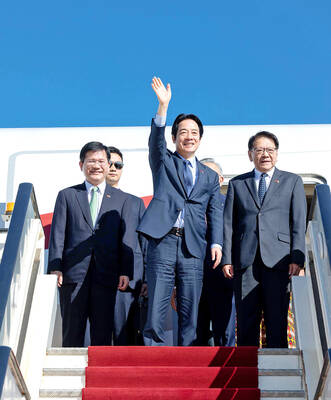
DELAYED BUT DETERMINED: The president’s visit highlights Taiwan’s right to international engagement amid regional pressure from China President Willaim Lai (賴清德) yesterday arrived in Eswatini, more than a week after his planned visit to Taiwan’s sole African ally was suspended because of revoked overflight permits. “The visit, originally scheduled for April 22, was postponed due to unforeseen external factors,” Lai wrote on social media. “After several days of careful arrangements by our diplomatic and national security teams, we successfully arrived today.” Lai said he looked forward to further deepening Taiwan-Eswatini relations through closer cooperation in the economy, agriculture, culture and education, as well as advancing the nation’s international partnerships. The president was initially scheduled to arrive in time to celebrate
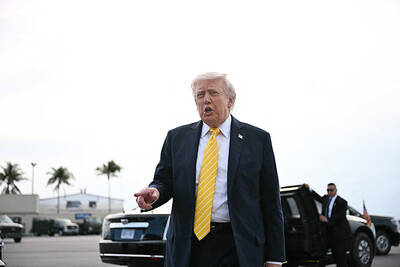
Iran’s Islamic Revolutionary Guard Corp (IRGC) yesterday said the US faced a choice between an “impossible” military operation or a “bad deal” with Tehran, after US President Donald Trump disparaged Iran’s latest peace proposal. Negotiations between the two countries have been deadlocked since a ceasefire came into effect on April 8, with only one round of direct peace talks held so far. Iran’s Tasnim and Fars news agencies reported that Tehran had submitted a 14-point proposal to mediator Pakistan, but Trump was quick to cast doubt on it. “I will soon be reviewing the plan that Iran has just sent to us, but


 RSS
RSS