


Retired US general Robert B. Abrams reportedly served as adviser to Chief of the General Staff Admiral Mei Chia-shu (梅家樹) during the Ministry of National Defense’s computer-simulated war games in the buildup to this year’s 41st annual Han Kuang military exercises, local media reported yesterday.
For 14 days and 13 nights starting on April 5 and ending yesterday, the armed forces conducted the computer-simulated war games component of the Han Kuang exercises, utilizing the joint theater-level simulation system (JTLS).
Using the JTLS, the exercise simulated a continuous 24-hour confrontation based on scenarios such as “gray zone” incursions and the Chinese People’s Liberation Army (PLA) transitioning from an exercise to an actual full-scale invasion.
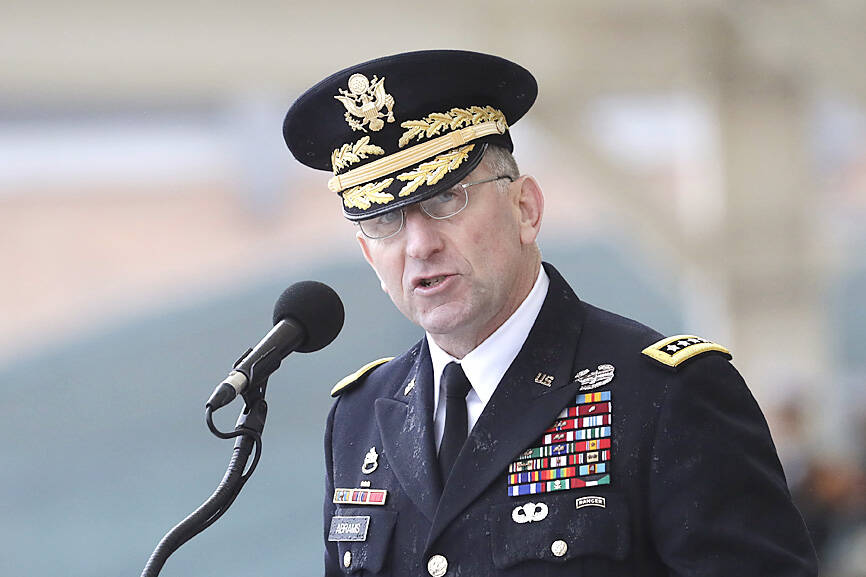
Photo: AP
Abrams, a former four-star general who served as commander of US forces in South Korea, was present at the military exercises, the Chinese-language United Daily News reported, adding that he served as an observer and senior adviser to Mei.
In response to media queries for confirmation, the ministry yesterday said only that military exchanges between Taiwan and the US are proceeding normally and that the ministry would not comment on individual cases.
When reached for comment, Chieh Chung (揭仲), a research fellow at the Association of Strategic Foresight, said that a senior US general serving as an adviser during an exercise indicates that military exchanges between Taiwan and the US have been upgraded to the point where both sides have started to coordinate plans.
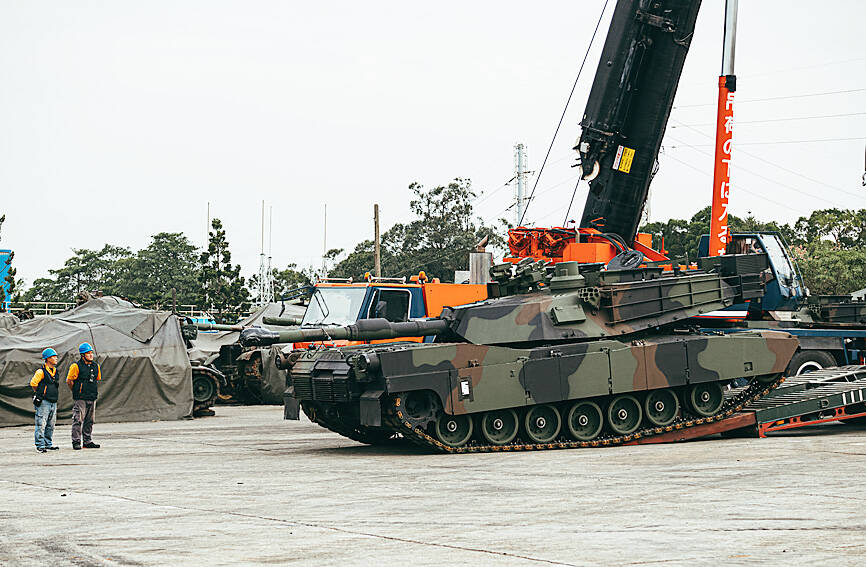
Photo: EPA-EFE / Military News Agency
Institute for National Defense and Security Research research fellow Su Tzu-yun (蘇紫雲) said that in the past, US representatives have participated in the Han Kuang exercises as observers, playing a neutral role within the war simulation and offering suggestions during the review, but this time, the US directly advised the commander of the defending force, symbolizing its joint participation in defending against China, emphasizing that this has far-reaching implications.
In related news, 38 out of 108 M1A2T tanks purchased from the US arrived in Taiwan at the end of last year and would be put into service in the second half of this year after passing various tests.
Military personnel yesterday said that US representatives would be invited to attend the commissioning ceremony of Taiwan’s first M1A2T tank.
There is also a possibility of inviting descendants of famed US army general Creighton Williams Abrams Jr to Taiwan for the event, they said.
The A in M1A stands for Abrams, named for the famous general, whose third son is Robert B. Abrams.
Additional reporting by Huang Chin-hsuan and Lo Tien-pin

A signaling system malfunction disrupted high-speed rail (HSR) services beginning at 8am today, with trains temporarily reduced to three northbound and three southbound trains per hour as authorities conduct inspections. The malfunction occurred on a section of track in Miaoli County during pre-operation checks early this morning, forcing northbound and southbound trains to use a single track, the HSR operator said. The regular schedule has been replaced with three hourly trains offering only nonreserved seating in each direction, stopping at every station, it said, adding that business class cars would still have reserved seating. Departures from terminal stations are scheduled at the top

Taiwan is still in the process of assessing the possibility of recruiting workers from Eswatini, the Ministry of Foreign Affairs said yesterday, adding that its goal is to help Eswatini upgrade its vocational training centers. If there are plans to recruit workers from Eswatini, safeguarding national security, protecting public health and ensuring the employment rights of Taiwanese would be prerequisites, Department of West Asian and African Affairs Director-General Yen Chia-liang (顏嘉良) told a news conference. Key considerations would also include filling labor shortages in specific industries, and fostering bilateral professional and technical exchanges, he said. Yen was asked about the progress of labor

A US uncrewed surface vessel (USV) encountered multiple Chinese warships during an autonomous transit of the Taiwan Strait, US defense company Seasats said in a statement on Wednesday. Seasats announced that a Lightfish USV had completed the first autonomous transit of the Taiwan Strait. Over five days, the USV traversed the entire length of the Strait while constantly monitoring surface vessel traffic, the company said. The Lightfish encountered multiple Chinese warships, one of which was a Chinese People’s Liberation Army Navy (PLAN) Type 056 corvette, it said. The Chinese vessels were operating “well within Taiwan’s exclusive economic zone without transmitting their identity via the

VERBOSE VESSELS: A CGA cutter and a China Coast Guard exchanged verbal barbs for more than a day in Taiwanese-controlled waters before the Chinese vessel left The Taiwanese and Chinese coast guards had a standoff near the strategically located Pratas Islands (Dongsha Islands, 東沙群島) in the north of the South China Sea, the Coast Guard Administration (CGA) said yesterday. The two sides engaged in intense radio exchanges over sovereignty claims during the 33-hour standoff. China Coast Guard vessel 3501 eventually left the restricted waters, 26.6 nautical miles (49.2km) west of the Pratas Islands, at 5pm yesterday, the CGA said. Lying approximately between southern Taiwan and Hong Kong, the Taiwan-controlled Pratas are seen by some security experts as vulnerable to Chinese attack due to their distance — more than


 RSS
RSS