


Israeli strikes across the southern Gaza Strip killed at least 26 Palestinians overnight into yesterday, including a Hamas political leader and several women and children, as the death toll surpasses 50,000.
Residents said tanks had advanced into an area of the southern city of Rafah as the military ordered it evacuated.
Palestinian health authorities said the total number of Palestinians killed in Gaza since the start of the Israel-Hamas war has passed 50,000 after Israel ended the ceasefire last week with a wave of strikes that have killed nearly 700 people.
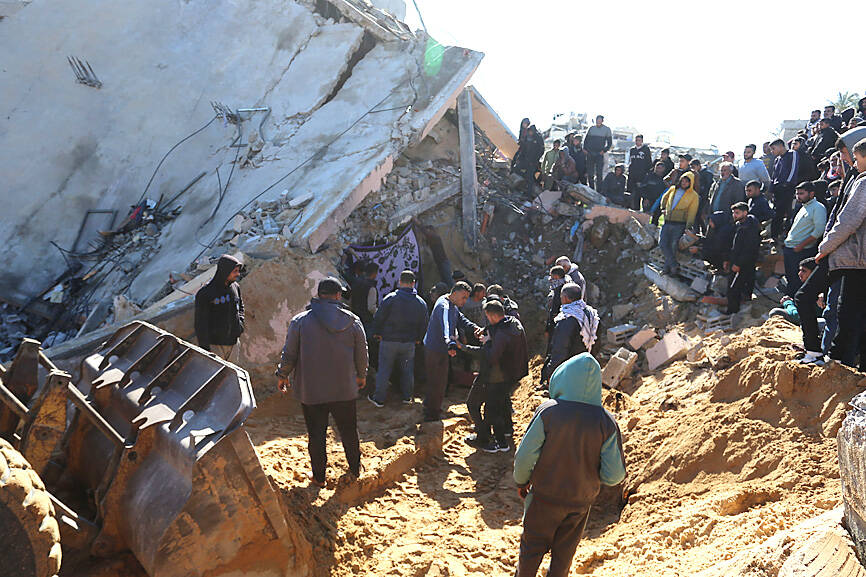
Photo: AFP
The military ordered people to leave the already heavily destroyed Tel al-Sultan neighborhood on foot along a single route to Muwasi, a sprawling area of squalid tent camps.
Late on Saturday, Israel’s Cabinet approved a proposal to set up a new directorate tasked with advancing the “voluntary departure” of Palestinians in line with US President Donald Trump’s proposal to depopulate Gaza and rebuild it for others.
Palestinians say they do not want to leave their homeland, and rights groups have said the plan could amount to expulsion in violation of international law.
Israeli Minister of Defense Israel Katz said the new body would be “subject to Israeli and international law” and coordinate “passage by land, sea and air to the destination countries.”
In Rafah yesterday, Palestinian men, women and children were walking along a dirt road, carrying their belongings in their arms, a recurring scene in a war that has forced most of Gaza’s population to flee within the territory, often multiple times.
“It’s displacement under fire,” said Mustafa Gaber, a local journalist who left Tel al-Sultan with his family.
In a video call, he said hundreds of people were fleeing as tank and drone fire echoed nearby.
“There are wounded people among us. The situation is very difficult,” he said.
Mohammed Abu Taha, another resident who fled, said many people were unable to evacuate because of the surprise incursion overnight.
He also said his sister and her family were sheltering in a school in an area of Rafah surrounded by Israeli forces.
Hamas said that Salah Bardawil, a member of its political bureau and the Palestinian parliament, was killed in a strike in Muwasi that also killed his wife.
Bardawil was a well-known member of the group’s political wing who gave media interviews over the years.
Hospitals in southern Gaza said they had received another 24 bodies from strikes overnight, including several women and children.
The European Hospital said five children and their parents were killed in a strike on the southern city of Khan Younis.
Another family — two girls and their parents — were killed in a separate strike.
Gaza’s health ministry said 50,021 Palestinians have been killed in the war and more than 113,000 have been wounded. The latest toll announced yesterday included 673 people killed since Israel’s surprise bombardment on Tuesday.

A signaling system malfunction disrupted high-speed rail (HSR) services beginning at 8am today, with trains temporarily reduced to three northbound and three southbound trains per hour as authorities conduct inspections. The malfunction occurred on a section of track in Miaoli County during pre-operation checks early this morning, forcing northbound and southbound trains to use a single track, the HSR operator said. The regular schedule has been replaced with three hourly trains offering only nonreserved seating in each direction, stopping at every station, it said, adding that business class cars would still have reserved seating. Departures from terminal stations are scheduled at the top

Taiwan is still in the process of assessing the possibility of recruiting workers from Eswatini, the Ministry of Foreign Affairs said yesterday, adding that its goal is to help Eswatini upgrade its vocational training centers. If there are plans to recruit workers from Eswatini, safeguarding national security, protecting public health and ensuring the employment rights of Taiwanese would be prerequisites, Department of West Asian and African Affairs Director-General Yen Chia-liang (顏嘉良) told a news conference. Key considerations would also include filling labor shortages in specific industries, and fostering bilateral professional and technical exchanges, he said. Yen was asked about the progress of labor

VERBOSE VESSELS: A CGA cutter and a China Coast Guard exchanged verbal barbs for more than a day in Taiwanese-controlled waters before the Chinese vessel left The Taiwanese and Chinese coast guards had a standoff near the strategically located Pratas Islands (Dongsha Islands, 東沙群島) in the north of the South China Sea, the Coast Guard Administration (CGA) said yesterday. The two sides engaged in intense radio exchanges over sovereignty claims during the 33-hour standoff. China Coast Guard vessel 3501 eventually left the restricted waters, 26.6 nautical miles (49.2km) west of the Pratas Islands, at 5pm yesterday, the CGA said. Lying approximately between southern Taiwan and Hong Kong, the Taiwan-controlled Pratas are seen by some security experts as vulnerable to Chinese attack due to their distance — more than

A US uncrewed surface vessel (USV) encountered multiple Chinese warships during an autonomous transit of the Taiwan Strait, US defense company Seasats said in a statement on Wednesday. Seasats announced that a Lightfish USV had completed the first autonomous transit of the Taiwan Strait. Over five days, the USV traversed the entire length of the Strait while constantly monitoring surface vessel traffic, the company said. The Lightfish encountered multiple Chinese warships, one of which was a Chinese People’s Liberation Army Navy (PLAN) Type 056 corvette, it said. The Chinese vessels were operating “well within Taiwan’s exclusive economic zone without transmitting their identity via the


 RSS
RSS