


Some civil society groups yesterday announced that they have collected enough signatures to pass the first-stage threshold to initiate a recall vote against Chinese Nationalist Party (KMT) legislators in 18 constituencies nationwide, saying that they would submit the signatures to the Central Election Commission (CEC) today.
They also said that they expected to pass the threshold in eight more constituencies in the coming days, meaning the number of KMT legislators facing a recall vote could reach 26.
The groups set up stations to collect signatures at local marketplaces and busy commercial districts. The legislators their petition drives target include Fu Kun-chi (傅?萁) of Hualien County, KMT caucus deputy secretary-general Wang Hung-wei (王鴻薇), Lee Yen-hsiu (李彥秀) of Taipei, Yeh Yuan-chih (葉元之) of New Taipei City, Yen Kuan-heng (顏寬恒) of Taichung and Cheng Cheng-chien (鄭正鈐) of Hsinchu City.
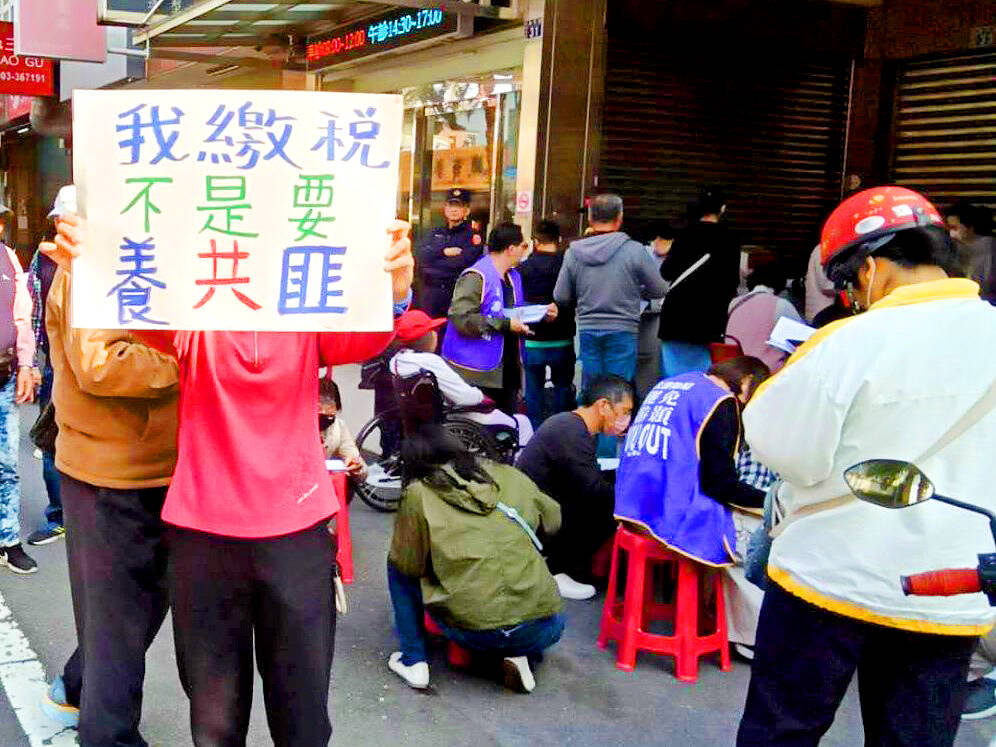
Photo courtesy of Chen Yu-ling
Activists from “Shimmer Hualien” (微光花蓮) are leading the effort in the east coast county to remove Fu from the legislature. Shimmer Hualien members said they would hold a joint news conference with other civil organizations today at 9am in front of the CEC in Taipei.
A Shimmer Hualien representative said last month they had gathered 7,161 signatures, which is over 5,000 more than the required first-stage threshold of 1,938.
The representative did not say his name and had his photos taken only from his back, saying he fears retribution from Fu.
A petition drive to recall an elected official is required in the first stage to reach 1 percent of voters in the electoral district, while in the second stage, the number of signatures needs to reach at least 10 percent of voters within 60 days, according to the Public Officials Election and Recall Act (公職人員選舉罷免法).
“We shall recall Fu and must cancel him. Let us together say ‘no’ to this proxy of the Chinese Communist Party,” Shimmer Hualien activists said in a social media post.
“After the first stage, the second stage is a tougher challenge, so we need more Hualien County residents to stand up to make it happen,” they wrote. “As Fu is facing a recall drive, he does not reflect on last year and how he led KMT legislators to create political turmoil, contravene the Constitution and take part in other harmful actions.”
“Instead, he requested 30 police officers as personal escorts. We shall persist in these efforts to ensure that Fu hears and feels the public anger,” they wrote.
“Most Hualien residents are angry and are no longer afraid of Fu. We are all standing up to face him and show that we are not intimidated by his power anymore,” they said. “We must let him know that what he has done is against the public’s will.”
“People who were oppressed and threatened by Fu in the past have come out to assist in the recall drive,” it added.
A Democratic Progressive Party (DPP) official yesterday quoted President William Lai (賴清德) as saying that all civil society groups that launched the recall drives are at the grassroots level.
“They represent the real voices of civil society and ordinary people. The DPP would respect the autonomy and independent efforts of these groups, and our party members would listen to the public in humble fashion,” the official said. “We must not let them be labeled as tools for political fighting.”
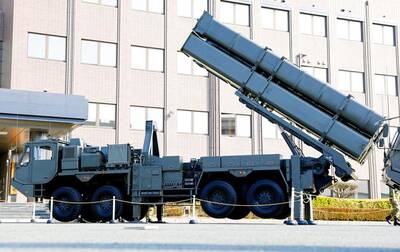
Japan has deployed long-range missiles in a southwestern region near China, the Japanese defense minister said yesterday, at a time when ties with Beijing are at their lowest in recent years. The missiles were installed in Kumamoto in the southern region of Kyushu, as Japan is attempting to shore up its military capacity as China steps up naval activity in the East China Sea. “Standoff defense capabilities enable us to counter the threat of enemy forces attempting to invade our country ... while ensuring the safety of our personnel,” Japanese Minister of Defense Shinjiro Koizumi said. “This is an extremely important initiative for
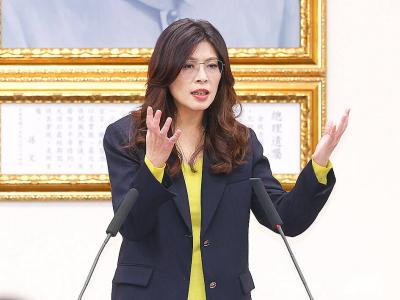
Chinese Nationalist Party (KMT) Chairwoman Cheng Li-wun (鄭麗文) today accepted an invitation from Chinese President Xi Jinping (習近平) to lead a delegation to China next month, saying she hopes to promote the peaceful development of cross-strait relations and bring stability to the Taiwan Strait. “I am grateful and happy to accept this invitation,” Cheng said in a statement from the KMT chairperson’s office. Cheng said she hopes both sides can work together to promote the peaceful development of cross-strait relations, enhance exchange and cooperation, bring stability to the Taiwan Strait and improve people’s livelihoods. At today's news conference, Cheng said any efforts to

MORE POPULAR: Taiwan Pass sales increased by 59 percent during the first quarter compared with the same period last year, the Tourism Administration said The Tourism Administration yesterday said that it has streamlined the Taiwan Pass, with two versions available for purchase beginning today. The tourism agency has made the pass available to international tourists since 2024, allowing them to access the high-speed rail, Taiwan Railway Corp services, four MRT systems and four Taiwan Tourist Shuttles. Previously, five types of Taiwan Pass were available, but some tourists have said that the offerings were too complicated. The agency said only two types of Taiwan Pass would be available, starting from a three-day pass with the high-speed rail and a three-day pass with Taiwan Railway Corp. The former costs NT$2,800

The nation’s fastest supercomputer, Nano 4 (晶創26), is scheduled to be launched in the third quarter, and would be used to train large language models in finance and national defense sectors, the National Center for High-Performance Computing (NCHC) said. The supercomputer, which would operate at about 86.05 petaflops, is being tested at a new cloud computing center in the Southern Taiwan Science Park in Tainan. The exterior of the server cabinet features chip circuitry patterns overlaid with a map of Taiwan, highlighting the nation’s central position in the semiconductor industry. The center also houses Taiwania 2, Taiwania 3, Forerunner 1 and


 RSS
RSS