


President William Lai (賴清德) yesterday called on the public to be vigilant against China’s “united front” tactics, which have become increasingly severe, as the Chinese Communist Party (CCP) remains committed to annexing Taiwan.
Lai made the remarks while visiting Lecheng Temple (樂成宮) in Taichung, where he gave out limited-edition red envelopes and greeted the public for the Lunar New Year.
The red envelope, with a NT$1 coin inside, features dog and cat drawings designed by Lai and Vice President Hsiao Bi-khim (蕭美琴) to symbolize Taiwan’s warm and friendly attitude, and love for animals.
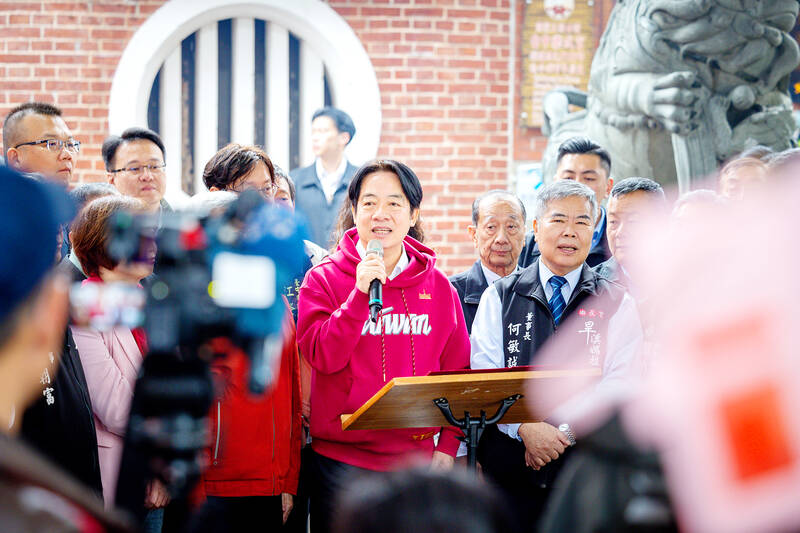
Photo: Screen grab from the Presidential Office’s Flickr page
A recipient said she joined the line outside the temple at 4:30am and waited for six hours before receiving a red envelope from the president.
Speaking to the crowd, Lai said the CCP’s use of military and economic coercion to annex Taiwan has not changed.
“No matter how nice their [CCP] words sound, the threats against Taiwan remain,” he said.
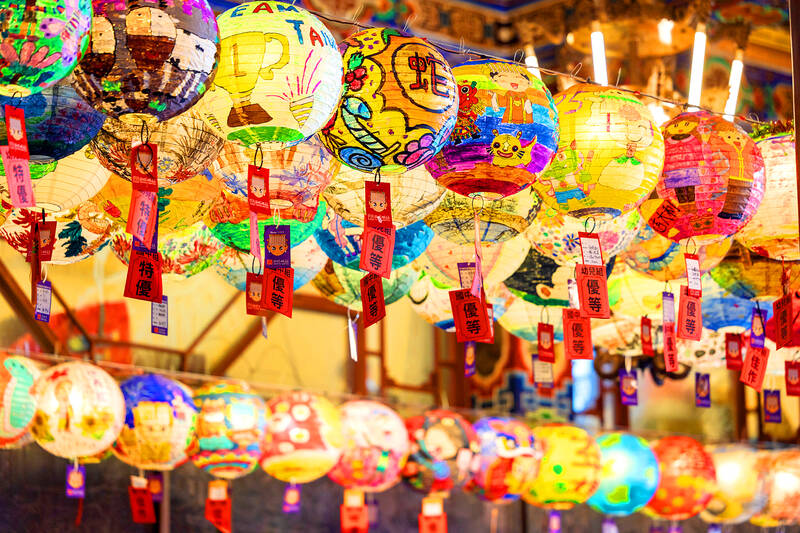
Photo: Screen grab from the Presidential Office’s Flickr page
The president cited the increasing number of indicted and convicted cases of espionage over the past year or two as an example of the “united front” operations by China that have become increasingly severe.
Taiwan is our democratic homeland, Lai said, urging “everyone to protect the country, its democratic and free way of life, and resist China’s ‘united front’ efforts.”
Lai said that as president, he is responsible for ensuring a stable life for the public by safeguarding national security, promoting economic growth and caring for underprivileged members of society.
However, he also urged the public to join the collective effort to protect the country, maintain social stability and prevent fraud.
Financial scams and fraud remain a bane, with more than 500 cases of fraud recorded per day, costing the public an average of NT$400 million to NT$500 million (US$12.2 million to US$15.3 million), he said.
Seventy percent of these cases are investment fraud, he added.
These cases lead to huge financial losses and family issues, Lai said, urging the public to be alert against scams.
Lai also visited other temples in central Taiwan, including Fongyuan Cihji Temple (豐原慈濟宮), also in Taichung, and Lugang Tianhou Temple (鹿港天后宮) in Changhua County and Fusing Temple (福興宮) in Yunlin County’s Siluo Township (西螺).
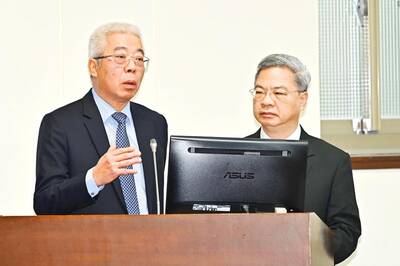
Taiwan has arranged for about 8 million barrels of crude oil, or about one-third of its monthly needs, to be shipped from the Red Sea this month to bypass the Strait of Hormuz and ease domestic supply pressures, CPC Corp, Taiwan (CPC, 台灣中油) said yesterday. The state-run oil company has worked with Middle Eastern suppliers to secure routes other than the Strait of Hormuz, through which about 20 percent of the world’s oil and liquefied natural gas typically passes, CPC chairman Fang Jeng-zen (方振仁) said at a meeting of the legislature’s Economics Committee in Taipei. Suppliers in Saudi Arabia have indicated they

South Korea has adjusted its electronic arrival card system to no longer list Taiwan as a part of China, a move that the Ministry of Foreign Affairs said would help facilitate exchanges between the two sides. South Korea previously listed “Taiwan” as “Taiwan (China)” in the drop-down menus of its online arrival card system, where people had to fill out where they came from and their next destination. The ministry had requested South Korea make a revision and said it would change South Korea’s name on Taiwan’s online immigration system from “Republic of Korea” to “Korea (South),” should the issue not be
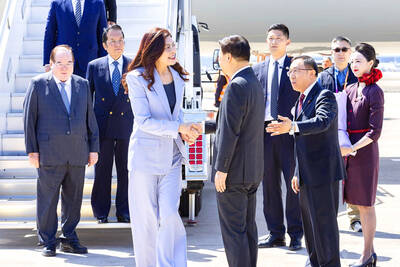
CCP ‘PAWN’? Beijing could use the KMT chairwoman’s visit to signal to the world that many people in Taiwan support the ‘one China’ principle, an academic said Chinese Nationalist Party (KMT) Chairwoman Cheng Li-wun (鄭麗文) yesterday arrived in China for a “peace” mission and potential meeting with Chinese President Xi Jinping (習近平), while a Taiwanese minister detailed the number of Chinese warships currently deployed around the nation. Cheng is visiting at a time of increased Chinese military pressure on Taiwan, as the opposition-dominated Legislative Yuan stalls a government plan for US$40 billion in extra defense spending. Speaking to reporters before going to the airport, Cheng said she was going on a “historic journey for peace,” but added that some people felt uneasy about her trip. “If you truly love Taiwan,
Both sides of the Taiwan Strait share a political foundation based on the “1992 consensus” and opposition to Taiwanese independence, Chinese Nationalist Party (KMT) Chairwoman Cheng Li-wun (鄭麗文) today said during her meeting with Chinese President Xi Jinping (習近平). Both sides of the Strait should plan and build institutionalized and sustainable mechanisms for dialogue and cooperation based on that foundation to make peaceful development across the Strait irreversible, she said. Peace is a shared moral value across the Strait, and both sides should move beyond political confrontation to seek institutionalized solutions to prevent war, she said. Mutually beneficial cross-strait relations are what the


 RSS
RSS