


An Israeli military raid targeting Hamas militants has forced a major hospital in northern Gaza out of service and led to the detention of its director, the WHO and health officials said yesterday.
The attack comes just days after an Israeli airstrike hit Yemen’s main airport as a civilian Airbus 320 with hundreds of passengers on board was landing and a UN delegation was waiting to leave.
The assault on Kamal Adwan Hospital has rendered the facility “useless,” further worsening Gaza’s severe health crisis, the Palestinian territory’s health officials said.
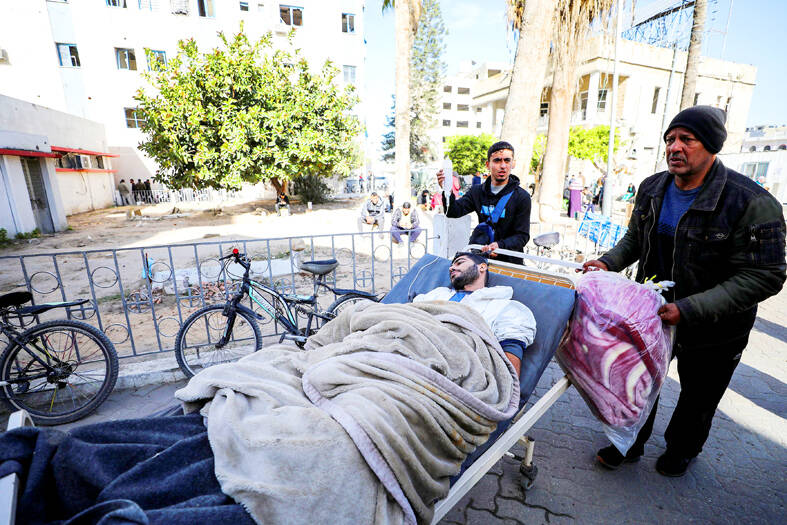
Photo: Reuters
“This morning’s raid on Kamal Adwan Hospital has put this last major health facility in north Gaza out of service. Initial reports indicate that some key departments were severely burnt and destroyed during the raid,” the WHO said overnight on X, referring to the Israeli operation that began in the early hours of Friday.
The WHO said 60 health workers and 25 patients in critical condition, including some on ventilators, reportedly remain in the hospital.
Patients in moderate to severe condition were forced to evacuate to the destroyed, nonfunctioning Indonesian Hospital, the UN health agency said, adding that it was “deeply concerned for their safety.”
Hamas-run Gaza’s health ministry reported that Israeli forces detained Kamal Adwan Hospital’s director, Hossam Abu Safiyeh, along with several medical staff members. Gaza’s civil defence agency said Abu Safiyeh was held alongside its north Gaza chief, Ahmed Hassan al-Kahlout.
Ammar al-Barsh, a resident of Jabalia where the military has focused its assault in the past few weeks, said that the raid on Kamal Adwan and its environs had left dozens of homes in the area in ruins.
“The situation is catastrophic, there is no medical service, no ambulances and no civil dfense in the north,” Barsh, 50, said.
Meanwhile, WHO Director-General Tedros Adhanom Ghebreyesus told BBC radio that his ears were still ringing following Thursday’s attack as he prepared to board a flight in Sana’a, and stressed that the protection for civilian installations under international law must be respected.
The strikes hit Sana’a’s international airport and other areas in Yemen on Thursday, against what Israel’s military called rebel “military targets.”
“We heard a heavy explosion nearby, and then I think repeated,” Tedros said. “The sound was so, so loud... So deafening, actually. Still my ear rings. It’s already more than 24 hours now. I don’t know if it affected my ear. The explosion was so heavy.”
He said it was a “matter of luck,” that a missile deviated slight, missing them.
Houthi Deputy Minister of Transport Yahya al-Sayani said four people were killed and 20 wounded in the strikes.
Additional reporting by AP
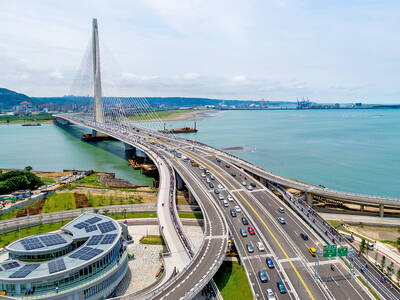
The Ministry of Transportation and Communications yesterday inaugurated the Danjiang Bridge across the Tamsui River in New Taipei City, saying that the structure would be an architectural icon and traffic artery for Taiwan. Feted as a major engineering achievement, the Danjiang Bridge is 920m long, 211m tall at the top of its pylon, and is the longest single-pylon asymmetric cable-stayed bridge in the world, the government’s Web site for the structure said. It was designed by late Iraqi-British architect Zaha Hadid. The structure, with a maximum deck of 70m, accommodates road and light rail traffic, and affords a 200m navigation channel for boats,
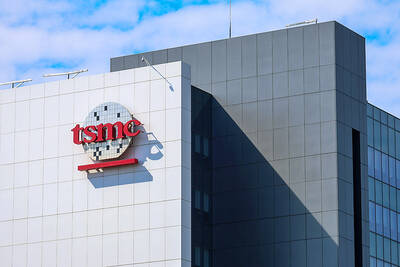
Taiwan Semiconductor Manufacturing Co (TSMC, 台積電), the world’s largest foundry service provider, yesterday said that global semiconductor revenue is projected to hit US$1.5 trillion in 2030, after the figure exceeds US$1 trillion this year, as artificial intelligence (AI) demand boosts consumption of token and compute power. “We are still at the beginning of the AI revolution, but we already see a significant impact across the whole semiconductor ecosystem,” TSMC deputy cochief operating officer Kevin Zhang (張曉強) said at the company’s annual technology symposium in Hsinchu City. “It is fair to say that in the past decade, smartphones and other mobile devices were
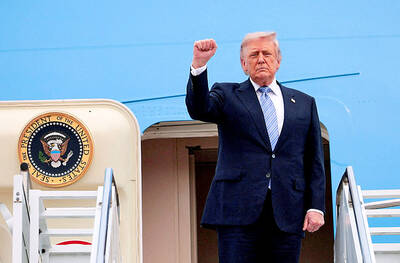
US-CHINA SUMMIT: MOFA welcomed US reassurance of no change in its Taiwan policy; Trump said he did not comment when Xi talked of opposing independence US President Donald Trump yesterday said he has not made a decision on whether to move forward with a major arms package for Taiwan after hearing concerns about it from Chinese President Xi Jinping (習近平). Trump’s comments on Taiwan came as he flew back to Washington after wrapping up critical talks in which both leaders said important progress was made in stabilizing US-China relations even as deep differences persist between the world’s two biggest powers on Iran and Taiwan. “I will make a determination,” Trump said, adding: “I’ll be making decisions. But, you know, I think the last thing we need right

TAIWAN ISSUE: US treasury secretary Scott Bessent said on the first day of meetings that ‘it wouldn’t be a US-China summit without the Taiwan issue coming up’ There were no surprises on the first day of the summit between US President Donald Trump and Chinese President Xi Jinping (習近平), the Mainland Affairs Council (MAC) said yesterday, as the government reiterated that cross-strait stability is crucial to the Asia-Pacific region, as well as the world. As the two presidents met for a highly anticipated summit yesterday, Chinese state media reported that Xi warned Trump that missteps regarding Taiwan could push their two countries into “conflict.” Trump arrived in China with accolades for his host, calling Xi a “great leader” and “friend,” and extending an invitation to visit the White House


 RSS
RSS