


Prosecutors yesterday indicted Taiwan People’s Party (TPP) Chairman Ko Wen-je (柯文哲) on charges of corruption, embezzlement, breach of trust and other alleged offenses, requesting a combined 28-year, six-month prison term for the former Taipei mayor.
Ten other defendants were also indicted by the Taipei District Prosecutors’ Office, mainly for alleged bribery and abuse of public office for private benefit, while some face money laundering, forgery, fraudulent accounting and other similar charges.
Investigators have gathered sufficient evidence and testimony from witnesses in four separate cases from when Ko served as Taipei mayor from 2018 to 2022, and during his campaign leading up to the presidential election in January, Deputy Chief Prosecutor Kao I-shu (高一書) told a news conference in Taipei.
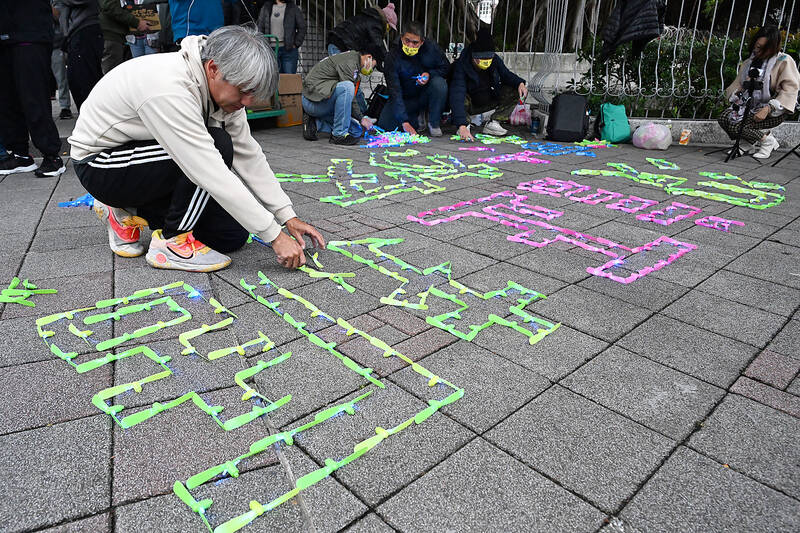
Photo: Liao Chen-huei, Taipei Times
The four cases relate to the former city administration’s dealings with the Core Pacific City (京華城購物中心) redevelopment project, use of political donations, use of a foundation and alleged bribery, prosecutors said.
Officials have accused Ko and other defendants of granting unlawful financial benefits in the Core Pacific City case, embezzlement of political donations, breach of trust by illegally transferring funds from a foundation to pay presidential campaign expenses and false declarations of assets relating to political donations.
When Ko was mayor, he allegedly helped Core Pacific Group (威京集團) and its subsidiary gain unlawful financial benefits of more than NT$12.105 billion (US$370.23 million), prosecutors said.
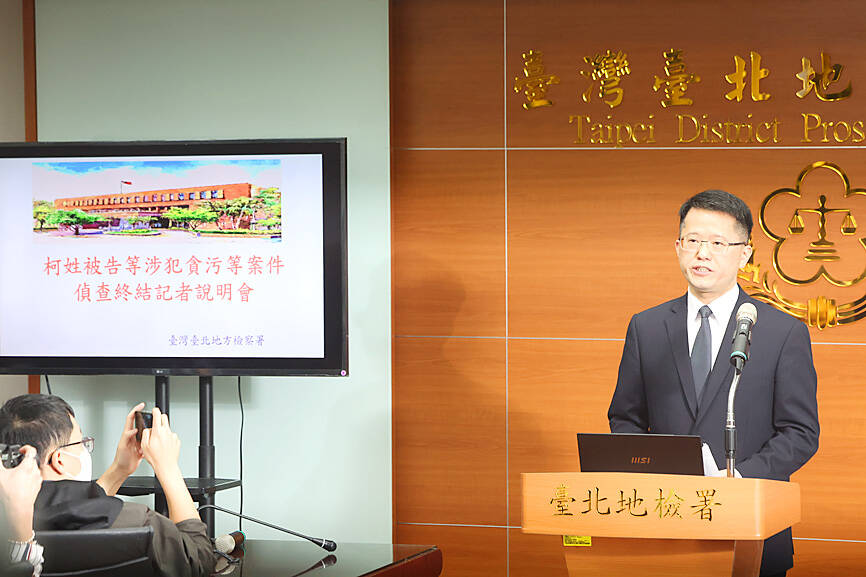
Photo: CNA
Meanwhile, accounts controlled by Ko have accumulated about NT$93.71 million in alleged unlawful gains, Kao said.
Ko has been accused of receiving NT$17.1 million in kickbacks and embezzling NT$68.35 million from his presidential campaign, Kao said.
Ko allegedly arranged illegal transfers from his public affairs foundation totaling NT$8.27 million to pay for expenses and wages during his presidential campaign, prosecutors said.
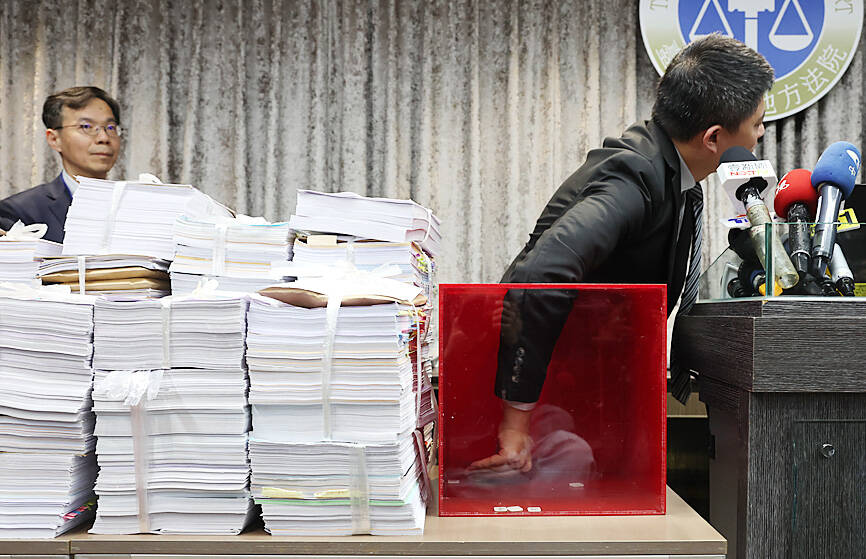
Photo: CNA
“Ko violated the declaration he made when he was sworn in as Taipei mayor that he would obey the nation’s laws not to take bribes or engage in corruption while serving in public office,” Kao said, reading from the indictment.
Prosecutors obtained written instructions for other suspects to swiftly leave Taiwan and notes to check on the financial accounts of Muko Public Relations Co (木可公關), Kao said.
Muko PR was contracted by the TPP to manage its presidential campaign funds.
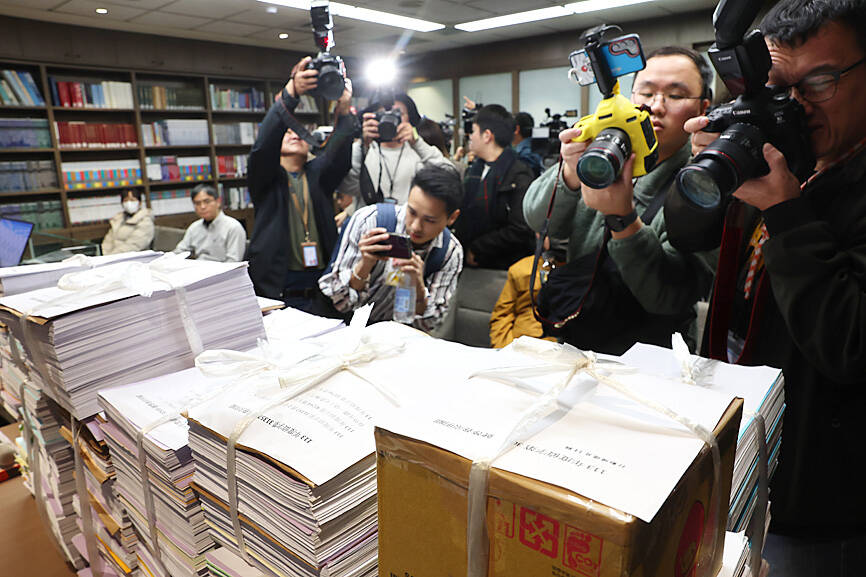
Photo: CNA
Investigators found shredded documents with the instructions, as well as torn notes at Ko’s office, indicating that he had tried to destroy evidence, Kao said.
Moreover, his attitude was hostile during the investigation, he said.
Based on the evidence and the other factors, prosecutors pressed charges and requested the nearly 30-year sentence, he said.
They also requested Ko be deprived of his civil rights for 10 years and fined NT$50 million according to stipulations of the Anti-Corruption Act (貪污治罪條例), he said.
Prominent figures among the other defendants include Sheen Ching-jing (沈慶京), chairman of Core Pacific Group; Pong Cheng-sheng (彭振聲), a former Taipei deputy mayor; Chinese Nationalist Party (KMT) Taipei City Councilor Angela Ying (應曉薇); Wu Shun-min (吳順民), Ying’s office assistant; Lee Wen-chung (李文宗), who was in charge of Ko’s presidential campaign finances; and Tuanmu Cheng (端木正), an accountant.
Other defendants are Chu Yea-hu (朱亞虎), former head of Dingyue Development Corp (鼎越開發), a subsidiary of Core Pacific Group; Taipei Urban Planning Commission Executive Secretary Shao Hsiu-pei (邵琇珮); Huang Ching-mao (黃景茂), a former head of the Taipei Urban Development Department; and Chang Chih-cheng (張志澄), a Core Pacific Group supervisor.
In the indictment, prosecutors requested that Sheen be handed a 12-year prison term and fined NT$30 million for charges of illegally obtaining financial benefits, and five years and NT$3 million for bribery.
Ying received NT$52.5 million in bribes from Sheen to use her position as a councilor to shield the Core Pacific City project amid evaluations by Taipei regulatory and urban planning agencies, the indictment said.
She pressed agencies to approve a higher floor area ratio through verbal abuse and scorn during meetings and telephone calls, putting mental and other stresses on city employees, the indictment said.
Ying was accused of contravening her public duty by taking bribes to push for financial gains for a corporation and laundering the money abroad.
She allegedly attempted to evade prosecution by fleeing to Hong Kong, but was stopped at the airport, prosecutors said, adding that she refused to cooperate during questioning.
They sought a 13-year sentence and a fine of NT$30 million on bribery charges for Ying, while the money laundering charges and those related to her alleged receipt of NT$52.5 million in bribes warrant a three-and-a-half year sentence and a fine of NT$20 million, prosecutors said.

‘NO SECURITY RISK’: The Railway Bureau reassured the public that the technicians’ activities were limited to technical guidance and did not involve sensitive systems The Railway Bureau yesterday said it had invited eight Chinese technicians to assist with an airport MRT construction project. The bureau issued the confirmation after an Internet user said Chinese nationals had entered the construction zone of Taiwan Taoyuan International Airport’s Terminal 3 project. They asked why “individuals from an enemy state” were allowed access to such a major national infrastructure project, which raised serious concerns over Taiwan’s industrial safety, sensitive systems and information security. The bureau’s Northern Region Engineering Branch Office said subcontractor Taiwan Handle Industrial Co (台灣手把工業) of the Taoyuan airport MRT’s “Contract No. CU05 Project A14 Station Civil, MEP &

A US uncrewed surface vessel (USV) encountered multiple Chinese warships during an autonomous transit of the Taiwan Strait, US defense company Seasats said in a statement on Wednesday. Seasats announced that a Lightfish USV had completed the first autonomous transit of the Taiwan Strait. Over five days, the USV traversed the entire length of the Strait while constantly monitoring surface vessel traffic, the company said. The Lightfish encountered multiple Chinese warships, one of which was a Chinese People’s Liberation Army Navy (PLAN) Type 056 corvette, it said. The Chinese vessels were operating “well within Taiwan’s exclusive economic zone without transmitting their identity via the
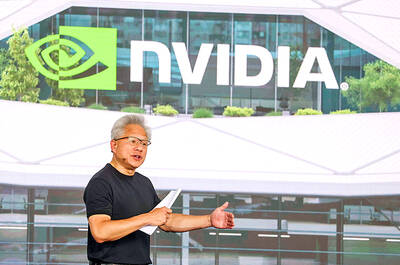
‘BOOMING’: ’ The number of partners we have here is incredible. You can see from their stock prices. They’re doing so well, they’re so happy,’ Jensen Huang said Nvidia Corp’s spending in Taiwan has ballooned to about US$150 billion a year, 10 times the US$10 billion to US$15 billion the company spent five years ago, Nvidia chief executive officer Jensen Huang (黃仁勳) said yesterday, suggesting Taiwan’s strategic importance in the global artificial intelligence (AI) supply chain. “Taiwan is the epicenter of the AI revolution. This is where the chips come, packaging comes. This is where the systems are made. This is where AI supercomputers were created,” Huang said at a meeting for the company’s employees in Beitou-Shilin Technology Park (北投士林科技園區) in Taipei, the planned site of Nvidia’s Taipei headquarters. “Taiwan
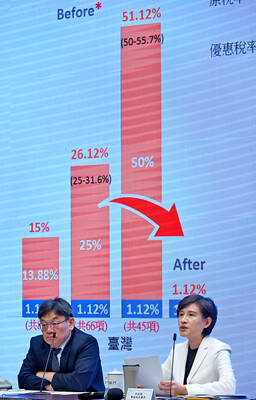
GREATER REACH? Auto parts and wood products would face tariffs of up to 15%, matching those targeting the EU, Japan and South Korea, Vice Premier said The US has announced that preferential tariff treatment for Taiwan’s non-semiconductor Section 232 goods would take effect retroactively from May 1, the Executive Yuan said yesterday. The US government yesterday posted a notice on the Federal Register’s public inspection Web site previewing tariff concessions for Taiwan under a memorandum of understanding (MOU) on Taiwan-US investment after two months of negotiations. The MOU signed on Jan. 15 stipulated three major preferential tariff arrangements: a 15 percent “reciprocal” tariff rate for Taiwan without stacking most-favored nation (MFN) rates; preferential Section 232 treatment for semiconductors and related products; and preferential Section 232 treatment for non-semiconductor


 RSS
RSS