


Legislative Speaker Han Kuo-yu (韓國瑜) is to lead a delegation of officials to US president-elect Donald Trump’s inauguration next month, Presidential Office Secretary-General Pan Men-an (潘孟安) said during a meeting of the Legislative Yuan’s Judiciary and Organic Laws and Statutes Committee in Taipei yesterday.
Trump’s inauguration is scheduled for Jan. 20.
Pan denied that efforts by Chinese Nationalist Party (KMT), with help from the Taiwan People’s Party (TPP), to pass amendments last week that the Democratic Progressive Party (DPP) opposed could lead to Han being denied the opportunity to lead a delegation to the US.
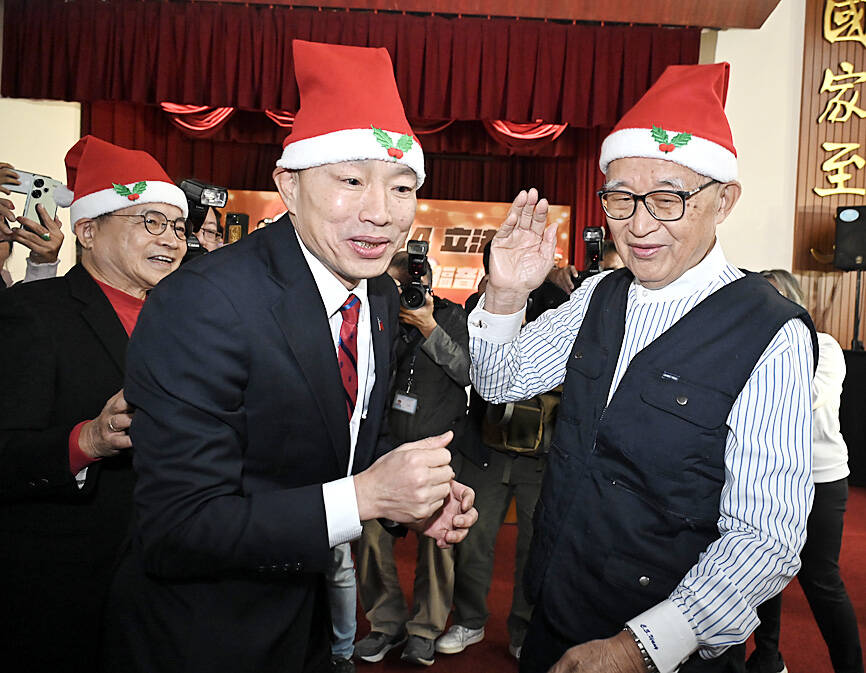
Photo: Tu Chien-rong, Taipei Times
The amendments to the Constitutional Court Procedure Act (憲法訴訟法), the Public Officials Election and Recall Act (公職人員選舉罷免法) and the Act Governing the Allocation of Government Revenues and Expenditures (財政收支劃分法) were approved on Friday last week.
KMT Legislator Hung Meng-kai (洪孟楷) asked Pan about media reports suggesting that Han could be denied the chance to visit the US as special envoy because of his party’s role in passing the controversial amendments to the three bills.
“There is no such thing,” Pan said, adding that he did not know where the reports originated.
Although it is not the norm for a legislative speaker to attend the inauguration of a US president, President William Lai (賴清德) invited Han to represent the presidency and the nation as the leader of a special delegation, Pan said, adding that he was instructed by Lai to meet with Han and discuss the matter three to four weeks ago.
If Han agrees to lead the delegation to the US and a final review is completed, Lai would instruct the Ministry of Foreign Affairs to carry out the plan, including confirming which other legislators would make the trip and arranging logistics, Pan said.
On Sunday, DPP Legislator Wang Ting-yu (王定宇) said that Lai had asked Han to lead a delegation and the ministry had asked the main political parties to nominate representatives to join it.
There are to be two representatives each from the DPP and the KMT, as well as one from the TPP, a notice from the Legislative Yuan’s Department of International Affairs showed.
The delegation is scheduled to be in the US from Jan. 18 to 24, it said.
The KMT on Tuesday sent notices to its members to register interest and held a draw yesterday afternoon at 5pm to determine who would go.
KMT Legislators Ko Ju-chun (葛如鈞) and Lee Yen-hsiu (李彥秀) won and are set to join the delegation.
Additional reporting by CNA
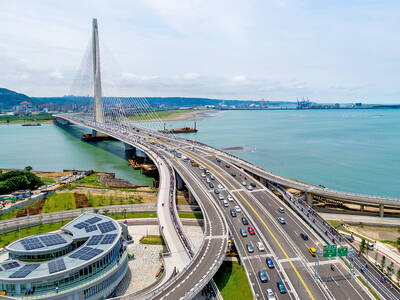
The Ministry of Transportation and Communications yesterday inaugurated the Danjiang Bridge across the Tamsui River in New Taipei City, saying that the structure would be an architectural icon and traffic artery for Taiwan. Feted as a major engineering achievement, the Danjiang Bridge is 920m long, 211m tall at the top of its pylon, and is the longest single-pylon asymmetric cable-stayed bridge in the world, the government’s Web site for the structure said. It was designed by late Iraqi-British architect Zaha Hadid. The structure, with a maximum deck of 70m, accommodates road and light rail traffic, and affords a 200m navigation channel for boats,
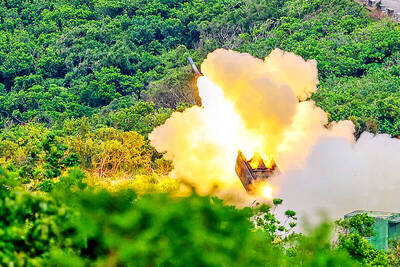
PRECISION STRIKES: The most significant reason to deploy HIMARS to outlying islands is to establish a ‘dead zone’ that the PLA would not dare enter, a source said A High Mobility Artillery Rocket System (HIMARS) would be deployed to Penghu County and Dongyin Island (東引) in Lienchiang County (Matsu) to force the Chinese military to retreat at least 100km from the coastline, a military source said yesterday. Taiwan has been procuring HIMARS and Army Tactical Missile Systems (ATACMS) from the US in batches. Once all batches have been delivered, Taiwan would possess 111 HIMARS units and 504 ATACMS, which have a range of 300km. Considering that “offense is the best defense,” the military plans to forward-deploy the systems to outlying islands such as Penghu and Dongyin so that
Taiwan Semiconductor Manufacturing Co (TSMC, 台積電), the world’s largest foundry service provider, yesterday said that global semiconductor revenue is projected to hit US$1.5 trillion in 2030, after the figure exceeds US$1 trillion this year, as artificial intelligence (AI) demand boosts consumption of token and compute power. “We are still at the beginning of the AI revolution, but we already see a significant impact across the whole semiconductor ecosystem,” TSMC deputy cochief operating officer Kevin Zhang (張曉強) said at the company’s annual technology symposium in Hsinchu City. “It is fair to say that in the past decade, smartphones and other mobile devices were
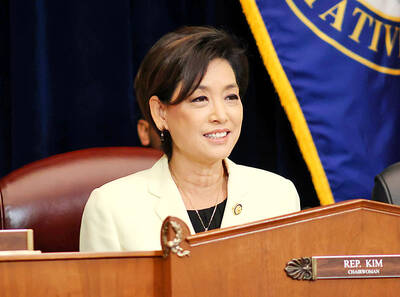
‘CLEAR MESSAGE’: The bill would set up an interagency ‘tiger team’ to review sanctions tools and other economic options to help deter any Chinese aggression toward Taiwan US Representative Young Kim has introduced a bill to deter Chinese aggression against Taiwan, calling for an interagency “tiger team” to preplan coordinated sanctions and economic measures in response to possible Chinese military or political action against Taiwan. “[Chinese President] Xi Jinping [習近平] has directed the People’s Liberation Army to be ready to invade Taiwan by 2027. China has a plan. America should have one too,” Kim said in a news release on Thursday last week. She introduced the “Deter PRC [People’s Republic of China] aggression against Taiwan act” to “ensure the US has a coordinated sanctions strategy ready should


 RSS
RSS