


The top UN court is to take up the largest case in its history today when it opens two weeks of hearings into what countries worldwide are legally required to do to combat climate change and help vulnerable nations fight its devastating impact.
After years of lobbying by island nations who fear they could simply disappear under rising sea waters, the UN General Assembly asked the International Court of Justice last year for an opinion on “the obligations of States in respect of climate change.”
“We want the court to confirm that the conduct that has wrecked the climate is unlawful,” said Margaretha Wewerinke-Singh, who is leading the legal team for the Pacific island nation of Vanuatu.
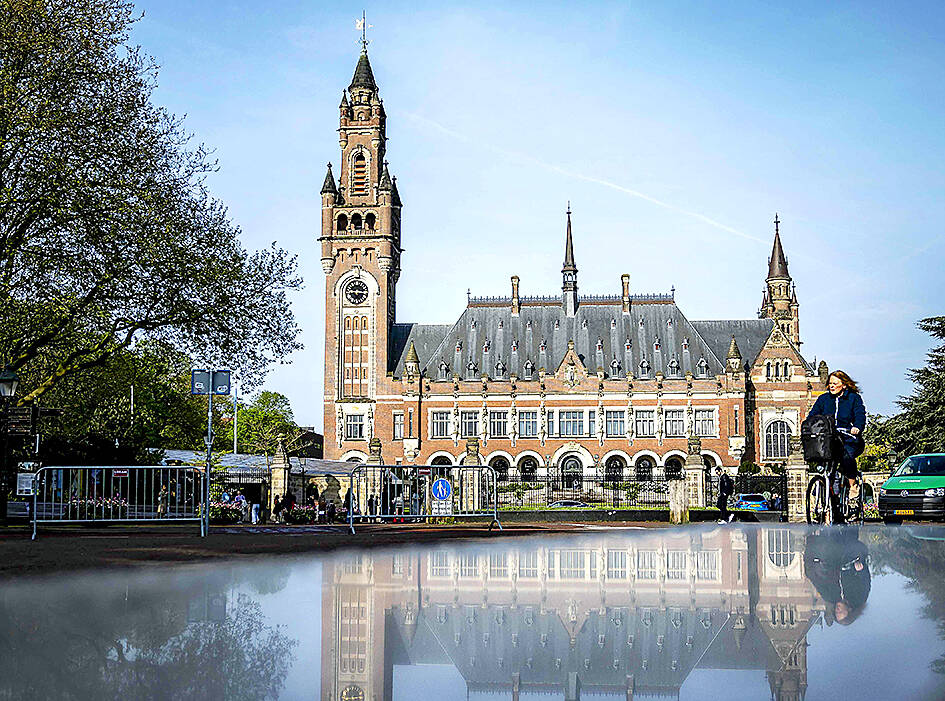
Photo: AFP
In the decade up to last year, sea levels have risen by a global average of about 4.3cm, with parts of the Pacific Ocean rising higher still. The world has also warmed 1.3°C since pre-industrial times because of the burning of fossil fuels.
Vanuatu is one of a group of small states pushing for international legal intervention in the climate crisis.
“We live on the front lines of climate change impact. We are witnesses to the destruction of our lands, our livelihoods, our culture and our human rights,” Vanuatu’s climate change envoy Ralph Regenvanu told reporters ahead of the hearing.
Any decision by the court would be non-binding advice and unable to directly force wealthy nations into action to help struggling countries. Yet it would be more than just a powerful symbol since it could serve as the basis for other legal actions, including domestic lawsuits.
From today, The Hague-based court would hear from 99 countries and more than a dozen intergovernmental organizations over two weeks. It is the largest lineup in the institution’s nearly 80-year history.
Last month at the UN’s annual climate meeting, countries cobbled together an agreement on how rich countries can support poor countries in the face of climate disasters. Wealthy countries have agreed to pool together at least US$300 billion a year by 2035, but the total is short of the US$1.3 trillion that experts and threatened nations said is needed.
Fifteen judges from around the world would seek to answer two questions: What are countries obliged to do under international law to protect the climate and environment from human-caused greenhouse gas emissions? And what are the legal consequences for governments where their acts, or lack of action, have significantly harmed the climate and environment?
The second question makes particular reference to “small island developing States” likely to be hardest hit by climate change.

‘NO SECURITY RISK’: The Railway Bureau reassured the public that the technicians’ activities were limited to technical guidance and did not involve sensitive systems The Railway Bureau yesterday said it had invited eight Chinese technicians to assist with an airport MRT construction project. The bureau issued the confirmation after an Internet user said Chinese nationals had entered the construction zone of Taiwan Taoyuan International Airport’s Terminal 3 project. They asked why “individuals from an enemy state” were allowed access to such a major national infrastructure project, which raised serious concerns over Taiwan’s industrial safety, sensitive systems and information security. The bureau’s Northern Region Engineering Branch Office said subcontractor Taiwan Handle Industrial Co (台灣手把工業) of the Taoyuan airport MRT’s “Contract No. CU05 Project A14 Station Civil, MEP &

The National Chungshan Institute of Science and Technology yesterday showcased its locally developed variants of the Vision 60 robotic patrol dog, which it plans to deploy on the nation’s outlying territories in the South China Sea. The variants were produced under the Joint Lab project — created by the institute and domestic companies — and assembled with domestically produced motors, lenses and artificial intelligence (AI) systems alongside licensed tech from the US, Missile and Rocket Systems Research Division deputy director Jen Kuo-kang (任國光) told the media event at a military base in Taipei’s Dazhi (大直) area. Taiwan has built up its strengths

NOT IMMEDIATE: Taiwan has a chance to appeal the proposed 10 percent tariff before it starts, while other countries face a 12.5 percent tariff from the trade office Taiwan is among 60 economies determined by the US to have failed to impose or enforce a ban on the importation of goods produced with forced labor, according to a notice released on Tuesday by the Office of the US Trade Representative (USTR), which proposed imposing an additional 10 percent or more tariff on them. The USTR in a statement said that following an investigation, it had determined under Section 301 of the Trade Act of 1974 that the failure of the 60 economies to impose and effectively enforce a prohibition on the importation of goods produced with forced labor is

TIT-FOR-TAT: The US allegedly revoked the visa of a Chinese national working at Xinhua News Agency in the US in response to Beijing’s expulsion of Vivian Wang The Presidential Office yesterday condemned China for expelling a New York Times correspondent from Beijing following the newspaper’s interview with President William Lai (賴清德), saying the move highlighted Beijing’s suppression of press freedom and its threat to international news media. Taiwan has noted a series of recent incidents in which Beijing used similar tactics to “threaten and pressure international media outlets and journalists,” Presidential Office spokeswoman Karen Kuo (郭雅慧) said in a statement. “This concerns not only press freedom and freedom of expression, but also the safety of journalists, and Taiwan and relevant partners are paying close attention to the situation,” she


 RSS
RSS