


G20 leaders gathered in Brazil yesterday to discuss fighting poverty, boosting climate financing and other multilateral initiatives that could yet be upended by US president-elect Donald Trump’s impending return to the White House.
US President Joe Biden is to attend his last summit of the world’s leading economies, but as a lame duck whom other leaders are already looking beyond.
The main star of the show is expected to be Chinese President Xi Jinping (習近平), who has cast himself as a global statesman and protector of free trade in the face of Trump’s “America first” agenda.
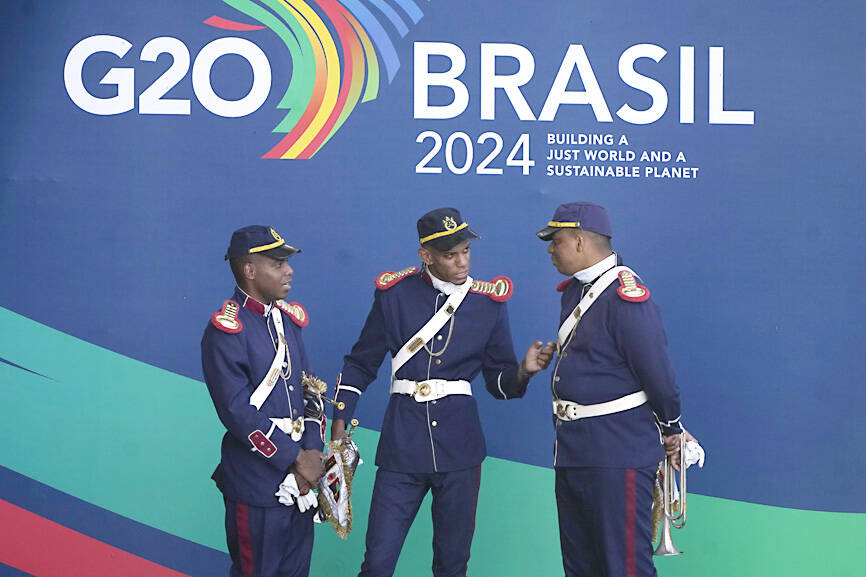
Photo: AP
Brazilian President Luiz Inacio Lula da Silva would be using his hosting duties to highlight his championing of Global South issues and the fight against climate change.
The summit venue is Rio de Janeiro’s stunning bayside museum of modern art.
Security is tight for the gathering, which comes days after a failed bomb attack on Brazil’s Supreme Court in Brasilia by a suspected far-right extremist, who killed himself in the process.
The summit would cap a farewell diplomatic tour by Biden which took him to Lima for a meeting of Asia-Pacific trading partners, and then to the Amazon in the first such visit for a sitting US president.
Biden, who has looked to burnish his legacy as time runs down on his presidency, has insisted his climate record would survive another Trump mandate.
The G20 meeting is happening at the same time as the COP29 climate conference in Azerbaijan, which has stalled on the issue of greater climate finance for developing countries.
All eyes have turned to Rio for a breakthrough.
UN Secretary-General Antonio Guterres has called for G20 members, who account for 80 percent of global emissions, to show “leadership and compromise” to facilitate a deal.
A Brazilian diplomatic source said fast-developing nations like China were refusing pressure by rich countries to join them in funding global climate projects, but added that he was hopeful of progress at the summit.

The National Chungshan Institute of Science and Technology yesterday showcased its locally developed variants of the Vision 60 robotic patrol dog, which it plans to deploy on the nation’s outlying territories in the South China Sea. The variants were produced under the Joint Lab project — created by the institute and domestic companies — and assembled with domestically produced motors, lenses and artificial intelligence (AI) systems alongside licensed tech from the US, Missile and Rocket Systems Research Division deputy director Jen Kuo-kang (任國光) told the media event at a military base in Taipei’s Dazhi (大直) area. Taiwan has built up its strengths

RIGHT DIRECTION: Taiwan’s efforts to prevent forced labor include a proposal to ‘fully prohibit’ employers from withholding workers’ documents, an official said Taiwan is to establish a mechanism to restrict imports of goods linked to forced labor, the Executive Yuan said yesterday, after the US proposed imposing additional tariffs on Taiwanese goods over labor concerns. “The Ministry of Labor and the Ministry of Economic Affairs are to establish an interministerial review procedure,” Executive Yuan spokesperson Michelle Lee (李慧芝) said at a news briefing in Taipei. “The government is to use the Foreign Trade Act [貿易法] as the legal basis to restrict imports of goods produced with forced labor” and bring its supply chain governance more in line with international standards on human rights, resilience

NOT IMMEDIATE: Taiwan has a chance to appeal the proposed 10 percent tariff before it starts, while other countries face a 12.5 percent tariff from the trade office Taiwan is among 60 economies determined by the US to have failed to impose or enforce a ban on the importation of goods produced with forced labor, according to a notice released on Tuesday by the Office of the US Trade Representative (USTR), which proposed imposing an additional 10 percent or more tariff on them. The USTR in a statement said that following an investigation, it had determined under Section 301 of the Trade Act of 1974 that the failure of the 60 economies to impose and effectively enforce a prohibition on the importation of goods produced with forced labor is

TIT-FOR-TAT: The US allegedly revoked the visa of a Chinese national working at Xinhua News Agency in the US in response to Beijing’s expulsion of Vivian Wang The Presidential Office yesterday condemned China for expelling a New York Times correspondent from Beijing following the newspaper’s interview with President William Lai (賴清德), saying the move highlighted Beijing’s suppression of press freedom and its threat to international news media. Taiwan has noted a series of recent incidents in which Beijing used similar tactics to “threaten and pressure international media outlets and journalists,” Presidential Office spokeswoman Karen Kuo (郭雅慧) said in a statement. “This concerns not only press freedom and freedom of expression, but also the safety of journalists, and Taiwan and relevant partners are paying close attention to the situation,” she


 RSS
RSS