


Japanese lawmakers yesterday voted for Prime Minister Shigeru Ishiba to stay on as leader, after his scandal-tarnished coalition lost its parliamentary majority in a lower house election last month.
Ishiba, who called the snap poll after taking office on Oct. 1, must now run a fragile minority government as protectionist Donald Trump returns to office in main ally the US, tension rises with rivals China and North Korea, and domestic pressure mounts to rein in the cost of living.
His Liberal Democratic Party (LDP) and coalition partner Komeito won the biggest bloc of seats in the election, but lost the majority held since 2012, leaving him beholden to small opposition parties to pass his policy agenda.
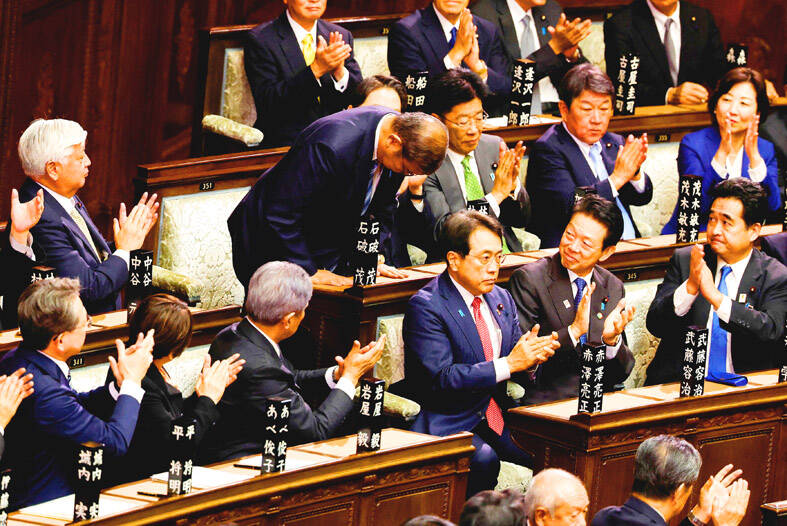
Photo: Reuters
Underlining that fragility, yesterday’s vote in parliament, broadcast on television, went to a runoff for the first time in 30 years, with no candidate able to muster majority support in the first round.
However, Ishiba eventually prevailed as expected, garnering 221 votes, well clear of his nearest challenger, former prime minister Yoshihiko Noda, the head of the main opposition Constitutional Democratic Party, but still short of a majority in the 465-seat lower house.
Japan is to hold elections next year for the less powerful upper house, where the ruling coalition’s slim majority could also be at risk if Ishiba cannot revive public trust roiled by a scandal over unrecorded donations to lawmakers.
His imminent challenge is compiling a supplementary budget for the fiscal year through March, under pressure from voters and opposition parties to raise spending on welfare and take steps to offset rising prices.
For approval he needs the backing of at least one opposition party, which is most likely to be the Democratic Party for the People (DPP) headed by Yuichiro Tamaki.
Tamaki has held co-operation talks with Ishiba, but DPP lawmakers on Friday did not vote for Ishiba to stay on as prime minister.
Tamaki is also in a precarious position after yesterday admitting to an extramarital affair revealed in a tabloid magazine.
With his prime ministership confirmed Ishiba appointed three new Cabinet ministers, one each for transport, justice and agriculture, two of whom replace LDP lawmakers who lost their seats in the lower house election.
Ishiba now has to prepare for a slate of international engagements, including a summit of the G20 big economies in Brazil on Monday and Tuesday next week.
He is also trying to arrange a stopover in the US on the way to or from that gathering to meet Trump. The Japanese leader spoke to the president-elect for the first time on Thursday in a “friendly” five-minute conversation during which he congratulated him on his election victory.
Some Japanese officials nonetheless fear Trump might again hit Tokyo with protectionist trade measures and revive demands for it to pay more for the cost of stationing US forces there.
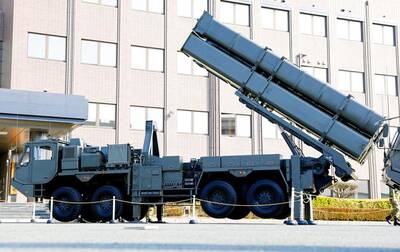
Japan has deployed long-range missiles in a southwestern region near China, the Japanese defense minister said yesterday, at a time when ties with Beijing are at their lowest in recent years. The missiles were installed in Kumamoto in the southern region of Kyushu, as Japan is attempting to shore up its military capacity as China steps up naval activity in the East China Sea. “Standoff defense capabilities enable us to counter the threat of enemy forces attempting to invade our country ... while ensuring the safety of our personnel,” Japanese Minister of Defense Shinjiro Koizumi said. “This is an extremely important initiative for
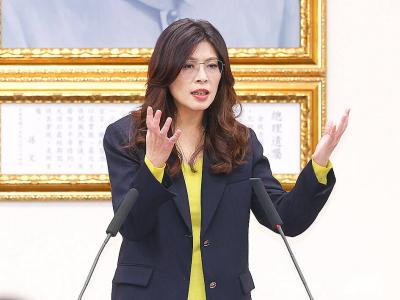
Chinese Nationalist Party (KMT) Chairwoman Cheng Li-wun (鄭麗文) today accepted an invitation from Chinese President Xi Jinping (習近平) to lead a delegation to China next month, saying she hopes to promote the peaceful development of cross-strait relations and bring stability to the Taiwan Strait. “I am grateful and happy to accept this invitation,” Cheng said in a statement from the KMT chairperson’s office. Cheng said she hopes both sides can work together to promote the peaceful development of cross-strait relations, enhance exchange and cooperation, bring stability to the Taiwan Strait and improve people’s livelihoods. At today's news conference, Cheng said any efforts to
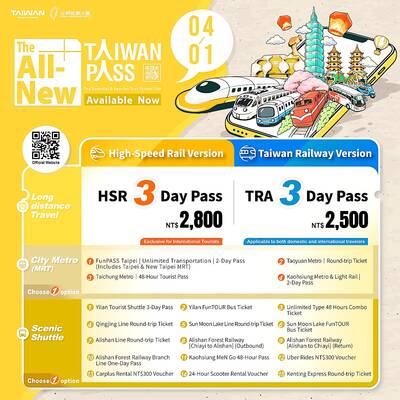
MORE POPULAR: Taiwan Pass sales increased by 59 percent during the first quarter compared with the same period last year, the Tourism Administration said The Tourism Administration yesterday said that it has streamlined the Taiwan Pass, with two versions available for purchase beginning today. The tourism agency has made the pass available to international tourists since 2024, allowing them to access the high-speed rail, Taiwan Railway Corp services, four MRT systems and four Taiwan Tourist Shuttles. Previously, five types of Taiwan Pass were available, but some tourists have said that the offerings were too complicated. The agency said only two types of Taiwan Pass would be available, starting from a three-day pass with the high-speed rail and a three-day pass with Taiwan Railway Corp. The former costs NT$2,800

The nation’s fastest supercomputer, Nano 4 (晶創26), is scheduled to be launched in the third quarter, and would be used to train large language models in finance and national defense sectors, the National Center for High-Performance Computing (NCHC) said. The supercomputer, which would operate at about 86.05 petaflops, is being tested at a new cloud computing center in the Southern Taiwan Science Park in Tainan. The exterior of the server cabinet features chip circuitry patterns overlaid with a map of Taiwan, highlighting the nation’s central position in the semiconductor industry. The center also houses Taiwania 2, Taiwania 3, Forerunner 1 and


 RSS
RSS