

The Ministry of Justice is to propose amendments to the Criminal Code that would increase fines for illegal abortions to NT$80,000 (US$2,498) from NT$3,000, saying the current penalties are “anachronistic.”
The ministry would propose the bill in 14 days to amend Articles 288 and 290, and revoke Article 292 of the Criminal Code, it said in a statement on Tuesday.
According to the draft, the fine for pregnant women who abort a fetus would be increased to NT$80,000 from NT$3,000, while the fine for carrying out an abortion for purposes of gain would be raised to NT$500,000 from NT$15,000.
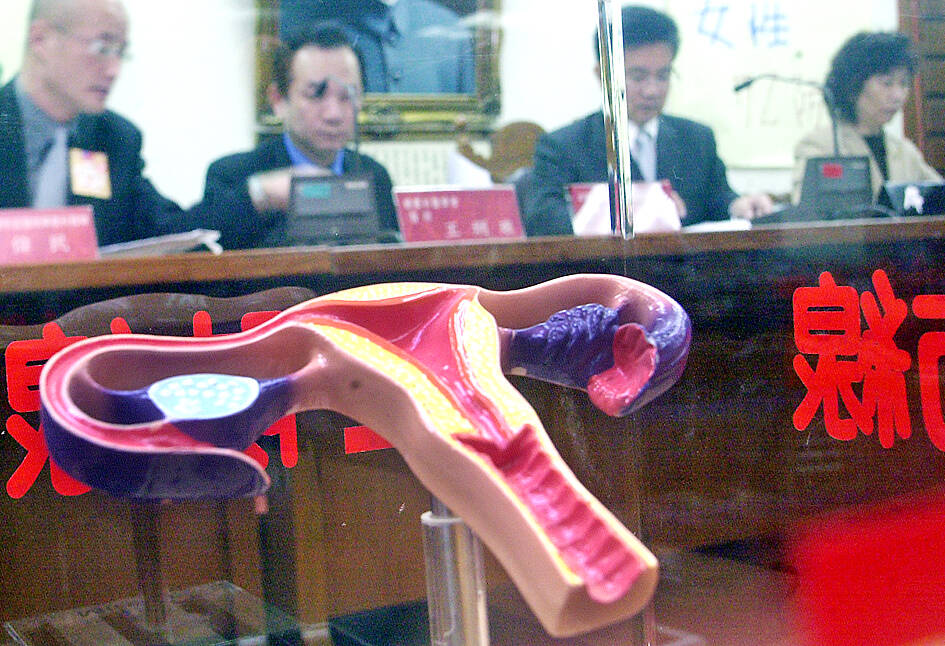
Photo: Chen Tse-ming, Taipei Times
Those who at the request or with the consent of a pregnant woman cause an abortion for purposes of gain would be fined NT$2 million, up from NT$15,000, if their commission of the offense results in her death, or NT$1 million, up from NT$15,000, if aggravated injury results, it says.
Not all abortions are a crime, as pregnant women could still have an abortion pursuant to the Genetic Health Act (優生保健法) if her bodily autonomy and the fetus’ right to life are respected, the ministry said.
However, abortions should be limited, as a fetus is “a living being growing into a person,” whose right to life should not be deprived or infringed, it said, citing similar laws in Germany and Japan.
Other regulations were established to allow women to get an abortion under circumstances in line with the Convention on the Elimination of All Forms of Discrimination against Women, it added.
As illegal abortions could be committed in many ways, the constituent element stating that an abortion is conducted “by taking drugs or by other means” would be deleted, the ministry said.
The fines have become “anachronistic” and would be increased to align with the penalty brackets of the Criminal Code, it added.
The punishment for pregnant women who cause her abortion or permit others to cause her abortion in situations necessitated by illness or life-threatening conditions — other than those specified in the Genetic Health Act — would be revised from “remitted” to “not punishable,” it said.
Article 292, which stipulates penalties and punishments for advertising abortion, would be deleted, following the example of Germany.
The Medical Care Act (醫療法) has set out regulations on advertisements for medical care, it said.

The Hualien District Prosecutors’ Office yesterday launched an investigation following allegations by a former foreign correspondent in Taiwan of widespread vote-buying in Hualien County. In an interview with Formosa TV (FTV, 民視) aired on Saturday, former Financial Times Taiwan correspondent Kathrin Hille spoke about Taiwan’s democracy and said that she now lives in rural Hualien, where “all the votes are bought.” Neighbors would talk about who had come by and leave cash on the table showing “how much each vote was worth that year,” Hille said. The practice needs to be addressed, considering Taiwan has been a democracy for many

INCREASING IMBALANCE: The percentage of working-age people is expected to shrink to 42.3% of the population, while older people would comprise 52.9%, the agency said Taiwan’s population is projected to shrink by almost half over the next five decades, intensifying labor shortages and placing a growing drag on economic growth as the technology-intensive economy confronts a rapidly aging workforce. The population is expected to fall to 12.15 million by 2075, a 48 percent decline from this year, National Development Council projections released yesterday showed. The decline would fundamentally alter Taiwan’s workforce. From 2037, more than half of the working-age population is projected to be aged between 45 and 64, signaling the end of an era when the economy could rely on a relatively large labor force. The shift

SAFETY RISKS: A Taiwanese man who was traveling to Shanghai for business was allegedly questioned for six hours due to his past work for Amnesty International The Mainland Affairs Council (MAC) urged Taiwanese to exercise caution when considering trips to China after a Taiwanese man was allegedly questioned for six hours in Shanghai over past work with Amnesty International. The council on Saturday said in a report that 426 Taiwanese have gone missing or been detained or had their freedom of movement restricted in China since Jan. 1, 2024. The figure is up by seven from the previous week. New Chinese entry and exit regulations are due to take effect on Sept. 15, the council said. Of the 426 cases, 160 people have gone missing, up

DEFENSE PROCUREMENT: The Pentagon has told a US congressional hearing that Taiwan has ‘top priority worldwide’ in the delivery of Harpoon missile systems The US Navy and Boeing Co have conducted a series of tests for land-based Harpoon anti-ship missile system being supplied to Taiwan and released footage showing the system striking a target vessel at sea. The weapons system and support equipment tested were reportedly tailored for Taiwan, while the first launch vehicles and other components have already begun arriving in Taiwan, with the full delivery of 100 systems scheduled to be completed by the end of 2028. Pentagon officials have previously told a US congressional hearing that Taiwan has “top priority worldwide” in the delivery of Harpoon missile systems, with production


 RSS
RSS