

The government is considering the possibility of participating in the Philippines’ Luzon Economic Corridor (LEC) project aimed at driving infrastructure development in the region, the Ministry of Foreign Affairs said.
In a written report sent to lawmakers, the ministry said it is considering working with other nations to participate in the LEC project launched by the US, Japan and the Philippines.
The project, part of the G7’s Partnership for Global Infrastructure and Investment, seeks to accelerate coordinated investment in infrastructure projects, including rail and port modernization, clean energy, semiconductors and agribusiness.
Photo: Taipei Times
The LEC is part of the bloc’s efforts to counter China’s Belt and Road Initiative, and Taiwan, a close democratic ally of the US and Japan, has an interest in joining the effort, a diplomatic source said.
Taiwan is thinking about building demonstration farms in the LEC that use smart agricultural technology to promote closer cooperation and boost agricultural production efficiency, the ministry said.
Minister of Foreign Affairs Lin Chia-lung (林佳龍) on the sidelines of a legislative session on Monday said that the Philippines, Taiwan’s neighbor in the first island chain, is facing similar security challenges as Taiwan, and the two economies are also complementary.
“Taiwan could play a pivotal role in the LEC, and it has started close negotiations with the US and other friendly allies” about potentially joining the project, Lin said.
A fact-finding group consisting of people from the public and private sectors have recently concluded a visit to the Philippines, he said.
He did not identify members of the group, but local media reported that a delegation led by National Development Council Minister Paul Liu (劉鏡清) concluded a three-day visit to the Philippines on Friday last week.
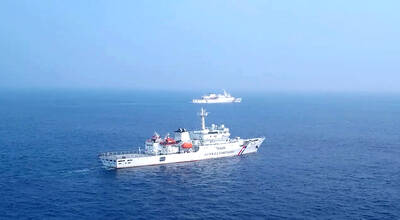
PATROL PARTNERS: The ‘Chiayi’ and the ‘Penghu’ departed for a two-day joint patrol of Palau’s exclusive economic zone, the CGA’s second diplomatic visit to the country The Coast Guard Administration (CGA) set a record for its southernmost deployment of a coast guard vessel as the vessels Chiayi and the Penghu reached Palau’s Pulo Anna Island on Saturday in a cooperative exercise between the two countries. The island, about 217 nautical miles (401km) southwest of Koror in the Palauan state of Sonsorol and 1,220 nautical miles from Taiwan’s southernmost point, Oluanpi (鵝鑾鼻), is the furthest south a CGA vessel has sailed. The two vessels are in Palau for the coast guard’s second diplomatic visit to the country. They docked at Malakal Harbor on Tuesday last week. The coast guard
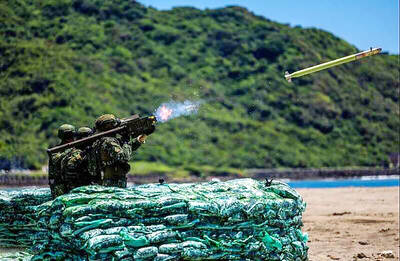
BATCH 1: The military has plans to assign the weapons to the army to defend Taiwan proper, as well as outlying islands and the navy for the Marine Corps, the official said Taiwan is to receive 500 Stinger missiles and 178 launchers from the US by the end of the year, the first batch under a planned two-stage acquisition totaling 2,621 missiles and 763 launchers, a defense official said yesterday on condition of anonymity. The portable missiles would play a vital role in the nation’s air defense capabilities, the source said. The army plans to deploy 2,235 missiles and 657 launchers to defend Taiwan proper and outlying islands, they said, citing military documents. The navy is allotted 295 missiles and 85 launchers to arm the Marine Corps and some surface vessels that lack air defense

The European Parliament on Wednesday adopted a recommendation on EU-China political relations that rejected China’s efforts to restrict Taiwan’s participation in international organizations and exchanges. The recommendation, addressed to the European Council, the European Commission and EU High Representative for Foreign Affairs and Security Policy Kaja Kallas, includes several references to EU-Taiwan relations and expresses support for closer ties, saying they would bring positive benefits and have strategic importance. Describing Taiwan as a valuable partner in trade and technology, the European Parliament said it “rejects China’s attempts to coerce international organizations, third countries and other actors into restricting Taiwan’s international participation and
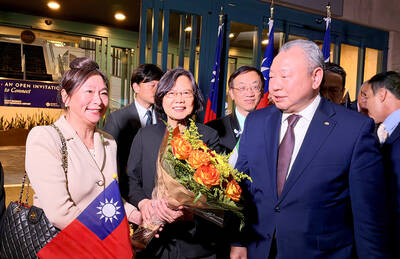
Former president Tsai Ing-wen (蔡英文) on Monday arrived in San Francisco, receiving a warm welcome from hundreds of overseas Taiwanese as she launched a week-long visit. Accompanied by Representative to the US Alexander Yui (俞大?), and head of Taiwan’s San Francisco office Wu Chih-hsiang (伍志翔), Tsai arrived at her hotel, waving, smiling and giving high-fives to Taiwanese compatriots amid cheers of “Taiwan’s democracy involves you and me” to welcome her to the San Francisco Bay Area. It is Tsai’s first visit to the US since she left office in May 2024 after serving two four-year terms as president. Tsai is today to deliver


 RSS
RSS