


Former Indonesian general Prabowo Subianto yesterday took over as president of the world’s third-largest democracy, vowing to combat internal issues such as corruption that plague the country and to make it more self-sufficient.
The 73-year-old has undergone a remarkable transformation, from being a former military commander facing unproven allegations of rights abuses to sweeping the polls and leading the country of 280 million people.
“We will lead the Indonesian government ... by prioritizing the interests of all Indonesian people, including those who did not vote for us,” he said as he was sworn in as the country’s eighth president, pledging to tackle corruption and protect democracy.
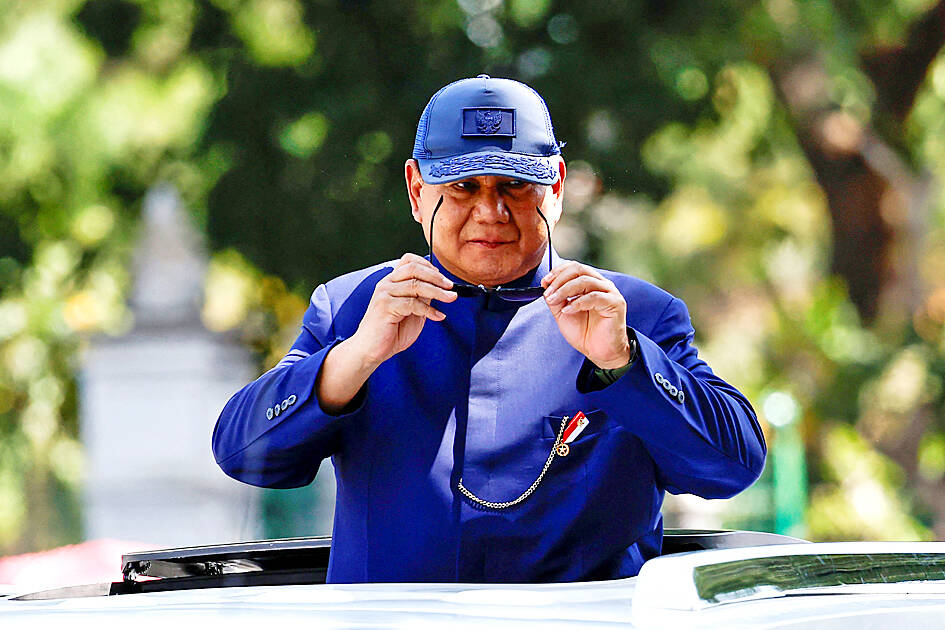
Photo: Reuters
“We must always realize that a free nation is where the people are free,” he said, at times raising his voice.
In a wide-ranging speech lasting about an hour, Prabowo said that self-sufficiency for food was possible within five years, while also pledging to become self-sufficient in energy.
He also vowed to eradicate corruption and said that while he wanted to live in a democracy, it must be “polite.”
“A difference of opinion must come without enmity ... fighting without hating,” he said.
Prabowo won the Feb. 14 contest with nearly 60 percent of the vote and has spent the past nine months building a formidable parliamentary coalition.
He was joined in the swearing-in ceremony by his running mate, Gibran Rakabuming Raka, 37, the eldest son of outgoing Indonesian president Joko “Jokowi” Widodo.
Prabowo made China his first foreign visit after his election, before embarking on trips to a dozen other countries including Russia and Australia, where he signed a key security deal.
He spoke of sticking to Indonesia’s neutral foreign policy, but said that territorial defense would be a priority.
“We want to be the good neighbor,” he said. “We don’t want to disturb other countries, but we will not let any countries disturb us.”
After his speech, Prabowo wore a baseball cap and waved through a car sunroof as he made his way to the presidential palace, passing thousands of flag-waving supporters thronging Jakarta’s streets.
Flower boards outside the palace either congratulated Prabowo and Gibran or thanked Jokowi for his decade of service.
Jokowi supporters are also attending the celebrations to bid farewell to Indonesia’s outgoing leader.
Anneta Yuniar, a bystander who had excitedly waved at Jokowi’s motorcade as it slowly made its way past supporters before the ceremony, said she would miss Jokowi, but that Prabowo was a strong leader.
“Prabowo will continue the development that Jokowi started. There’s continuity. It’s what I want,” she said.


RESILIENCE: Taiwan plays a key role in semiconductors, energy, information infrastructure and advanced manufacturing, AIT Director Raymond Greene said Taiwan’s continued investment in deterrence and resilience remains vital, especially in uncrewed systems and other emerging technologies, American Institute in Taiwan (AIT) Director Raymond Greene said yesterday. Greene made the remarks at the annual National Strategic Summit on Supply Chain Resilience held by the Research Institute for Democracy, Society and Emerging Technology (DSET), a government-backed think tank. As Taiwan last year became the US’ fourth-largest trading partner and supply chain security is becoming more important, cooperation in emerging technologies continues to deepen between the two countries, he said. The US is committed to accelerating innovation, building key infrastructure, strengthening cooperation

The National Chungshan Institute of Science and Technology yesterday showcased its locally developed variants of the Vision 60 robotic patrol dog, which it plans to deploy on the nation’s outlying territories in the South China Sea. The variants were produced under the Joint Lab project — created by the institute and domestic companies — and assembled with domestically produced motors, lenses and artificial intelligence (AI) systems alongside licensed tech from the US, Missile and Rocket Systems Research Division deputy director Jen Kuo-kang (任國光) told the media event at a military base in Taipei’s Dazhi (大直) area. Taiwan has built up its strengths

RIGHT DIRECTION: Taiwan’s efforts to prevent forced labor include a proposal to ‘fully prohibit’ employers from withholding workers’ documents, an official said Taiwan is to establish a mechanism to restrict imports of goods linked to forced labor, the Executive Yuan said yesterday, after the US proposed imposing additional tariffs on Taiwanese goods over labor concerns. “The Ministry of Labor and the Ministry of Economic Affairs are to establish an interministerial review procedure,” Executive Yuan spokesperson Michelle Lee (李慧芝) said at a news briefing in Taipei. “The government is to use the Foreign Trade Act [貿易法] as the legal basis to restrict imports of goods produced with forced labor” and bring its supply chain governance more in line with international standards on human rights, resilience

NOT IMMEDIATE: Taiwan has a chance to appeal the proposed 10 percent tariff before it starts, while other countries face a 12.5 percent tariff from the trade office Taiwan is among 60 economies determined by the US to have failed to impose or enforce a ban on the importation of goods produced with forced labor, according to a notice released on Tuesday by the Office of the US Trade Representative (USTR), which proposed imposing an additional 10 percent or more tariff on them. The USTR in a statement said that following an investigation, it had determined under Section 301 of the Trade Act of 1974 that the failure of the 60 economies to impose and effectively enforce a prohibition on the importation of goods produced with forced labor is


 RSS
RSS