


A research team led by National Tsing Hua University Department of Physics and Center for Quantum Science and Technology professor Chuu Chih-sung (褚志崧) has developed Taiwan’s first and the world’s smallest quantum computer, using a single photon, the university said yesterday.
Chuu said in the study, which was published in the journal Physical Review Applied last month, that they had resolved the main obstacles for quantum computing development — high energy costs and a low-temperature operating environment.
Chuu said that photons are the smallest possible particle of electromagnetic energy, and his team had devised a way to encode information in 32time bins, or dimensions, of a single photon.
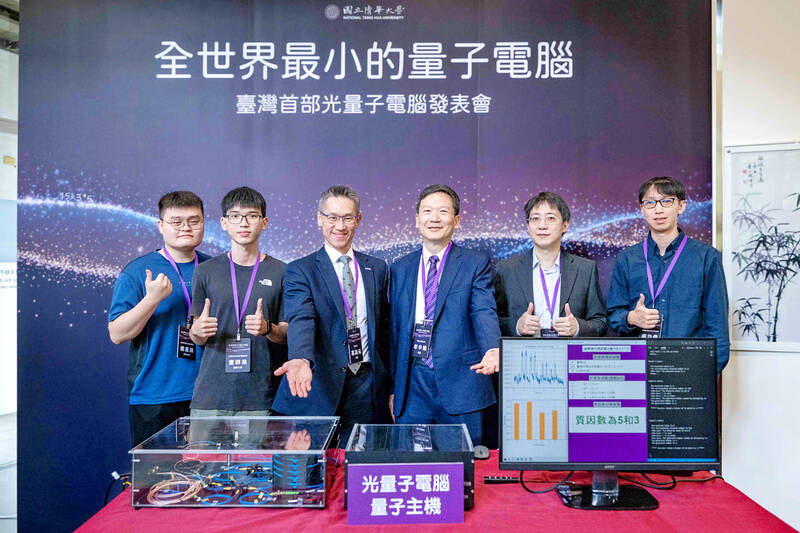
Photo: Hung Mei-hsiu, Taipei Times
Photons can be kept at a stable quantum state even at room temperature, he said.
Quantum computing is normally prone to information loss and calculation errors from vibrations or magnetic fields, he said.
However, photons have a more extended range of transmission, and they are less prone to interference, which contributes to a unique advantage when developing a commercialized quantum computer, he added.
Traditional computers enact computation on circuit boards, while quantum computing relays information through photonics and enacts computation using quantum physics.
The smallest unit of digital information in a traditional computer is the binary digit, or bit, which can only represent 0 or 1, Chuu said.
However, the quantum bit, or qubit, can be processed as both 0 and 1, a characteristic referred to as quantum superposition, he added.
Superposition enables quantum computing to process complex computations, such as prime factorizations or big data searches, up to 100 million times faster than traditional computers.
University president John Kao (高為元) said the paper’s publication in Physical Review Applied was an excellent milestone for quantum computing, as the device could operate at room temperature and was compact.
Kao said he remembered touring the US’ most advanced quantum computer lab last year.
He was struck by the enormity of the cooling system, which took up a whole room and kept temperatures at extremely low levels, Kao said.
Separately, the National Science and Technology Council has invited Alain Aspect, the 2022 Nobel Prize in Physics laureate, to attend this year’s Quantum Taiwan event, highlighting the nation’s focus on developing quantum technology.
The event would discuss quantum technology, superconducting quantum computers, quantum communications, quantum metrology, sensing and imaging.
National Science and Technology Council Minister Wu Cheng-wen (吳誠文) said quantum technology promises unforeseen computational abilities and could make communication safer.
The seminar is aimed at fostering international collaboration in creating a global platform to further develop quantum technology and ensure that Taiwan is an indispensable member of the global quantum technology development effort, Wu added.
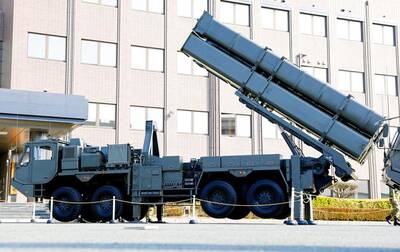
Japan has deployed long-range missiles in a southwestern region near China, the Japanese defense minister said yesterday, at a time when ties with Beijing are at their lowest in recent years. The missiles were installed in Kumamoto in the southern region of Kyushu, as Japan is attempting to shore up its military capacity as China steps up naval activity in the East China Sea. “Standoff defense capabilities enable us to counter the threat of enemy forces attempting to invade our country ... while ensuring the safety of our personnel,” Japanese Minister of Defense Shinjiro Koizumi said. “This is an extremely important initiative for
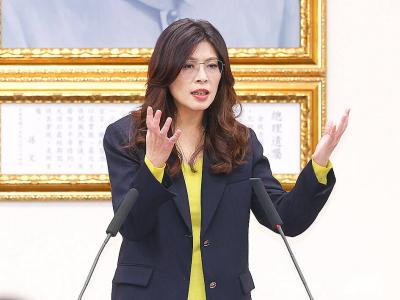
Chinese Nationalist Party (KMT) Chairwoman Cheng Li-wun (鄭麗文) today accepted an invitation from Chinese President Xi Jinping (習近平) to lead a delegation to China next month, saying she hopes to promote the peaceful development of cross-strait relations and bring stability to the Taiwan Strait. “I am grateful and happy to accept this invitation,” Cheng said in a statement from the KMT chairperson’s office. Cheng said she hopes both sides can work together to promote the peaceful development of cross-strait relations, enhance exchange and cooperation, bring stability to the Taiwan Strait and improve people’s livelihoods. At today's news conference, Cheng said any efforts to
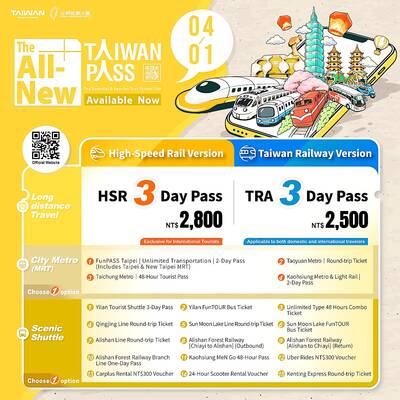
MORE POPULAR: Taiwan Pass sales increased by 59 percent during the first quarter compared with the same period last year, the Tourism Administration said The Tourism Administration yesterday said that it has streamlined the Taiwan Pass, with two versions available for purchase beginning today. The tourism agency has made the pass available to international tourists since 2024, allowing them to access the high-speed rail, Taiwan Railway Corp services, four MRT systems and four Taiwan Tourist Shuttles. Previously, five types of Taiwan Pass were available, but some tourists have said that the offerings were too complicated. The agency said only two types of Taiwan Pass would be available, starting from a three-day pass with the high-speed rail and a three-day pass with Taiwan Railway Corp. The former costs NT$2,800

The nation’s fastest supercomputer, Nano 4 (晶創26), is scheduled to be launched in the third quarter, and would be used to train large language models in finance and national defense sectors, the National Center for High-Performance Computing (NCHC) said. The supercomputer, which would operate at about 86.05 petaflops, is being tested at a new cloud computing center in the Southern Taiwan Science Park in Tainan. The exterior of the server cabinet features chip circuitry patterns overlaid with a map of Taiwan, highlighting the nation’s central position in the semiconductor industry. The center also houses Taiwania 2, Taiwania 3, Forerunner 1 and


 RSS
RSS