


The Philippines yesterday denounced China’s alleged assault of Vietnamese fishers in the South China Sea, where Manila and Beijing are also locked in violent confrontations that have led to fears of armed conflict.
Vietnam has accused “Chinese law enforcement forces” of beating the 10 fishers with iron bars and robbing them of thousands of dollars’ of fish and equipment on Sunday off the Paracel Islands (Xisha Islands, 西沙群島).
A Chinese Ministry of Foreign Affairs spokesperson acknowledged an incident took place there, but disputed the Vietnamese version of the events.
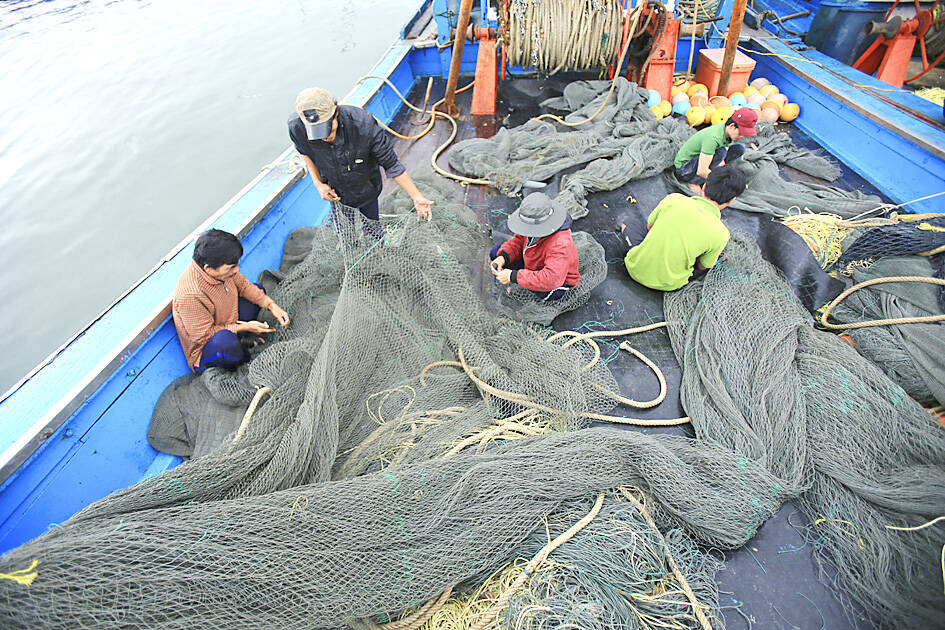
Photo: AP
China and Vietnam both claim the Paracel Islands, but the Philippines does not.
“We strongly condemn the violent and illegal actions of Chinese maritime authorities against Vietnamese fishermen near the Paracel Islands on September 29, 2024,” Philippine National Security Adviser Eduardo Ano said in a statement.
He described the “unjustified assault” as an “alarming act with no place in international relations.”
The Philippine Department of Foreign Affairs also issued a statement yesterday saying that it was aware of the “serious incident.”
“The Philippines has consistently denounced the use of force, aggression and intimidation in the South China Sea, and emphasized the need for actors to exercise genuine self-restraint,” it said. “It is a paramount obligation to ensure the safety at sea of vessels and their crew, especially fisherfolk.”
The incident came just over three months after Chinese law enforcement personnel armed with knives, sticks and an axe attacked Filipino troops attempting to resupply a garrison on Second Thomas Shoal (Renai Shoal, 仁愛暗沙) in the Spratly Islands (Nansha Islands, 南沙群島).
The Chinese seized guns and other equipment, and damaged Philippine boats, while a Filipino sailor lost a thumb in the June 17 melee.
China Coast Guard and other vessels have also rammed, water-cannoned and blocked Philippine government vessels on several occasions around Second Thomas Shoal and Sabina Shoal (Xianbin, 仙濱暗沙) in the Spratly Islands, as well as Scarborough Shoal (Huangyan Island, 黃岩島) in another area of the sea.
Beijing claims most of the South China Sea and has for years sought to expand its presence in contested areas there, brushing aside an international ruling that its claim to most of the waterway has no legal basis.

A signaling system malfunction disrupted high-speed rail (HSR) services beginning at 8am today, with trains temporarily reduced to three northbound and three southbound trains per hour as authorities conduct inspections. The malfunction occurred on a section of track in Miaoli County during pre-operation checks early this morning, forcing northbound and southbound trains to use a single track, the HSR operator said. The regular schedule has been replaced with three hourly trains offering only nonreserved seating in each direction, stopping at every station, it said, adding that business class cars would still have reserved seating. Departures from terminal stations are scheduled at the top

Taiwan is still in the process of assessing the possibility of recruiting workers from Eswatini, the Ministry of Foreign Affairs said yesterday, adding that its goal is to help Eswatini upgrade its vocational training centers. If there are plans to recruit workers from Eswatini, safeguarding national security, protecting public health and ensuring the employment rights of Taiwanese would be prerequisites, Department of West Asian and African Affairs Director-General Yen Chia-liang (顏嘉良) told a news conference. Key considerations would also include filling labor shortages in specific industries, and fostering bilateral professional and technical exchanges, he said. Yen was asked about the progress of labor

VERBOSE VESSELS: A CGA cutter and a China Coast Guard exchanged verbal barbs for more than a day in Taiwanese-controlled waters before the Chinese vessel left The Taiwanese and Chinese coast guards had a standoff near the strategically located Pratas Islands (Dongsha Islands, 東沙群島) in the north of the South China Sea, the Coast Guard Administration (CGA) said yesterday. The two sides engaged in intense radio exchanges over sovereignty claims during the 33-hour standoff. China Coast Guard vessel 3501 eventually left the restricted waters, 26.6 nautical miles (49.2km) west of the Pratas Islands, at 5pm yesterday, the CGA said. Lying approximately between southern Taiwan and Hong Kong, the Taiwan-controlled Pratas are seen by some security experts as vulnerable to Chinese attack due to their distance — more than

A US uncrewed surface vessel (USV) encountered multiple Chinese warships during an autonomous transit of the Taiwan Strait, US defense company Seasats said in a statement on Wednesday. Seasats announced that a Lightfish USV had completed the first autonomous transit of the Taiwan Strait. Over five days, the USV traversed the entire length of the Strait while constantly monitoring surface vessel traffic, the company said. The Lightfish encountered multiple Chinese warships, one of which was a Chinese People’s Liberation Army Navy (PLAN) Type 056 corvette, it said. The Chinese vessels were operating “well within Taiwan’s exclusive economic zone without transmitting their identity via the


 RSS
RSS