


Rescuers on Saturday struggled with washed-out bridges and debris-strewn roads in the search for survivors of devastating Hurricane Helene, which killed at least 63 people across five states and caused massive power outages.
Helene slammed into Florida on Thursday as a Category 4 hurricane and surged north, gradually weakening, but leaving in its wake toppled trees, downed power lines and mudslide-wrecked homes.
Federal emergencies were declared in six states — Alabama, Florida, Georgia, North Carolina, South Carolina and Tennessee — with more than 800 personnel from the US Federal Emergency Management Administration deployed.
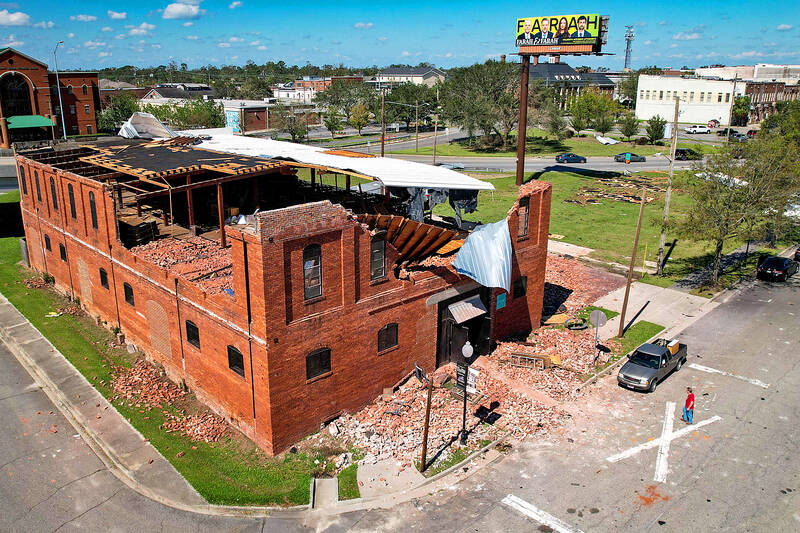
Photo: AFP
Now classified as a “post-tropical cyclone,” the remnants of the storm were expected to continue inundating the Ohio Valley and the central Appalachians through yesterday, the US National Hurricane Center said.
In affected communities across the eastern coast and the Midwest, storm victims and volunteers toting trash bags, mops and hammers tried to repair what they could and clean up the rest. At least 24 people died in South Carolina, 17 in Georgia, 11 in Florida, 10 in North Carolina and one in Virginia, according to local authorities and media tallied by AFP.
The US National Weather Service said conditions would “continue to improve today following the catastrophic flooding over the past two days.”
However, it warned of possible “long-duration power outages.”
“Main issue is the electrical power,” said another man from Valdosta who declined to give his name. “With the whole town down, the traffic lights are out. So driving around... people should just stay home.”
More than 2.6 million customers were still without electricity across 10 states from Florida in the southeast to Indiana in the Midwest as of yesterday morning, tracker poweroutage.us said.
Helene blew into Florida’s northern Gulf shore with powerful winds of 225kph. Even as it weakened into a post-tropical cyclone, it has wreaked havoc.
The North Atlantic hurricane season runs from the beginning of June to the end of November, with most of the severe storms historically forming about the end of last month or beginning of this month.
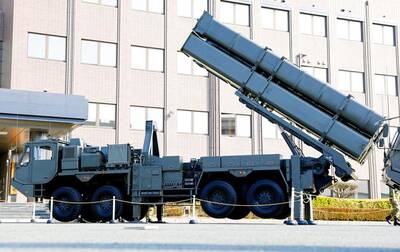
Japan has deployed long-range missiles in a southwestern region near China, the Japanese defense minister said yesterday, at a time when ties with Beijing are at their lowest in recent years. The missiles were installed in Kumamoto in the southern region of Kyushu, as Japan is attempting to shore up its military capacity as China steps up naval activity in the East China Sea. “Standoff defense capabilities enable us to counter the threat of enemy forces attempting to invade our country ... while ensuring the safety of our personnel,” Japanese Minister of Defense Shinjiro Koizumi said. “This is an extremely important initiative for

Chinese Nationalist Party (KMT) Chairwoman Cheng Li-wun (鄭麗文) today accepted an invitation from Chinese President Xi Jinping (習近平) to lead a delegation to China next month, saying she hopes to promote the peaceful development of cross-strait relations and bring stability to the Taiwan Strait. “I am grateful and happy to accept this invitation,” Cheng said in a statement from the KMT chairperson’s office. Cheng said she hopes both sides can work together to promote the peaceful development of cross-strait relations, enhance exchange and cooperation, bring stability to the Taiwan Strait and improve people’s livelihoods. At today's news conference, Cheng said any efforts to

MORE POPULAR: Taiwan Pass sales increased by 59 percent during the first quarter compared with the same period last year, the Tourism Administration said The Tourism Administration yesterday said that it has streamlined the Taiwan Pass, with two versions available for purchase beginning today. The tourism agency has made the pass available to international tourists since 2024, allowing them to access the high-speed rail, Taiwan Railway Corp services, four MRT systems and four Taiwan Tourist Shuttles. Previously, five types of Taiwan Pass were available, but some tourists have said that the offerings were too complicated. The agency said only two types of Taiwan Pass would be available, starting from a three-day pass with the high-speed rail and a three-day pass with Taiwan Railway Corp. The former costs NT$2,800

The nation’s fastest supercomputer, Nano 4 (晶創26), is scheduled to be launched in the third quarter, and would be used to train large language models in finance and national defense sectors, the National Center for High-Performance Computing (NCHC) said. The supercomputer, which would operate at about 86.05 petaflops, is being tested at a new cloud computing center in the Southern Taiwan Science Park in Tainan. The exterior of the server cabinet features chip circuitry patterns overlaid with a map of Taiwan, highlighting the nation’s central position in the semiconductor industry. The center also houses Taiwania 2, Taiwania 3, Forerunner 1 and


 RSS
RSS