


The Food and Drug Administration (FDA) on Tuesday last week issued a recall for 11 batches, 306 boxes in total, of two types of contact lenses by Alcon Inc, due to a quality issue that might cause eye irritation, red eyes or blurred vision.
The two types of contact lenses are Dailies Total1 One-Day Contact Lenses for Astigmatism, with the batch numbers N1276094, N1275909 and N1275914; and Dailies Total1 One-Day Contact Lenses Multifocal, with the batch numbers N1275753, N1276198, N1276224, N1276237, N1276203, N1277330, N1276304 and N1275728.
Alcon recently identified an isolated quality issue with a solvent supplied by a third-party vendor that was used in manufacturing specific lots of the contact lenses, the FDA said.
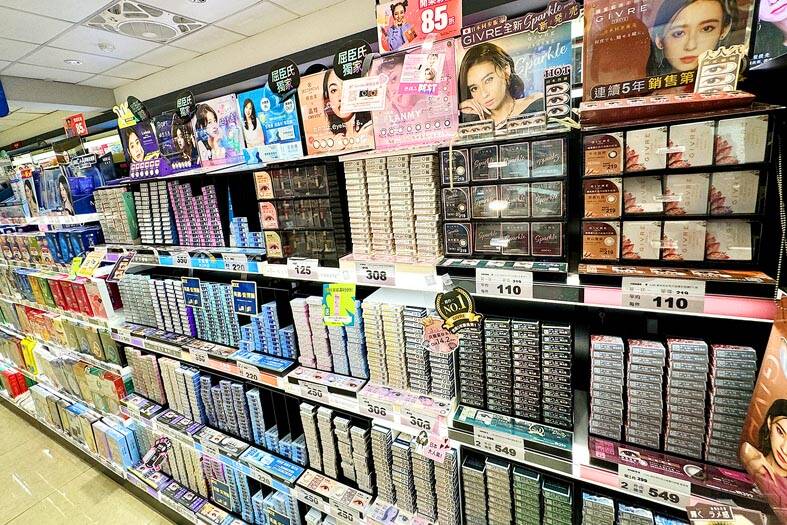
Photo: Chiu Chih-jo, Taipei Times
The identified lots might not meet Alcon’s performance standards for the entirety of their shelf life, so the company initiated a voluntary recall, it said.
The quality issue is not expected to cause a safety risk to people, but they might have temporary symptoms, such as eye irritation, red eyes or blurred vision, it said, adding that wearers should remove the lenses if such symptoms occur.
FDA Deputy Director-General Wang Der-yuan (王德原) yesterday said Taiwan is a major manufacturer of contact lenses, with annual sales exceeding US$500 million, marking the highest export value among medical devices made in the nation.
There are 34 registered local manufacturers and 51 importers of contact lenses, and the FDA has issued about 1,400 permits for such products, he said.
Wang said 1,163 of those products are made in Taiwan and more than 600 are circle lenses (also known as a big eye-contacts).
The government classifies contact lenses as medical devices, and according to the Medical Devices Act (醫療器材管理法), the entire manufacturing process, from material to packing, must comply with the quality management system standards, he said.
As medical devices, contact lenses cannot be sold online, he said.
The FDA advises consumers to carefully check the product information and medical device permit number on their package before purchasing them from a legal and credible supplier, he added.
Taipei Medical University Hospital ophthalmologist Lin I-hung (林宜鴻) yesterday said the most common types of soft contact lenses are made of hydrogel or silicone hydrogel materials, which are quite different.
Hydrogel lenses are cheaper, flexible and feel soft and comfortable on the eyes due to their higher water content, but as water gradually evaporates, they could get drier and feel less comfortable, he said.
Silicone hydrogel lenses have less water content, but higher oxygen permeability levels, so they could be a healthier option for the cornea if worn for longer periods, he said.
Hydrogel lenses could be a better option for people who have sensitive eyes or who wear them for shorter periods, such as when exercising, he said.
On the other hand, silicone hydrogel lenses could be better for office workers who look at computer screens for long hours, he said.
However, none of them should be worn for more than eight hours at a time, he said.

CREDIT-GRABBER: China said its coast guard rescued the crew of a fishing vessel that caught fire, who were actually rescued by a nearby Taiwanese boat and the CGA Maritime search and rescue operations do not have borders, and China should not use a shipwreck to infringe upon Taiwanese sovereignty, the Coast Guard Administration (CGA) said yesterday. The coast guard made the statement in response to the China Coast Guard (CCG) saying it saved a Taiwanese fishing boat. The Chuan Yu No. 6 (全漁6號), a fishing vessel registered in Keelung, on Thursday caught fire and sank in waters northeast of Diaoyutai Islands (釣魚台). The vessel left Keelung’s Badouzih Fishing Harbor (八斗子漁港) at 3:35pm on Sunday last week, with seven people on board — a 62-year-old Taiwanese captain surnamed Chang (張) and six

RISKY BUSINESS: The ‘incentives’ include initiatives that get suspended for no reason, creating uncertainty and resulting in considerable losses for Taiwanese, the MAC said China’s “incentives” failed to sway sentiment in Taiwan, as willingness to work in China hit a record low of 1.6 percent, a Ministry of Labor survey showed. The Directorate-General of Budget, Accounting and Statistics (DGBAS) also reported that the number of Taiwanese workers in China has nearly halved from a peak of 430,000 in 2012 to an estimated 231,000 in 2024. That marked a new low in the proportion of Taiwanese going abroad to work. The ministry’s annual survey on “Labor Life and Employment Status” includes questions respondents’ willingness to seek employment overseas. Willingness to work in China has steadily declined from

The Legislative Yuan’s Finance Committee yesterday approved proposed amendments to the Amusement Tax Act (娛樂稅法) that would abolish taxes on films, cultural activities and competitive sporting events, retaining the fee only for dance halls and golf courses. The proposed changes would set the maximum tax rate for dance halls and golf courses at 50 and 20 percent respectively, with local governments authorized to suspend the levies. Article 2 of the act says that “amusement tax shall be levied on tickets sold or fees charged by amusement places, facilities or activities” in six categories: “Cinema; professional singing, story-telling, dancing, circus, magic show, acrobatics

INFLATION UP? The IMF said CPI would increase to 1.5 percent this year, while the DGBAS projected it would rise to 1.68 percent, with GDP per capita of US$44,181 The IMF projected Taiwan’s real GDP would grow 5.2 percent this year, up from its 2.1 percent outlook in January, despite fears of global economic disruptions sparked by the US-Iran conflict. Taiwan’s consumer price index (CPI) is projected to increase to 1.5 percent, while unemployment would be 3.4 percent, roughly in line with estimates for Asia as a whole, the international body wrote in its Global Economic Outlook Report published in the US on Monday. The figures are comparatively better than the IMF outlook for the rest of the world, which pegged real GDP growth at 3.1 percent, down from 3.3 percent


 RSS
RSS