


Wild Taiwanese tea plants populating Nantou County’s Fonghuang Mountain (or Phoenix Mountain, 鳳凰山) are rich in catechins, a research institution said on Thursday, urging the government to designate the site as a conservation area to better protect the species.
The leaf of the Camellia formosensis, or wild Taiwanese tea, resembles that of Assam tea and belongs to the large-leaf variety, the National Taiwan University Experimental Forest Administration said.
The plant is mainly found in mountainous areas with a low-to-medium altitude of 700m to 1,650m in central and southern Taiwan, especially in Nantou County’s Renai (仁愛), Sinyi (信義) and Lugu (鹿谷) townships, as well as on Yongkang Mountain (永康山) in Taitung County’s Yanping Township (延平), it said.
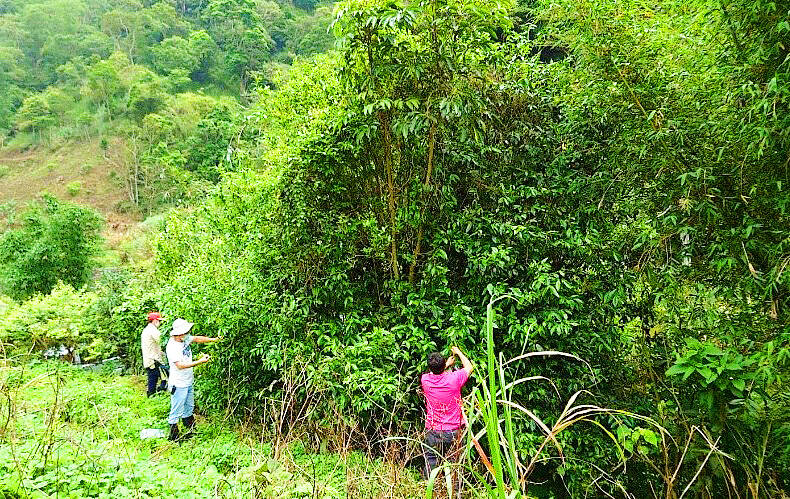
Photo courtesy of the National Taiwan University Experimental Forest Administration
Taiwanese tea is high in tea polyphenol and caffeine content, producing a beverage that has a mellow and mature flavor, while its dried tea leaves smell like mulberry, it said.
Given the lack of research on this tea species, the National Taiwan University Experimental Forest Administration conducted a study on the catechin and caffeine content of different populations of wild Taiwanese tea trees in central Taiwan, with the goal of informing future selection of elite single plants and resource conservation.
Researchers collected samples from Renai’s Meiyuan Mountain (眉原山), Lugu’s Fonghuang Mountain and Jhanghu Mountain (樟湖山), and Sinyi’s Shuanglong Village (雙龍).
The study found that Taiwanese tea samples from Fonghuang Mountain have the highest content of total catechins of 103.70mg/g, with epigallocatechin gallate (EGCG), epigallocatechin and gallocatechol as the primary catechins, it said.
Their EGCG, which is believed to have the greatest antioxidant effect among the three catechins, ranked the highest at an average of 62.23mg/g, it said.
As for caffeine, samples from the Jhanghu Mountain ranked the highest, while those from Shuanglong Village were the lowest, at an average of 25.68mg/g, it said.
However, few Taiwanese tea trees are left in the wild, as many of the populations in different regions are facing threats from human interference, it said.
The institution is dedicated to protecting the germplasm of Taiwanese tea via asexual reproduction, as well as building a complete gene pool to ensure the conservation of the plant species’ genetic diversity, it said.
A conservation area should be established to protect wild Taiwanese tea trees, with monitoring and patrols strengthened to reduce human interference and ensure the growth of the wild populations, it said.
Responsible agencies should also formulate a policy to help develop the Taiwanese tea industry, as the plant has a promising market potential, but requires more efforts from the government to help promote, advise and regulate management, it added.
A complete industry chain, from planting to processing and marketing, should be established to better meet future market needs, it said.
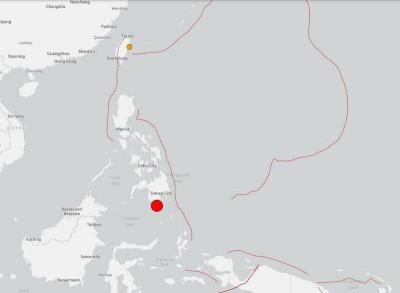
A magnitude 7.8 earthquake struck off the southern coast of Mindanao in the Philippines at 7:38am today, prompting the US Tsunami Warning System to issue an alert for neighboring countries, including Taiwan. The system issued a purple alert indicating a "tsunami threat." The potential threat zone includes Taiwan, the Philippines, Papua New Guinea, Yap and Palau. Philippine authorities were assessing the damage from the quake, with the office of civil defense seeking to verifying initial reports that 15 people had been killed and 129 injured in the region, mostly from falling debris. Arlene Hollero, disaster chief of Maasim town in the Philippines' Sarangani Province,

‘GRAY ZONE’ PRESSURE: Beijing’s activities are intended to create the deceitful impression that China has jurisdiction over the area around Taiwan, the CGA said Taiwan’s rights over its territorial waters and exclusive economic zone must not be violated by any country, the Mainland Affairs Council said yesterday, adding that it will not accept any unprovoked actions. The council issued the remarks in response to the China Coast Guard conducting maritime enforcement drills near eastern Taiwan and claiming to fully exercise China’s maritime administrative law enforcement authority. The Coast Guard Administration (CGA) has been closely monitoring the situation and is taking concrete steps to defend the nation’s sovereignty and secure its waters, the council said. China has no sovereign rights over the waters off eastern

RESILIENCE: Taiwan plays a key role in semiconductors, energy, information infrastructure and advanced manufacturing, AIT Director Raymond Greene said Taiwan’s continued investment in deterrence and resilience remains vital, especially in uncrewed systems and other emerging technologies, American Institute in Taiwan (AIT) Director Raymond Greene said yesterday. Greene made the remarks at the annual National Strategic Summit on Supply Chain Resilience held by the Research Institute for Democracy, Society and Emerging Technology (DSET), a government-backed think tank. As Taiwan last year became the US’ fourth-largest trading partner and supply chain security is becoming more important, cooperation in emerging technologies continues to deepen between the two countries, he said. The US is committed to accelerating innovation, building key infrastructure, strengthening cooperation

The National Chungshan Institute of Science and Technology yesterday showcased its locally developed variants of the Vision 60 robotic patrol dog, which it plans to deploy on the nation’s outlying territories in the South China Sea. The variants were produced under the Joint Lab project — created by the institute and domestic companies — and assembled with domestically produced motors, lenses and artificial intelligence (AI) systems alongside licensed tech from the US, Missile and Rocket Systems Research Division deputy director Jen Kuo-kang (任國光) told the media event at a military base in Taipei’s Dazhi (大直) area. Taiwan has built up its strengths


 RSS
RSS