


The Environmental Impact Assessment (EIA) committee yesterday gave its approval to the Suhua Highway Safety Enhancement Project and a plan to construct a highway connecting the Chiang Wei-shui Memorial Freeway (Freeway No. 5) and Dongao (東澳) in Yilan County, amid concerns by environmental groups that the projects might further damage the region’s fragile topography.
The Highway Bureau in 2020 completed the Suhua Highway Improvement Project, which covered several sections of the highway: between Suao (蘇澳) and Dongao (東澳) in Yilan County; between Nanao (南澳) in Yilan County and Heping Township (和平) in Hualien County; between Hejhong (和中) and Heren (和仁) in Hualien County; and between Heren and Dacingshuei (大清水) in Hualien County.
The new project covers sections that were not included in the previous project: between Dongao (東澳) and Nanao (南澳), between Heping and Hejhong, and from Heren to Jhongde (崇德) via Dacingshuei.
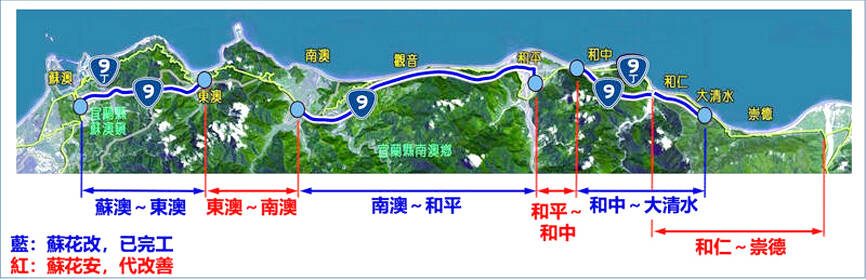
Photo courtesy of the Environmental Impact Assessment Committee
The Dongao-Nanao section is about 9.3km long, while Heping to Hejhong is about 5.5km. The longest section is from Heren to Jhongde via Dacingshuei, which is about 15.1km.
‘TAROKO’ TUNNEL
The construction of all three sections would involve drilling tunnels and building bridges. For the longest section of the project, a tunnel would be drilled through Taroko National Park.
Photo: Chen Chia-yi, Taipei Times
Enhancing the safety of the three sections that were not covered by previous projects is necessary, as they have been increasingly damaged by typhoons and heavy rainfall due to extreme weather, Highway Bureau Director-General Chen Wen-juei (陳文瑞) told the committee.
An earthquake measuring 7.2 on the Richter scale that struck Hualien in April did not affect sections of the Suhua Highway Improvement Project, but it caused landslides at the Heping-Hejhong section and the Heren-Jhongde sections, and crushed one of the bridges there, Chen said.
“The safety of the sections in the previous project was not compromised even when the nation was under the influence of Typhoon Gaemi, but it caused mudflow at the tunnel in Jhongde,” Chen said.
“We hope that the safety of the remaining sections can be improved through the methods used in the Suhua Highway Improvement Project, so that people can have safe and reliable road access all day between Taipei and Hualien,” he added.
Wild at Heart Legal Defense Association researcher Hong Shuo-cheng (洪碩辰) told the committee that improving the safety of the Dongao-Nanao section is not as urgent, as it has experienced fewer landslides and traffic accidents compared with other sections.
GEOLOGICAL SURVEYS
Environmental Rights Foundation executive director Tu Yo-wen (?又文) said that the project needs a Phase II environmental impact assessment, as questions remain on whether sufficient geological surveys have been conducted given the complex topography of the area.
The costs, technology and construction safety risks involved in the project are much higher and more complex than other freeways and expressways, Tu said.
Both organizations said the construction areas contain rich sources of underground water, but the bureau does not have plans on how to reuse water that might gush out during construction.
Earth excavated during construction is to be transported to Yilan, which is already burdened by the previous project, they said.
The committee approved the project on the condition that the earth removed by the new project can only be stored in Yilan for one year.
The committee also approved the bureau’s proposal to construct a 7.1km-long highway to connect Freeway No. 5 and Dongao to ease traffic congestion in downtown Suao during holidays.
As there is no road access connecting the freeway and sections of the Suhua Highway Improvement Project, motorists traveling to Hualien must get off at the Suao Interchange on the freeway and drive to Dongao via downtown Suao.
This has caused severe traffic congestion in Suao, particularly on weekends and holidays.
The highway would connect the Suao Interchange and Dongao directly. The construction is estimated to cost about NT$27.2 billion (US$832 million).

‘NO SECURITY RISK’: The Railway Bureau reassured the public that the technicians’ activities were limited to technical guidance and did not involve sensitive systems The Railway Bureau yesterday said it had invited eight Chinese technicians to assist with an airport MRT construction project. The bureau issued the confirmation after an Internet user said Chinese nationals had entered the construction zone of Taiwan Taoyuan International Airport’s Terminal 3 project. They asked why “individuals from an enemy state” were allowed access to such a major national infrastructure project, which raised serious concerns over Taiwan’s industrial safety, sensitive systems and information security. The bureau’s Northern Region Engineering Branch Office said subcontractor Taiwan Handle Industrial Co (台灣手把工業) of the Taoyuan airport MRT’s “Contract No. CU05 Project A14 Station Civil, MEP &

The National Chungshan Institute of Science and Technology yesterday showcased its locally developed variants of the Vision 60 robotic patrol dog, which it plans to deploy on the nation’s outlying territories in the South China Sea. The variants were produced under the Joint Lab project — created by the institute and domestic companies — and assembled with domestically produced motors, lenses and artificial intelligence (AI) systems alongside licensed tech from the US, Missile and Rocket Systems Research Division deputy director Jen Kuo-kang (任國光) told the media event at a military base in Taipei’s Dazhi (大直) area. Taiwan has built up its strengths

NOT IMMEDIATE: Taiwan has a chance to appeal the proposed 10 percent tariff before it starts, while other countries face a 12.5 percent tariff from the trade office Taiwan is among 60 economies determined by the US to have failed to impose or enforce a ban on the importation of goods produced with forced labor, according to a notice released on Tuesday by the Office of the US Trade Representative (USTR), which proposed imposing an additional 10 percent or more tariff on them. The USTR in a statement said that following an investigation, it had determined under Section 301 of the Trade Act of 1974 that the failure of the 60 economies to impose and effectively enforce a prohibition on the importation of goods produced with forced labor is

TIT-FOR-TAT: The US allegedly revoked the visa of a Chinese national working at Xinhua News Agency in the US in response to Beijing’s expulsion of Vivian Wang The Presidential Office yesterday condemned China for expelling a New York Times correspondent from Beijing following the newspaper’s interview with President William Lai (賴清德), saying the move highlighted Beijing’s suppression of press freedom and its threat to international news media. Taiwan has noted a series of recent incidents in which Beijing used similar tactics to “threaten and pressure international media outlets and journalists,” Presidential Office spokeswoman Karen Kuo (郭雅慧) said in a statement. “This concerns not only press freedom and freedom of expression, but also the safety of journalists, and Taiwan and relevant partners are paying close attention to the situation,” she


 RSS
RSS