


A poll by the Mainland Affairs Council (MAC) found that nearly 85 percent of Taiwanese disapprove of China’s 22-point set of “guidelines” to penalize “die-hard” Taiwanese independence separatists, and nearly 90 percent disapprove of China’s continual incursions.
The poll showed 85 percent of respondents opposed China’s “one country, two systems” formula and 84.6 percent disapproved of the guidelines published by Beijing on June 21 to punish Taiwanese independence die-hards and its enforcement of new national security laws to inspect the personal belongings of travelers.
The poll also showed that 88.9 percent of respondents disagreed with the ongoing activities by Chinese warplanes and warships around Taiwan, and their deliberate crossing of the median line of the Taiwan Strait, while 85.1 percent disagreed with the so-called “regular law enforcement patrols” by China Coast Guard vessels around Kinmen.
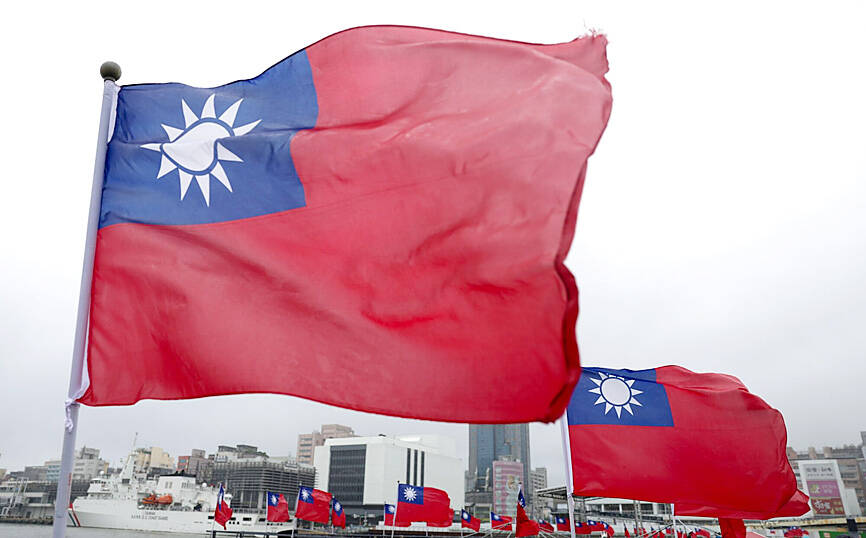
Photo: Cheng I-hwa, Bloomberg
Since the visit by then-US House of Representatives speaker Nancy Pelosi in August 2022, Chinese military incursions into Taiwan’s air defense identification zone have become more frequent, as have crossings of the median line — an unofficial border between Taiwan and China.
The Ministry of National Defense in a daily report yesterday said that 17 Chinese warplanes and 11 naval vessels were detected around Taiwan in the 24-hour period ending at 6am yesterday, among which 14 flights crossed the median line.
According to a chart from the air force, the Chinese flights crossing the median line were 42 nautical miles (77.8km) from Keelung, and those which intruded the southeastern air defense identification zone were 37 nautical miles (68.5km) from Oluanpi (鵝鑾鼻), Taiwan proper’s southernmost point.
Meanwhile, the poll showed that 85.2 percent of respondents agreed that Taiwan’s future should be decided by the 23 million people in Taiwan, and most Taiwanese considered China to be unfriendly to the government (72.5 percent) and Taiwanese (55.6 percent).
It also showed that 88.5 percent of respondents opt to “maintain the status quo”— consisted of 5.3 percent opt to “maintain the status quo and move toward unification later,” 25.5 percent opt to “maintain the status quo and move toward independence or unification contingent on the situation,” 36.9 percent opt to “indefinitely maintain the status quo” and 20.8 percent opt to “maintain the status quo and move toward independence later.”
Only 1.5 percent of respondents agreed to “achieve unification as soon as possible,” the poll showed.
Public opinion is firm in its defense of national sovereignty against China’s intimidation, as the poll revealed that people disagree with China’s continual activities in Taiwan’s surrounding waters and its enforcement of the new regulations against Taiwanese, the MAC said.
The government should therefore continue to uphold the constitutional structure of the nation and adhere to the “four commitments” laid out by former president Tsai Ing-wen (蔡英文) in 2021, it said.
The MAC also urged China to face the cross-strait reality and majority public opinion in Taiwan, stop pressuring Taiwan via hybrid warfare and respond to Taiwan’s goodwill with goodwill to forge a peaceful and stable cross-strait relationship.
The poll also suggested that the support rate of the Taiwan People’s Party (TPP) had plunged to 6.2 percent from 19.6 percent last year.
The Democratic Progressive Party (DPP) enjoyed the highest support rate at 35.4 percent, while support for the Chinese Nationalist Party (KMT) was at 19.6 percent, the New Power Party at 0.6 percent and 32.8 percent of respondents had a neutral stance, the poll showed.
In terms of party identification, 35.1 percent said they identified with the DPP, 19.7 percent with the KMT and 6.1 percent with the TPP, while 32.8 percent were neutral, it showed.
The poll was conducted by National Chengchi University’s Election Study Center from July 26 to Tuesday through telephone interviews with adults aged 20 or older.
It collected 1,073 valid samples, with a margin of error of 2.99 percentage points.
Additional reporting by CNA
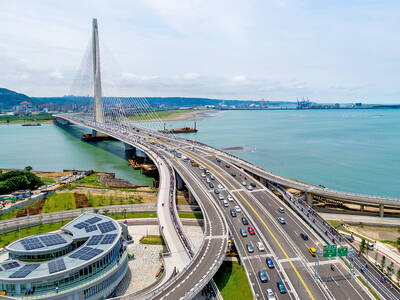
The Ministry of Transportation and Communications yesterday inaugurated the Danjiang Bridge across the Tamsui River in New Taipei City, saying that the structure would be an architectural icon and traffic artery for Taiwan. Feted as a major engineering achievement, the Danjiang Bridge is 920m long, 211m tall at the top of its pylon, and is the longest single-pylon asymmetric cable-stayed bridge in the world, the government’s Web site for the structure said. It was designed by late Iraqi-British architect Zaha Hadid. The structure, with a maximum deck of 70m, accommodates road and light rail traffic, and affords a 200m navigation channel for boats,
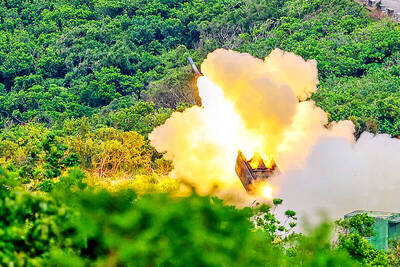
PRECISION STRIKES: The most significant reason to deploy HIMARS to outlying islands is to establish a ‘dead zone’ that the PLA would not dare enter, a source said A High Mobility Artillery Rocket System (HIMARS) would be deployed to Penghu County and Dongyin Island (東引) in Lienchiang County (Matsu) to force the Chinese military to retreat at least 100km from the coastline, a military source said yesterday. Taiwan has been procuring HIMARS and Army Tactical Missile Systems (ATACMS) from the US in batches. Once all batches have been delivered, Taiwan would possess 111 HIMARS units and 504 ATACMS, which have a range of 300km. Considering that “offense is the best defense,” the military plans to forward-deploy the systems to outlying islands such as Penghu and Dongyin so that

Taiwan Semiconductor Manufacturing Co (TSMC, 台積電), the world’s largest foundry service provider, yesterday said that global semiconductor revenue is projected to hit US$1.5 trillion in 2030, after the figure exceeds US$1 trillion this year, as artificial intelligence (AI) demand boosts consumption of token and compute power. “We are still at the beginning of the AI revolution, but we already see a significant impact across the whole semiconductor ecosystem,” TSMC deputy cochief operating officer Kevin Zhang (張曉強) said at the company’s annual technology symposium in Hsinchu City. “It is fair to say that in the past decade, smartphones and other mobile devices were

‘CLEAR MESSAGE’: The bill would set up an interagency ‘tiger team’ to review sanctions tools and other economic options to help deter any Chinese aggression toward Taiwan US Representative Young Kim has introduced a bill to deter Chinese aggression against Taiwan, calling for an interagency “tiger team” to preplan coordinated sanctions and economic measures in response to possible Chinese military or political action against Taiwan. “[Chinese President] Xi Jinping [習近平] has directed the People’s Liberation Army to be ready to invade Taiwan by 2027. China has a plan. America should have one too,” Kim said in a news release on Thursday last week. She introduced the “Deter PRC [People’s Republic of China] aggression against Taiwan act” to “ensure the US has a coordinated sanctions strategy ready should


 RSS
RSS