


Households in areas where flooding exceeded 50cm due to Typhoon Gaemi are to receive NT$20,000 each in planned relief funding, President William Lai (賴清德) said yesterday.
Lai announced the subsidies after being briefed about the storm situation during an inspection of severely affected areas in Kaohsiung’s Meinong District (美濃).
In areas where there was flooding, but under 50cm, low-to-middle-income households would receive NT$10,000, Lai added.
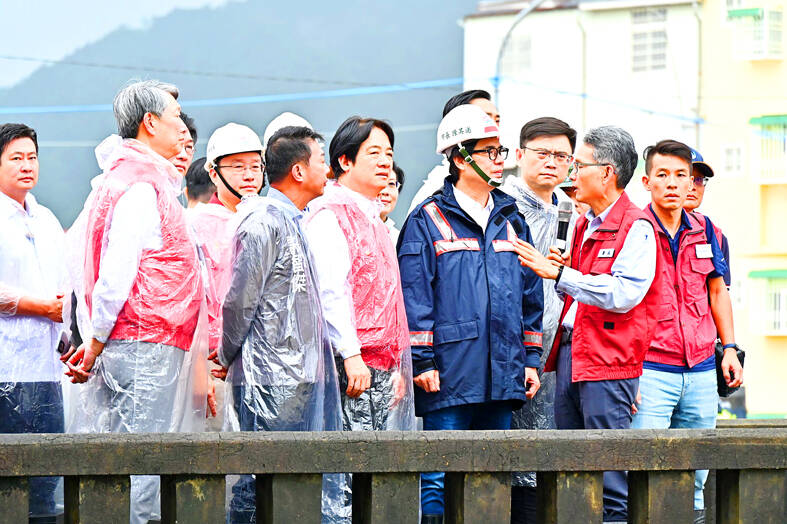
Photo: Lee Hui-chou, Taipei Times
The money would be drawn from the central government’s budget, Lai said.
He urged the legislature to swiftly approve the funds once it begins a new session in September.
In the meantime, the Ministry of Finance is mulling tax relief for individuals and businesses in areas severely affected by the typhoon, which brought heavy rainfall to central and southern Taiwan before being downgraded to a tropical storm.
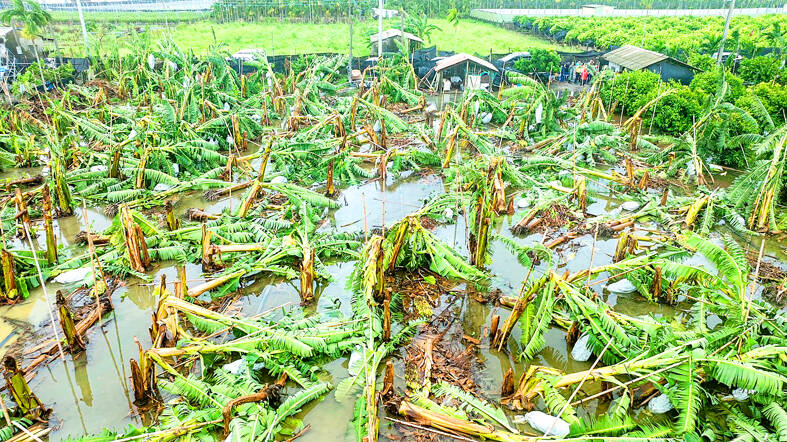
Photo: CNA
Duonalindao (多納林道) in Kaohsiung’s Maolin District (茂林) had 1,835mm of accumulated rainfall from Wednesday to noon yesterday, while Chiayi County’s Fencihu Township (奮起湖) had 1,677.5mm, Central Weather Administration (CWA) data showed.
Lai commended the Kaohsiung City Government’s efforts to enhance the city’s flood control system. While accumulated rainfall in the city was comparable to that brought by Typhoon Morakot in 2009, the flooding was less severe, he said.
Morakot caused catastrophic damage in Taiwan, killing at least 681 people, with 18 still missing, a Cabinet report said.
Lai said that additional cash would be provided to compensate for agricultural losses from Gaemi.
He promised to boost financial support for local governments to improve river infrastructure, including water detention facilities, to enhance the nation’s resilience to climate shocks.
The CWA yesterday morning lifted sea and land warnings for Gaemi, but added that heavy rain was likely to persist in many parts of Taiwan.
As of 8am yesterday, the eye of the storm was over China, roughly 200km west of Taiwan’s Lienchiang County, the CWA said.
It was moving at 9kph, down from 17kph, it said.
It had weakened and posed no further threat to Taiwan’s northern waters, or Kinmen and Lienchiang counties, it said.
The agency issued extremely heavy or heavy rain advisories for 15 administrative regions, including Taichung, Tainan and Kaohsiung, as well as Miaoli and Pingtung counties, and mountainous areas in Nantou County.
The CWA defines extremely heavy rain as accumulated rainfall of more than 200mm in a day or more than 100mm in three hours. Heavy rain means accumulated rainfall of at least 80mm within a 24-hour period.
Meanwhile, a tropical cloud system has developed east of the Philippines and is expected to move northwest toward Taiwan.
The system is forecast to become a tropical depression and approach Taiwan’s waters on Monday or Tuesday, the CWA said,
It is too early to tell if the system would become a tropical storm, it said, adding that even if it does not, it could still bring rain to the nation.
Additional reporting by Huang Chia-ling

‘NO SECURITY RISK’: The Railway Bureau reassured the public that the technicians’ activities were limited to technical guidance and did not involve sensitive systems The Railway Bureau yesterday said it had invited eight Chinese technicians to assist with an airport MRT construction project. The bureau issued the confirmation after an Internet user said Chinese nationals had entered the construction zone of Taiwan Taoyuan International Airport’s Terminal 3 project. They asked why “individuals from an enemy state” were allowed access to such a major national infrastructure project, which raised serious concerns over Taiwan’s industrial safety, sensitive systems and information security. The bureau’s Northern Region Engineering Branch Office said subcontractor Taiwan Handle Industrial Co (台灣手把工業) of the Taoyuan airport MRT’s “Contract No. CU05 Project A14 Station Civil, MEP &

The National Chungshan Institute of Science and Technology yesterday showcased its locally developed variants of the Vision 60 robotic patrol dog, which it plans to deploy on the nation’s outlying territories in the South China Sea. The variants were produced under the Joint Lab project — created by the institute and domestic companies — and assembled with domestically produced motors, lenses and artificial intelligence (AI) systems alongside licensed tech from the US, Missile and Rocket Systems Research Division deputy director Jen Kuo-kang (任國光) told the media event at a military base in Taipei’s Dazhi (大直) area. Taiwan has built up its strengths

TIT-FOR-TAT: The US allegedly revoked the visa of a Chinese national working at Xinhua News Agency in the US in response to Beijing’s expulsion of Vivian Wang The Presidential Office yesterday condemned China for expelling a New York Times correspondent from Beijing following the newspaper’s interview with President William Lai (賴清德), saying the move highlighted Beijing’s suppression of press freedom and its threat to international news media. Taiwan has noted a series of recent incidents in which Beijing used similar tactics to “threaten and pressure international media outlets and journalists,” Presidential Office spokeswoman Karen Kuo (郭雅慧) said in a statement. “This concerns not only press freedom and freedom of expression, but also the safety of journalists, and Taiwan and relevant partners are paying close attention to the situation,” she

NOT IMMEDIATE: Taiwan has a chance to appeal the proposed 10 percent tariff before it starts, while other countries face a 12.5 percent tariff from the trade office Taiwan is among 60 economies determined by the US to have failed to impose or enforce a ban on the importation of goods produced with forced labor, according to a notice released on Tuesday by the Office of the US Trade Representative (USTR), which proposed imposing an additional 10 percent or more tariff on them. The USTR in a statement said that following an investigation, it had determined under Section 301 of the Trade Act of 1974 that the failure of the 60 economies to impose and effectively enforce a prohibition on the importation of goods produced with forced labor is


 RSS
RSS