


A bridge collapse caused by torrential rains in northern China killed 12 people and left more than 30 missing, state media said yesterday.
Large parts of northern and central China have over the past few days been battered by rains that have caused flooding and significant damage.
The bridge in Shangluo city in northwestern Shaanxi Province buckled “due to a sudden downpour and flash floods” on Friday night, Xinhua news agency said.
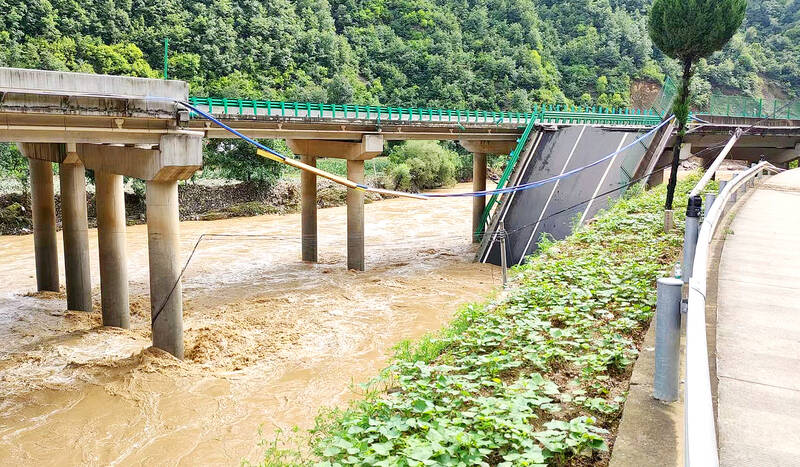
Photo: EPA-EFE / Xinhua / Liu Xiao
All 12 victims were found inside five vehicles that were recovered from the river below the bridge, Xinhua said.
At least 31 people remained missing and initial investigations indicated that 17 cars and eight trucks had fallen into the river, it said.
Images on state television showed a partially submerged section of the bridge with the river rushing over it.
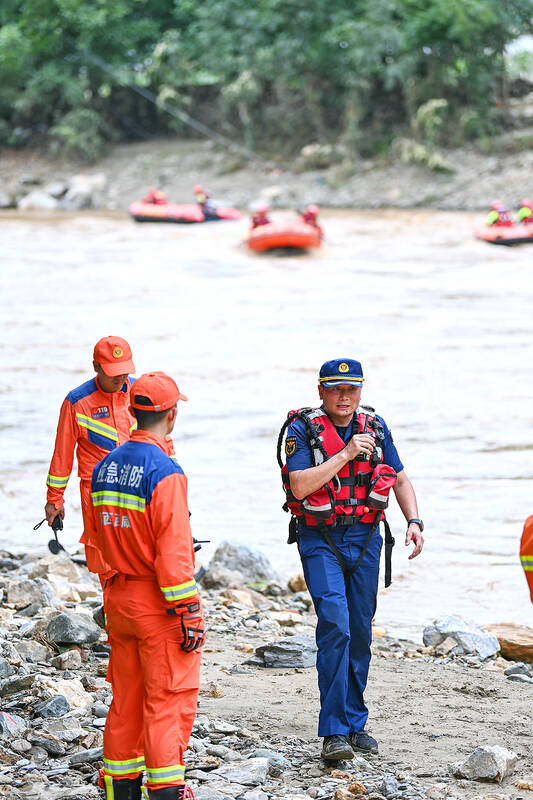
Photo: EPA-EFE / Xinhua / Zou Jingyi
One witness told local media that he had approached the bridge, but that other drivers started “yelling at me to brake and stop the car.”
“A truck in front of me did not stop” and fell into the water, the witness, surnamed Meng, said.
Chinese President Xi Jinping (習近平) has urged “all-out rescue and relief efforts” to find those still missing, Xinhua said.
In southwestern Sichuan Province, more than 30 people were yesterday reported missing after a violent thunderstorm caused flash flooding in the town of Ya’an, state broadcaster China Central Television said.
On Friday, state media reported at least five people dead and eight missing after the rains sparked flooding and mudslides in Shaanxi’s Baoji city.
State television broadcast images of neighborhoods completely flooded by muddy water, with excavators and residents attempting to clear the damage.
Gansu Province, which neighbors Shaanxi, and Henan in central China were also hit by heavy rains this week.
In Henan’s Nanyang city, the equivalent of a year’s worth of rain fell at the start of the week, China Central Television said.
In Sichuan Province, two people were reported killed and seven others missing on Friday after heavy rain triggered landslides, Xinhua said.
China is enduring a summer of extreme weather, with heavy rains across the east and south coming as much of the north has sweltered in successive heat waves.
The Ministry of Transportation and Communications yesterday inaugurated the Danjiang Bridge across the Tamsui River in New Taipei City, saying that the structure would be an architectural icon and traffic artery for Taiwan. Feted as a major engineering achievement, the Danjiang Bridge is 920m long, 211m tall at the top of its pylon, and is the longest single-pylon asymmetric cable-stayed bridge in the world, the government’s Web site for the structure said. It was designed by late Iraqi-British architect Zaha Hadid. The structure, with a maximum deck of 70m, accommodates road and light rail traffic, and affords a 200m navigation channel for boats,

Taiwan Semiconductor Manufacturing Co (TSMC, 台積電), the world’s largest foundry service provider, yesterday said that global semiconductor revenue is projected to hit US$1.5 trillion in 2030, after the figure exceeds US$1 trillion this year, as artificial intelligence (AI) demand boosts consumption of token and compute power. “We are still at the beginning of the AI revolution, but we already see a significant impact across the whole semiconductor ecosystem,” TSMC deputy cochief operating officer Kevin Zhang (張曉強) said at the company’s annual technology symposium in Hsinchu City. “It is fair to say that in the past decade, smartphones and other mobile devices were
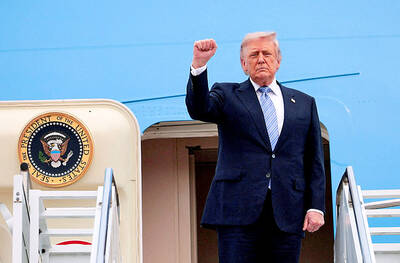
US-CHINA SUMMIT: MOFA welcomed US reassurance of no change in its Taiwan policy; Trump said he did not comment when Xi talked of opposing independence US President Donald Trump yesterday said he has not made a decision on whether to move forward with a major arms package for Taiwan after hearing concerns about it from Chinese President Xi Jinping (習近平). Trump’s comments on Taiwan came as he flew back to Washington after wrapping up critical talks in which both leaders said important progress was made in stabilizing US-China relations even as deep differences persist between the world’s two biggest powers on Iran and Taiwan. “I will make a determination,” Trump said, adding: “I’ll be making decisions. But, you know, I think the last thing we need right

TAIWAN ISSUE: US treasury secretary Scott Bessent said on the first day of meetings that ‘it wouldn’t be a US-China summit without the Taiwan issue coming up’ There were no surprises on the first day of the summit between US President Donald Trump and Chinese President Xi Jinping (習近平), the Mainland Affairs Council (MAC) said yesterday, as the government reiterated that cross-strait stability is crucial to the Asia-Pacific region, as well as the world. As the two presidents met for a highly anticipated summit yesterday, Chinese state media reported that Xi warned Trump that missteps regarding Taiwan could push their two countries into “conflict.” Trump arrived in China with accolades for his host, calling Xi a “great leader” and “friend,” and extending an invitation to visit the White House


 RSS
RSS