


The Ministry of Education (MOE) this week announced that it plans to change the name of its official certification test for Hoklo from Minnanyu (閩南語, “Southern Min [abbreviation of Fujian Province]”) to Taiyu (台語, “Taiwanese”).
The ministry on Thursday said it planned to amend Article 2 of the Minnanyu Language Certification Test’s Examination Fees Standards based on the Executive Yuan’s national language development plan launched on Aug. 22, 2022.
Suggestions are welcome during the 60-day public comment period, the ministry said, adding that barring any significant changes, the amendment is expected to be promulgated as soon as September.
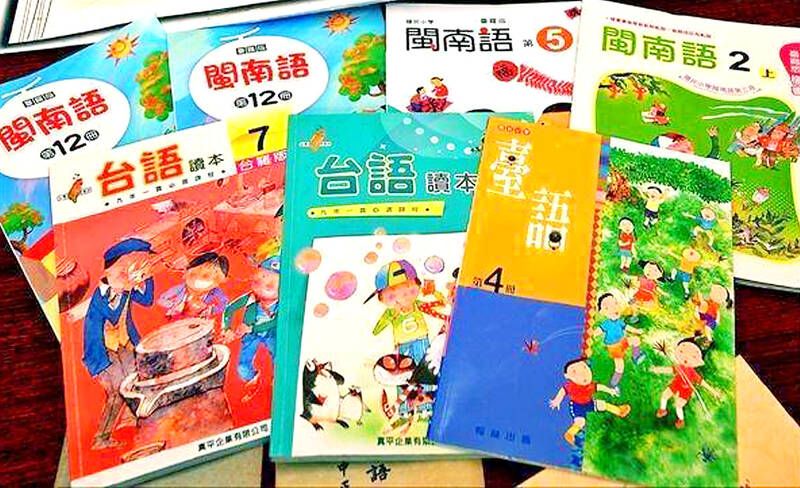
Photo:Wu Po-hsuan, Taipei Times
Book publishers have said that they have long used the term Taiyu in their educational materials, citing works by former Chinese Nationalist Party (KMT) chairman Lien Chan’s (連戰) grandfather Lien Heng (連橫), which also used the term Taiyu, the government said.
Academics and experts who compile and edit Taiwanese Minnanyu dictionaries have said that the version spoken in Taiwan is different from that used in China’s Fujian Province.
The education ministry in 2009 created the first Taiwanese Minnanyu proficiency certification test.
However, the following year, under then-president Ma Ying-jeou’s (馬英九) administration, the Nine-Year Education Program was updated to change all references of “Taiyu” and “Taiwanese Minnanyu” to simply “Minnanyu.”
In 2011, the ministry’s certification test was renamed the Minnanyu Proficiency Certification Test.
In 2019, during then-president Tsai Ing-wen’s (蔡英文) administration, the legislature passed the Development of National Languages Act (國家語言發展法), which certified that all “natural languages” used by ethnic groups in Taiwan and Taiwanese sign language are national languages.
In 2022, the Executive Yuan demanded that all government facilities prioritize using indigenous languages, Hakka, Taiyu, the Matsu dialect of the Eastern Min and Taiwanese sign language.
The directive was intended to promote uniformity in promoting national languages and standardizing language development, documents and other materials, the Executive Yuan said at the time.
About 30,000 to 40,000 people take the exam each year.

‘NO SECURITY RISK’: The Railway Bureau reassured the public that the technicians’ activities were limited to technical guidance and did not involve sensitive systems The Railway Bureau yesterday said it had invited eight Chinese technicians to assist with an airport MRT construction project. The bureau issued the confirmation after an Internet user said Chinese nationals had entered the construction zone of Taiwan Taoyuan International Airport’s Terminal 3 project. They asked why “individuals from an enemy state” were allowed access to such a major national infrastructure project, which raised serious concerns over Taiwan’s industrial safety, sensitive systems and information security. The bureau’s Northern Region Engineering Branch Office said subcontractor Taiwan Handle Industrial Co (台灣手把工業) of the Taoyuan airport MRT’s “Contract No. CU05 Project A14 Station Civil, MEP &

The National Chungshan Institute of Science and Technology yesterday showcased its locally developed variants of the Vision 60 robotic patrol dog, which it plans to deploy on the nation’s outlying territories in the South China Sea. The variants were produced under the Joint Lab project — created by the institute and domestic companies — and assembled with domestically produced motors, lenses and artificial intelligence (AI) systems alongside licensed tech from the US, Missile and Rocket Systems Research Division deputy director Jen Kuo-kang (任國光) told the media event at a military base in Taipei’s Dazhi (大直) area. Taiwan has built up its strengths
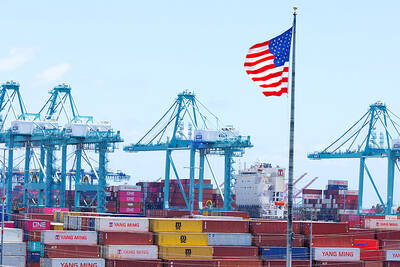
NOT IMMEDIATE: Taiwan has a chance to appeal the proposed 10 percent tariff before it starts, while other countries face a 12.5 percent tariff from the trade office Taiwan is among 60 economies determined by the US to have failed to impose or enforce a ban on the importation of goods produced with forced labor, according to a notice released on Tuesday by the Office of the US Trade Representative (USTR), which proposed imposing an additional 10 percent or more tariff on them. The USTR in a statement said that following an investigation, it had determined under Section 301 of the Trade Act of 1974 that the failure of the 60 economies to impose and effectively enforce a prohibition on the importation of goods produced with forced labor is

RIGHT DIRECTION: Taiwan’s efforts to prevent forced labor include a proposal to ‘fully prohibit’ employers from withholding workers’ documents, an official said Taiwan is to establish a mechanism to restrict imports of goods linked to forced labor, the Executive Yuan said yesterday, after the US proposed imposing additional tariffs on Taiwanese goods over labor concerns. “The Ministry of Labor and the Ministry of Economic Affairs are to establish an interministerial review procedure,” Executive Yuan spokesperson Michelle Lee (李慧芝) said at a news briefing in Taipei. “The government is to use the Foreign Trade Act [貿易法] as the legal basis to restrict imports of goods produced with forced labor” and bring its supply chain governance more in line with international standards on human rights, resilience


 RSS
RSS