


The Taiwan Professional Basketball Players’ Association (TPBPA) yesterday called on spectators to wear black to last night’s William Jones Cup game in New Taipei City to protest the Taiwanese basketball federation’s policy of paying female players less than their male counterparts.
The protest came after the Chinese Taipei Basketball Association (CTBA) on Monday announced that male players would be paid NT$5,000 and female players NT$3,000 for appearing in each commercial international game starting from this year’s Cup, which comprises men’s and women’s tournaments featuring teams from several countries, including Taiwan.
The appearance fees were first proposed by the CTBA in last month’s meeting with the players’ associate to negotiate the rights and benefits of national basketball team players in competitions.
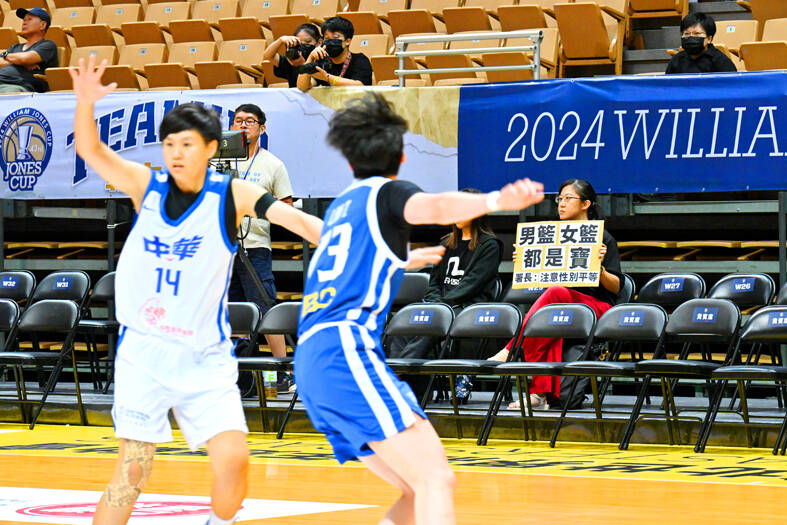
Photo: Tu Chien-jung, Taipei Times
CTBA deputy secretary-general Chang Cheng-chung (張承中) on Monday told reporters that while its meetings with the TPBPA have long been focused on the men’s division, its cooperation with the women’s division is a separate situation.
“Before the meeting, we proposed NT$3,000 per game for each selected player on the blue and white teams,” he said.
The CTBA has to balance its budget and maintain its business model while benefiting female players, he added.
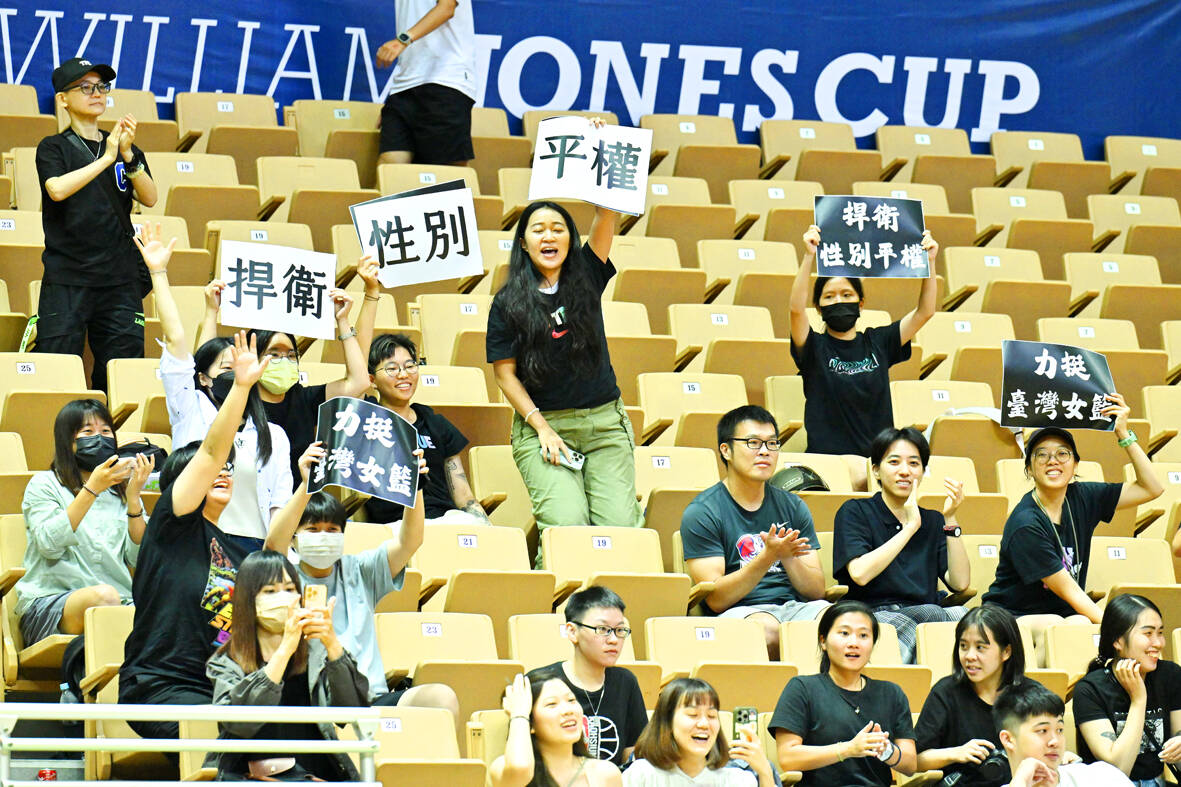
Photo: Tu Chien-jung, Taipei Times
The TPBPA on Monday said that players wearing a national team jersey should not be treated differently because of their gender.
Both men and women are fighting for Taiwan and should not be treated differently, women’s blue team head coach Chiu Chi-yi (邱啟益) said.
While the negotiations between the CTBA and the TPBPA have led to better support services for the national team players and deserve recognition, gender equity should be considered as well without any differential treatment, Sports Administration Director Cheng Shih-chung (鄭世忠) said in a statement on Monday.
The men’s division yesterday expressed support for the women’s division via a TPBPA statement, saying that the male players would lower their appearance fee to NT$3,000 to be the same as female players if the CTBA decides on that number.
The dedication of the women’s division to basketball is no less than their male counterparts and deserves to be seen, especially with a relatively harsh environment for female basketball players in Taiwan, it said.
The CTBA on Monday said in response to the Sports Administration’s statement that “the CTBA would like to negotiate the appearance fees with players contingent on the situation.”
In a statement issued yesterday, the CTBA said the four negotiating meetings with the TPBPA had been conducted with the men’s division in mind, before the TPBPA raised the issue of the women’s division on Tuesday last week and radically modified the agreement.
The fifth negotiation would be suspended without the national team players’ rights affected, it said, adding that the CTBA has established rights for the women’s division, but has yet to discuss it with the TPBPA.

‘NO SECURITY RISK’: The Railway Bureau reassured the public that the technicians’ activities were limited to technical guidance and did not involve sensitive systems The Railway Bureau yesterday said it had invited eight Chinese technicians to assist with an airport MRT construction project. The bureau issued the confirmation after an Internet user said Chinese nationals had entered the construction zone of Taiwan Taoyuan International Airport’s Terminal 3 project. They asked why “individuals from an enemy state” were allowed access to such a major national infrastructure project, which raised serious concerns over Taiwan’s industrial safety, sensitive systems and information security. The bureau’s Northern Region Engineering Branch Office said subcontractor Taiwan Handle Industrial Co (台灣手把工業) of the Taoyuan airport MRT’s “Contract No. CU05 Project A14 Station Civil, MEP &

The National Chungshan Institute of Science and Technology yesterday showcased its locally developed variants of the Vision 60 robotic patrol dog, which it plans to deploy on the nation’s outlying territories in the South China Sea. The variants were produced under the Joint Lab project — created by the institute and domestic companies — and assembled with domestically produced motors, lenses and artificial intelligence (AI) systems alongside licensed tech from the US, Missile and Rocket Systems Research Division deputy director Jen Kuo-kang (任國光) told the media event at a military base in Taipei’s Dazhi (大直) area. Taiwan has built up its strengths

NOT IMMEDIATE: Taiwan has a chance to appeal the proposed 10 percent tariff before it starts, while other countries face a 12.5 percent tariff from the trade office Taiwan is among 60 economies determined by the US to have failed to impose or enforce a ban on the importation of goods produced with forced labor, according to a notice released on Tuesday by the Office of the US Trade Representative (USTR), which proposed imposing an additional 10 percent or more tariff on them. The USTR in a statement said that following an investigation, it had determined under Section 301 of the Trade Act of 1974 that the failure of the 60 economies to impose and effectively enforce a prohibition on the importation of goods produced with forced labor is

RIGHT DIRECTION: Taiwan’s efforts to prevent forced labor include a proposal to ‘fully prohibit’ employers from withholding workers’ documents, an official said Taiwan is to establish a mechanism to restrict imports of goods linked to forced labor, the Executive Yuan said yesterday, after the US proposed imposing additional tariffs on Taiwanese goods over labor concerns. “The Ministry of Labor and the Ministry of Economic Affairs are to establish an interministerial review procedure,” Executive Yuan spokesperson Michelle Lee (李慧芝) said at a news briefing in Taipei. “The government is to use the Foreign Trade Act [貿易法] as the legal basis to restrict imports of goods produced with forced labor” and bring its supply chain governance more in line with international standards on human rights, resilience


 RSS
RSS