


American Institute in Taiwan (AIT) Director Sandra Oudkirk was yesterday honored with a diplomacy medal for her contributions to relations between Taipei and Washington as her term comes to an end.
Minister of Foreign Affairs Lin Chia-lung (林佳龍) presented the Grand Medal of Diplomacy to Oudkirk, praising her for her “great dedication in strengthening the bonds between Taiwan and the United States” during her three years in the position.
“Throughout Director Oudkirk’s term, the United States has maintained its rock-solid commitment to Taiwan, which stands on the front line in defending democracy against authoritarian expansionism,” Lin said.
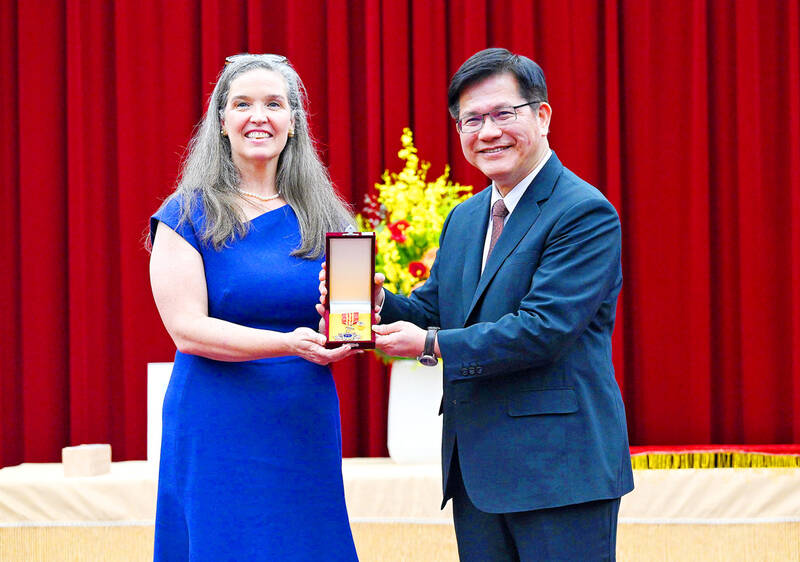
Photo: Chang Chia-ming, Taipei Times
During her tenure, Washington has also continued to support Taiwan’s self-defense needs with arms sales and backed its international participation, as well as peace and stability in the Taiwan Strait, Lin said.
Taiwan-US economic relations have continued to expand and become more institutionalized, including with the signing of the first agreement under the US-Taiwan Initiative on 21st Century Trade in June last year, he said.
Oudkirk said it has been “the privilege of a lifetime” to be able to serve the American people in Taiwan twice in her diplomatic career, the first time more than 30 years ago when she was a young diplomat in Taipei and over the past three years as AIT director.
Taipei-Washington relations have “broadened and deepened” over the past three decades, even as the world evolves, she said.
This is because both sides have a shared vision of a free, open, prosperous and secure Indo-Pacific region and an interest in maintaining peace and stability across the Taiwan Strait, Oudkirk said.
“That vision has stood the test of time and transcended any one person,” she said.
On her personal accomplishments as director, Oudkirk said she took pride in efforts made with Taiwanese partners in many areas, including supporting Taiwan’s self-defense capability, promoting global supply chain resilience and deepening people-to-people ties.
Oudkirk’s three-year term ends next week.
Raymond Greene, the deputy chief of mission of the US embassy in Japan, has been named as her successor, but no date has been given for when he would assume the role. He served as deputy AIT director from 2018 to 2021.
The AIT represents US interests in Taiwan in the absence of official diplomatic ties. It is headquartered in Virginia and has a main office in Taipei and a branch office in Kaohsiung.
Its Taipei director serves as the top US envoy to Taiwan while its chairperson serves more of a ceremonial role.

PROVOCATIVE: Chinese Deputy Ambassador to the UN Sun Lei accused Japan of sending military vessels to deliberately provoke tensions in the Taiwan Strait China denounced remarks by Japan and the EU about the South China Sea at a UN Security Council meeting on Monday, and accused Tokyo of provocative behavior in the Taiwan Strait and planning military expansion. Ayano Kunimitsu, a Japanese vice foreign minister, told the Council meeting on maritime security that Tokyo was seriously concerned about the situation in the East China and South China seas, and reiterated Japan’s opposition to any attempt to change the “status quo” by force, and obstruction of freedom of navigation and overflight. Stavros Lambrinidis, head of the EU delegation to the UN, also highlighted South China Sea

SILENCING CRITICS: In addition to blocking Taiwan, China aimed to prevent rights activists from speaking out against authoritarian states, a Cabinet department said The Ministry of Foreign Affairs (MOFA) yesterday condemned transnational repression by Beijing after RightsCon, a major digital human rights conference scheduled to be held in Zambia this week, was abruptly canceled due to Chinese pressure over Taiwanese participation. This year’s RightsCon, the world’s largest conference discussing issues “at the intersection of human rights and technology,” was scheduled to take place from tomorrow to Friday in Lusaka, and expected to draw 2,600 in-person attendees from 150 countries, along with 1,100 online participants. However, organizers were forced to cancel the event due to behind-the-scenes pressure from China, the ministry said, expressing its “strongest condemnation”
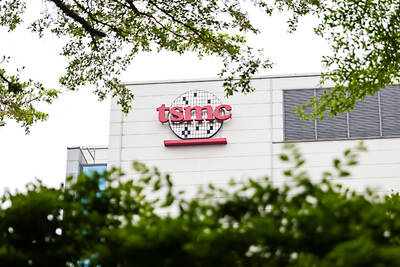
Taiwan Semiconductor Manufacturing Co (TSMC, 台積電), the world’s largest contract chipmaker, said it expects its 2-nanometer (2nm) chip capacity to grow at a compound annual rate of 70 percent from this year to 2028. The projection comes as five fabs begin volume production of 2-nanometer chips this year — two in Hsinchu and three in Kaohsiung — TSMC senior vice president and deputy cochief operating officer Cliff Hou (侯永清) said at the company’s annual technology symposium in Silicon Valley, California, last week. Output in the first year of 2-nanometer production, which began in the fourth quarter of last year, is expected to
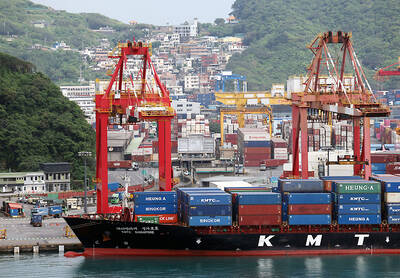
Taiwan’s economy grew far faster than expected in the first quarter, as booming demand for artificial intelligence (AI) applications drove a surge in exports, spilling over into investment and consumption, the Directorate-General of Budget, Accounting and Statistics (DGBAS) said yesterday. GDP growth was 13.69 percent year-on-year during the January-to-March period, beating the DGBAS’ February forecast by 2.23 percentage points and marking the most robust growth in nearly four decades, DGBAS senior official Chiang Hsin-yi (江心怡) told a news conference in Taipei. The result was powered by exports, which remain the backbone of Taiwan’s economy, Chiang said. Outbound shipments jumped 51.12 percent year-on-year to


 RSS
RSS