


More than a dozen people were missing in China yesterday after heavy rains and flooding struck swaths of the south, while the north baked under some of its highest temperatures this year.
Xinhua news agency reported that four people were unaccounted for after a flash flood in Changji, in the northwestern region of Xinjiang, where torrential rains triggered landslides and clogged roads.
Landslides in Meizhou, in southern Guangdong Province, on Monday killed five, left 15 missing and another 13 “trapped” by early the next morning, state broadcaster China Central Television (CCTV) said.
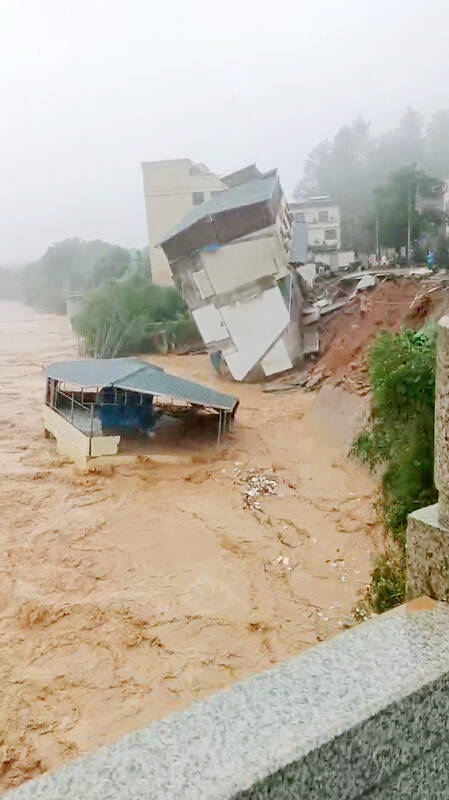
Photo: Reuters
Footage from CCTV showed upturned vehicles and damaged buildings near Meizhou, with residents in rubber boots picking through muddy, debris-laden streets to salvage their belongings.
Other images showed sections of highway swept away by landslides and rescue workers in orange jackets steering dinghies through the floodwaters to reach trapped villagers.
Chinese President Xi Jinping (習近平) called for emergency workers to “make every effort to respond to disaster situations, and do a good job of relief and rescue work to combat flooding and drought,” Xinhua reported yesterday.
He instructed rescuers to “guarantee the security of people’s lives and property, and overall social stability,” Xinhua added.
Meanwhile, the north of China is wilting under some of the year’s hottest weather as the mercury soared to 39°C in Beijing, the Chinese National Meteorological Center said.
Authorities have moved to offer drought prevention and disaster relief in seven provinces across north, east and central China.

BUILDUP: US General Dan Caine said Chinese military maneuvers are not routine exercises, but instead are ‘rehearsals for a forced unification’ with Taiwan China poses an increasingly aggressive threat to the US and deterring Beijing is the Pentagon’s top regional priority amid its rapid military buildup and invasion drills near Taiwan, US Secretary of Defense Pete Hegseth said on Tuesday. “Our pacing threat is communist China,” Hegseth told the US House of Representatives Appropriations Subcommittee on Defense during an oversight hearing with US General Dan Caine, chairman of the Joint Chiefs of Staff. “Beijing is preparing for war in the Indo-Pacific as part of its broader strategy to dominate that region and then the world,” Hegseth said, adding that if it succeeds, it could derail

CHIP WAR: The new restrictions are expected to cut off China’s access to Taiwan’s technologies, materials and equipment essential to building AI semiconductors Taiwan has blacklisted Huawei Technologies Co (華為) and Semiconductor Manufacturing International Corp (SMIC, 中芯), dealing another major blow to the two companies spearheading China’s efforts to develop cutting-edge artificial intelligence (AI) chip technologies. The Ministry of Economic Affairs’ International Trade Administration has included Huawei, SMIC and several of their subsidiaries in an update of its so-called strategic high-tech commodities entity list, the latest version on its Web site showed on Saturday. It did not publicly announce the change. Other entities on the list include organizations such as the Taliban and al-Qaeda, as well as companies in China, Iran and elsewhere. Local companies need
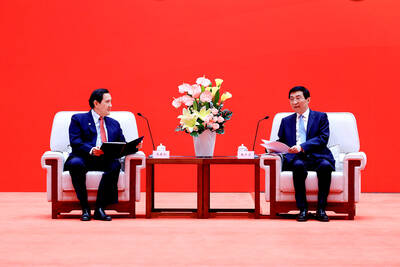
CRITICISM: It is generally accepted that the Straits Forum is a CCP ‘united front’ platform, and anyone attending should maintain Taiwan’s dignity, the council said The Mainland Affairs Council (MAC) yesterday said it deeply regrets that former president Ma Ying-jeou (馬英九) echoed the Chinese Communist Party’s (CCP) “one China” principle and “united front” tactics by telling the Straits Forum that Taiwanese yearn for both sides of the Taiwan Strait to move toward “peace” and “integration.” The 17th annual Straits Forum yesterday opened in Xiamen, China, and while the Chinese Nationalist Party’s (KMT) local government heads were absent for the first time in 17 years, Ma attended the forum as “former KMT chairperson” and met with Chinese People’s Political Consultative Conference Chairman Wang Huning (王滬寧). Wang
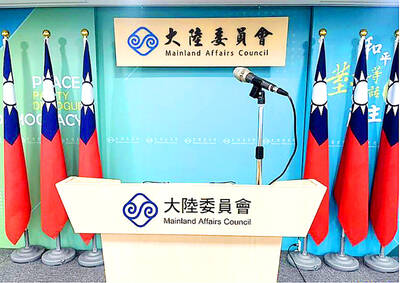
CROSS-STRAIT: The MAC said it barred the Chinese officials from attending an event, because they failed to provide guarantees that Taiwan would be treated with respect The Mainland Affairs Council (MAC) on Friday night defended its decision to bar Chinese officials and tourism representatives from attending a tourism event in Taipei next month, citing the unsafe conditions for Taiwanese in China. The Taipei International Summer Travel Expo, organized by the Taiwan Tourism Exchange Association, is to run from July 18 to 21. China’s Taiwan Affairs Office spokeswoman Zhu Fenglian (朱鳳蓮) on Friday said that representatives from China’s travel industry were excluded from the expo. The Democratic Progressive Party government is obstructing cross-strait tourism exchange in a vain attempt to ignore the mainstream support for peaceful development


 RSS
RSS