


World leaders yesterday were joining Ukrainian President Volodymyr Zelenskiy in Switzerland for a summit on peace in his country, but with Russia staying away it is seen as the first step in a long process.
The Swiss hosts have sought to temper expectations at the two-day gathering, with an agenda laying the groundwork for a path to peace — with future summits envisioned, eventually involving Moscow.
However, Zelenskiy has expressed high hopes for the outcome.

Photo: AFP
“We will see history being made here at the summit,” he said on social media platform Telegram, as he greeted presidents and prime ministers arriving at the luxury Burgenstock resort high above Lake Lucerne.
“Together, we are making the first step toward just peace based on the UN Charter and fundamental principles of international law,” he wrote on X.
In a combative speech on Friday, Russian President Vladimir Putin slammed the conference and demanded that Kyiv effectively surrender before any actual peace negotiations.
Zelenskiy branded Putin’s demands a territorial “ultimatum” reminiscent of Nazi Germany’s Adolf Hitler, while NATO and the US also rejected the conditions.
The conference, convening 100 countries and global institutions, comes at a perilous moment for exhausted Ukrainians and outgunned soldiers, more than two years since Moscow launched its full-scale invasion in February 2022.
More than 50 heads of state and government are among the attendees, including all of the G7 leaders who have been meeting in Italy — with one notable exception.
US President Joe Biden instead sent US Vice President Kamala Harris, who announced more than US$1.5 billion in new aid for Ukraine, mainly for its energy sector and in humanitarian assistance as she arrived in a US Army helicopter.
Near Ukraine’s embattled eastern front, hopes for any major breakthrough are nearly nil.
“I’d like to hope that it will bring some changes in the future, but, as experience shows, nothing comes of it,” said Maksym, a tank commander in the Donetsk region.
In Kyiv, Victoria, a 36-year-old energy industry worker, said she was “exhausted” by the war and wanted to believe the summit would help end it.
“I’m a realist in life, so I don’t have high hopes,” she said.
Experts have also warned against unrealistic expectations from the gathering.
“Meaningful negotiations that could truly end the devastating war in Ukraine remain out of reach, as both Kyiv and Moscow stick to theories of victory that amount to outlasting the other,” the International Crisis Group think tank said.

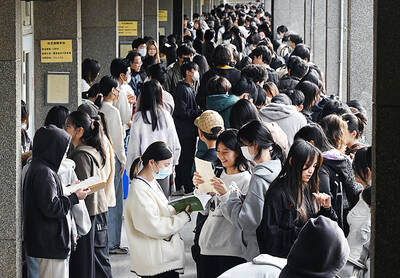
A global survey showed that 60 percent of Taiwanese had attained higher education, second only to Canada, the Ministry of the Interior said. Taiwan easily surpassed the global average of 43 percent and ranked ahead of major economies, including Japan, South Korea and the US, data from the Organisation for Economic Co-operation and Development (OECD) for 2024 showed. Taiwan has a high literacy rate, data released by the ministry showed. As of the end of last year, Taiwan had 20.617 million people aged 15 or older, accounting for 88.5 percent of the total population, with a literacy rate of 99.4 percent, the data

NEW LOW: The council in 2024 based predictions on a pessimistic estimate for the nation’s total fertility rate of 0.84, but last year that rate was 0.69, 17 percent lower An expected National Development Council (NDC) report expects the nation’s population to drop below 12 million by 2065, with the old-age dependency ratio to top 100 percent sooner than 2070, sources said yesterday. The council is slated to release its latest population projections in August, using an ultra-low fertility model, the sources said. The previous report projected that Taiwan’s population would fall to 14.37 million by 2070, but based on a new estimate of the total fertility rate (TFR) — the average number of children born to a woman over her lifetime — the population is expected to reach 12 million by
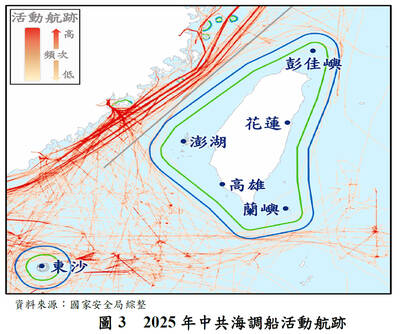
INTENSIFYING THREATS: Beijing’s tactics include massive attacks on the government service network, aircraft and naval vessel incursions and damaging undersea cables China is prepared to interfere in November’s nine-in-one local elections by launching massive attacks on the Taiwanese government’s service network (GSN), a report published by the National Security Bureau showed. The report was submitted to the Legislative Yuan ahead of the bureau’s scheduled briefing at the Foreign Affairs and National Defense Committee tomorrow. The national security team has identified about 13,000 suspicious Internet accounts and 860,000 disputed messages, the bureau said of China’s cognitive warfare against Taiwan. The disputed messages focus on major foreign affairs, national defense and economic issues, which were produced using generative artificial intelligence (AI) and distributed through Chinese

COUNTERING HOSTILITY: The draft bill would require the US to increase diplomatic pressure on China and would impose sanctions on those who sabotage undersea cable networks US lawmakers on Thursday introduced a bipartisan bill to bolster the resilience of Taiwan’s submarine cables to counter China’s hostile activities. The proposal, titled the critical undersea infrastructure resilience initiative act, was cosponsored by Republican representatives Mike Lawler and Greg Stanton, and Democratic Representative Dave Min. US Senators John Curtis and Jacky Rosen also introduced a companion bill in the US Senate, which has passed markup at the chamber’s Committee on Foreign Relations. The House’s version of the bill would prioritize the deployment of sensors to detect disruptions or potential sabotage in real-time and enhance early warning capabilities through global intelligence sharing frameworks,


 RSS
RSS