


The Coast Guard Administration’s (CGA) Chiayi-class CG 5002 Hsinchu (新竹) was anchoring in Honolulu in connection to an international fishery rules enforcement operation, CGA Director-General Hsieh Ching-chin (謝慶欽) told lawmakers yesterday.
Hsieh made the remarks during a question-and-answer session at the Legislative Yuan’s Foreign Affairs and National Defense Committee in Taipei after Chinese Nationalist Party (KMT) Legislator Huang Jen (黃仁) asked why the vessel was in Hawaiian waters.
MarineTraffic, an online ship tracker, showed that the Hsinchu departed the Port of Taipei almost two weeks ago and entered Honolulu Harbor on Tuesday.
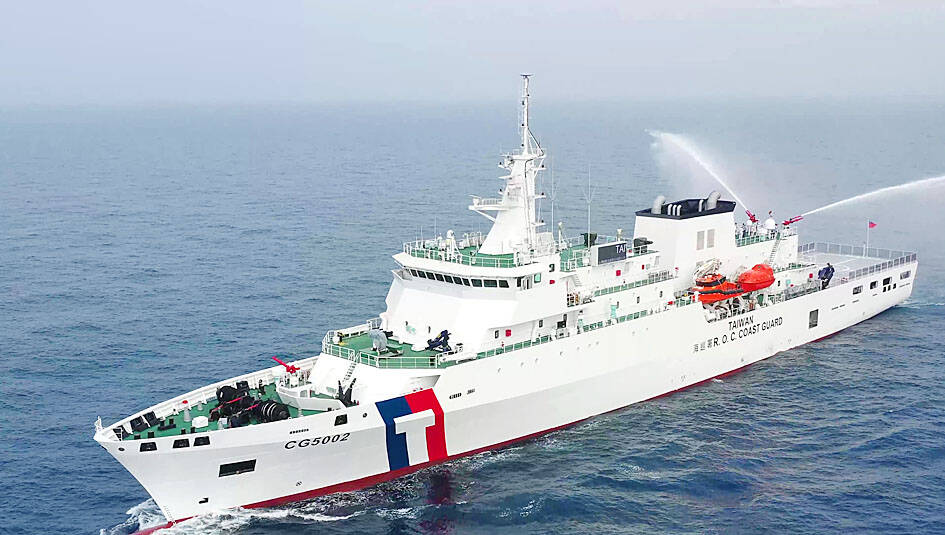
Photo courtesy of the Coast Guard Administration
The vessel’s presence in a US harbor ahead of the Rim of the Pacific (RIMPAC) exercises sparked media speculation about Taiwan possibly taking part in the exercises.
RIMPAC is the world’s largest naval exercise administered every two years by the US Indo-Pacific Command. The fleets of 29 nations are expected to attend this year’s drills, which would involve 43 ships and submarines, and 150 aircraft, the command said.
However, Hsieh said that the Hsinchu was engaged in a routine maritime fisheries enforcement patrol in the Pacific Ocean.
The CGA deployed the Hsinchu for the year’s first long-range patrol in the central and western Pacific for its superior capabilities over other ships in sustaining a voyage and providing medical care with an onboard hospital, he said.
The coast guard does not disclose operational details concerning its ships to the public, Hsieh said, declining to elaborate.
The CGA conducts two to three patrols in cooperation with the Council of Agriculture to ensure compliance with international treaties on fisheries on the high seas, it said later in a news release.
Patrol operations are limited to a designated area and ships make prearranged stops at foreign ports to replenish fuel, water and rations, the CGA said.
The CGA confirmed the Hsinchu’s itinerary as shown on the ship tracker, adding that Taiwanese ships received supplies in Hawaii during a previous voyage in 2011.
Taiwan’s participation in international operations demonstrated its commitment to being a responsible global actor and the safety of Taiwanese fishers, the CGA said.

RESILIENCE: Taiwan plays a key role in semiconductors, energy, information infrastructure and advanced manufacturing, AIT Director Raymond Greene said Taiwan’s continued investment in deterrence and resilience remains vital, especially in uncrewed systems and other emerging technologies, American Institute in Taiwan (AIT) Director Raymond Greene said yesterday. Greene made the remarks at the annual National Strategic Summit on Supply Chain Resilience held by the Research Institute for Democracy, Society and Emerging Technology (DSET), a government-backed think tank. As Taiwan last year became the US’ fourth-largest trading partner and supply chain security is becoming more important, cooperation in emerging technologies continues to deepen between the two countries, he said. The US is committed to accelerating innovation, building key infrastructure, strengthening cooperation

The National Chungshan Institute of Science and Technology yesterday showcased its locally developed variants of the Vision 60 robotic patrol dog, which it plans to deploy on the nation’s outlying territories in the South China Sea. The variants were produced under the Joint Lab project — created by the institute and domestic companies — and assembled with domestically produced motors, lenses and artificial intelligence (AI) systems alongside licensed tech from the US, Missile and Rocket Systems Research Division deputy director Jen Kuo-kang (任國光) told the media event at a military base in Taipei’s Dazhi (大直) area. Taiwan has built up its strengths

RIGHT DIRECTION: Taiwan’s efforts to prevent forced labor include a proposal to ‘fully prohibit’ employers from withholding workers’ documents, an official said Taiwan is to establish a mechanism to restrict imports of goods linked to forced labor, the Executive Yuan said yesterday, after the US proposed imposing additional tariffs on Taiwanese goods over labor concerns. “The Ministry of Labor and the Ministry of Economic Affairs are to establish an interministerial review procedure,” Executive Yuan spokesperson Michelle Lee (李慧芝) said at a news briefing in Taipei. “The government is to use the Foreign Trade Act [貿易法] as the legal basis to restrict imports of goods produced with forced labor” and bring its supply chain governance more in line with international standards on human rights, resilience

NOT IMMEDIATE: Taiwan has a chance to appeal the proposed 10 percent tariff before it starts, while other countries face a 12.5 percent tariff from the trade office Taiwan is among 60 economies determined by the US to have failed to impose or enforce a ban on the importation of goods produced with forced labor, according to a notice released on Tuesday by the Office of the US Trade Representative (USTR), which proposed imposing an additional 10 percent or more tariff on them. The USTR in a statement said that following an investigation, it had determined under Section 301 of the Trade Act of 1974 that the failure of the 60 economies to impose and effectively enforce a prohibition on the importation of goods produced with forced labor is


 RSS
RSS