


COVID-19 infections are rising in the nation, with 328 hospitalization cases recorded last week, an increase of 25 percent compared with the previous week, the Centers for Disease Control (CDC) said yesterday, adding that the outbreak might continue into August or September.
Twenty people died of the disease last week, fewer than the previous week, the CDC said.
According to the numbers of newly reported COVID-19 diagnoses, hospitalizations, deaths and prescribed anti-viral drugs, COVID-19 activity is rising and has entered an epidemic period, which is the most recent outbreak since the Lunar New Year holiday, CDC Deputy Director-General Tseng Shu-hui (曾淑慧) said.
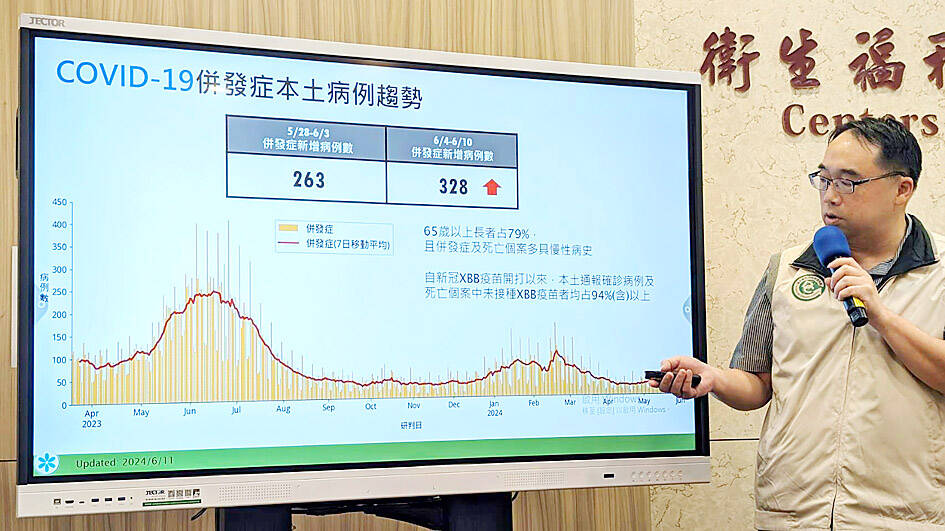
Photo: CNA
The incidence rate of local COVID-19 cases rose to 1.53 per 100,000 people, compared with 1.47 per 100,000 people in March last year, when the viral activity was relatively low and steady, she said.
Genomic surveillance data in the past four weeks show that the JN.1 subvariant of SARS-CoV-2 accounted for 64 percent of local cases and 59 percent of imported cases, while the new subvariant KP.2 accounted for 10 percent of local cases and 22 percent of imported cases, and another new subvariant KP.3 was responsible for 9 percent of both local and imported cases, Guo said.
The increase in COVID-19 activity might be caused by the emerging subvariants, as the rate of positive tests around the world is also increasing, except in a few regions, Tseng said.
The CDC predicts this new outbreak might cause cases to fluctuate, and could continue until August or September, she said.
People who develop a fever, cough, runny nose, sore throat or other suspected symptoms are advised to take a COVID-19 antigen rapid test at home, she added.
Since the XBB.1.5-adapted COVID-19 vaccine became available on Sept. 26 last year, only about 2.76 million doses of the vaccine have been administered, accounting for about 12 percent of the population, Tseng said.
However, up to 95 percent of the cumulative hospitalized cases and deaths did not get the updated vaccine, she said, urging people at a higher risk of developing severe complications to get vaccinated.
CDC physician Lin Yung-ching (林詠青) said two hospitalized cases last week were one-year-old boys who did not have underlying health conditions, but were unvaccinated.
Both developed a high fever of more than 40oC, and were hospitalized after experiencing shortness of breath and other symptoms, Lin said, adding that both have been discharged from hospital.
The CDC also reported a 4.9 percent increase in weekly hospital visits for enterovirus infection to 17,967 last week.
Although the CDC has determined that the peak of the enterovirus outbreak has passed, weekly hospital visits have increased for two straight weeks, and the number is expected to continue fluctuating until the summer vacation begins, so schoolchildren should still practice good hygiene and preventive measures, Tseng said.
Children aged five or younger are at a higher risk of developing serious illness from the infection, so caregivers should keep a close watch over infected children and immediately seek medical attention if they show any signs of severe complications, she said.
The CDC also reported the first local case of dengue fever in five weeks — a man in his 20s in Kaohsiung.
Tseng said the last reported locally acquired dengue case was in late April, and the CDC is conducting genome sequencing to see if the new case is associated with the previous outbreak.
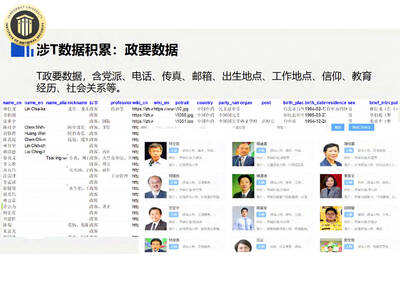
NETWORK-MAPPING PROJECT: The database contains 170 detailed files of Taiwanese politicians and about 23 million records of household registration data in Taiwan China has developed a network-mapping project targeting political figures and parties in Taiwan to monitor public opinion during elections and to craft tailored influence campaigns aimed at dividing Taiwanese society, according to documents leaked by Chinese technology firm GoLaxy (中科天璣). The documents, collected by Taipei-based Doublethink Lab, showed a database was specifically created to gather detailed information on Taiwanese political figures, including their political affiliations, job histories, birthplaces, residences, education, religion and a brief biography about them. Several notable Taiwanese politicians are in the database, including President William Lai (賴清德), former president Tsai Ing-wen (蔡英文), Minister of Foreign Affairs Lin Chia-lung (林佳龍),
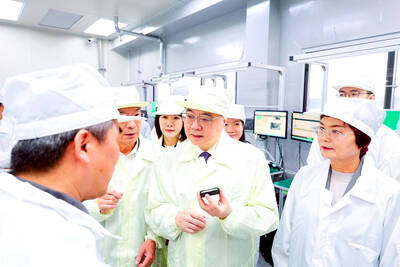
KEY INDUSTRY: The vice premier discussed a plan to create a non-red drone supply chain by next year, which has been allocated a budget of more than NT$7.2 billion The government has budgeted NT$44.2 billion (US$1.38 billion) to cultivate Taiwan’s uncrewed aerial vehicle (UAV) industry over the next five years, which would make the nation a major player in the industry’s democratic supply chain in the Asia-Pacific region, Premier Cho Jung-tai (卓榮泰) said yesterday. Cho made the remarks during a visit to the facilities of Cub Elecparts Inc (為升電裝). Democratic Progressive Party (DPP) Legislator Chen Su-yueh (陳素月) and Chinese Nationalist Party (KMT) Legislator Hsieh Yi-fong (謝依鳳) also participated in the trip. Cub Elecparts has transitioned from the automotive industry to the defense industry, which is the top priority among the nation’s
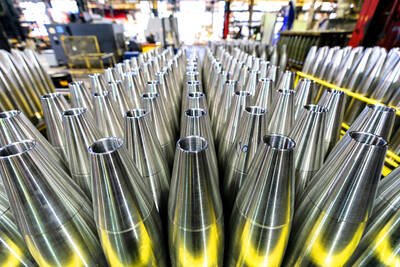
UPGRADED MISSILE: The Chungshan Institute of Science and Technology is reportedly to conduct a live-fire test of the Hsiung Feng III anti-ship missile on Thursday next week The US Army is planning to build new facilities to boost explosives production and strengthen its supply chain, a move aimed at addressing munitions shortages and supporting obligations to partners including Taiwan, Ukraine and Israel, Defense News reported. The army has issued a sources sought notice for a proposed Center of Excellence at the Blue Grass Army Depot in Kentucky, the report said. The facility would serve as a hub within the US industrial base for the production of key military explosives, including research department explosives (RDX) and high melting explosives (HMX), while also supporting research and development of next-generation materials. The proposed
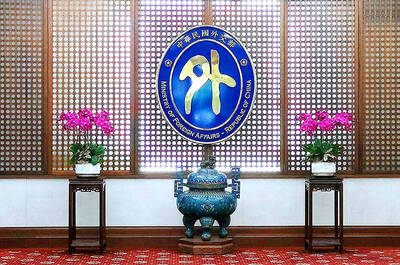
SOUTH KOREA DISPUTE: If Seoul continues to ignore its request, Taiwan would change South Korea’s designation on its arrival cards, the foreign ministry said If South Korea does not reply appropriately to a request to correct Taiwan’s name on its e-Arrival card system before March 31, the government would take corresponding measures to change how South Korea is labeled on the online Taiwan Arrival Card system, the Ministry of Foreign Affairs said yesterday. South Korea’s e-Arrival card system lists Taiwan as “China (Taiwan)” in the “point of departure” and “next destination” fields. Taipei has asked Seoul to change the wording. Since March 1, South Koreans who hold government-issued Alien Resident Certificates (ARC) have been identified as from “South Korea” rather than the “Republic of Korea,” the


 RSS
RSS