


Hundreds of people rallied in downtown Taipei yesterday, calling on people to unite to safeguard democracy and freedom, while condemning China’s crackdown on Hong Kong and marking the fifth anniversary of the start of the territory’s mass democracy protests in 2019.
More than 600 people participated in the event, said event organizers, which included the Hong Kong Outlanders, the New School for Democracy and the Taiwan Hong Kong Association.
Participants first observed a minute’s silence to recognize those who have been imprisoned for leading Hong Kong’s democracy movement and other protests, before marching from Liberty Square to Nishi Honganji Temple (西本願寺).
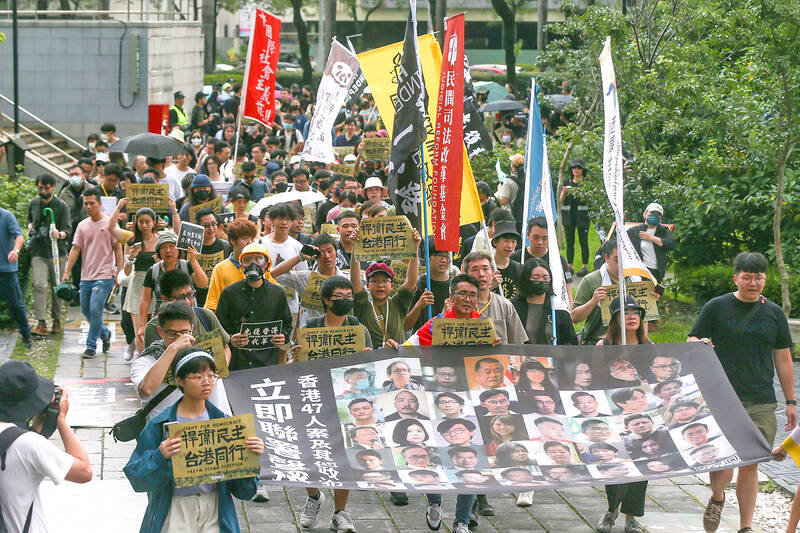
Photo: I-Hwa Cheng, AFP
The event ended with participants singing Do You Hear the People Sing and Glory to Hong Kong, which is banned in the territory.
Many people held placards reading: “Fight for Democracy” and “HK and Taiwan Stand Together,” while others carried a flag reading: “Liberate Hong Kong, Revolution of Our Times,” a slogan that was used by democracy advocates in Hong Kong.
Four people carried a giant banner, displaying the faces of 47 imprisoned democracy advocates from Hong Kong. Protesters were calling for their release.
“People yearning for freedom must stand up and fight against repression. Taking action is the only way there can be hope for the future,” Taiwan Hong Kong Association director Sang Pu (桑普) said.
Democratic Progressive Party Legislator Hung Sun-han (洪申翰) also attended the rally.
“In Taiwan, we have freedom of expression, and the freedom to exercise political rights, so we have a responsibility to speak up for those who are being oppressed by the Chinese regime,” he said. “We all hope that China’s ... authoritarian rule will be dismantled.”
Taiwanese human rights activist Lee Ming-che (李明哲), who was imprisoned in China for five years, said that Hong Kong’s struggles over the past few years were quite similar to Taiwan’s democracy movement, which fought against authoritarian rule for many decades.
“Too many Taiwanese have forgotten that we enjoy freedom and democracy right now, but this came after much suffering and the efforts of many who sacrificed their lives,” Lee said.
“Now we see the struggles facing activists in Hong Kong. People must understand that they must fight for freedom and democracy. If people do not, then that freedom and democracy could be lost at any moment,” Lee said.
Some members of the Human Rights Network for Tibet and Taiwan wrapped themselves in the Tibetan flag and called for closer cooperation between the peoples of Taiwan, Hong Kong and Tibet.
Additional reporting by CNA


RESILIENCE: Taiwan plays a key role in semiconductors, energy, information infrastructure and advanced manufacturing, AIT Director Raymond Greene said Taiwan’s continued investment in deterrence and resilience remains vital, especially in uncrewed systems and other emerging technologies, American Institute in Taiwan (AIT) Director Raymond Greene said yesterday. Greene made the remarks at the annual National Strategic Summit on Supply Chain Resilience held by the Research Institute for Democracy, Society and Emerging Technology (DSET), a government-backed think tank. As Taiwan last year became the US’ fourth-largest trading partner and supply chain security is becoming more important, cooperation in emerging technologies continues to deepen between the two countries, he said. The US is committed to accelerating innovation, building key infrastructure, strengthening cooperation

The National Chungshan Institute of Science and Technology yesterday showcased its locally developed variants of the Vision 60 robotic patrol dog, which it plans to deploy on the nation’s outlying territories in the South China Sea. The variants were produced under the Joint Lab project — created by the institute and domestic companies — and assembled with domestically produced motors, lenses and artificial intelligence (AI) systems alongside licensed tech from the US, Missile and Rocket Systems Research Division deputy director Jen Kuo-kang (任國光) told the media event at a military base in Taipei’s Dazhi (大直) area. Taiwan has built up its strengths

RIGHT DIRECTION: Taiwan’s efforts to prevent forced labor include a proposal to ‘fully prohibit’ employers from withholding workers’ documents, an official said Taiwan is to establish a mechanism to restrict imports of goods linked to forced labor, the Executive Yuan said yesterday, after the US proposed imposing additional tariffs on Taiwanese goods over labor concerns. “The Ministry of Labor and the Ministry of Economic Affairs are to establish an interministerial review procedure,” Executive Yuan spokesperson Michelle Lee (李慧芝) said at a news briefing in Taipei. “The government is to use the Foreign Trade Act [貿易法] as the legal basis to restrict imports of goods produced with forced labor” and bring its supply chain governance more in line with international standards on human rights, resilience

NOT IMMEDIATE: Taiwan has a chance to appeal the proposed 10 percent tariff before it starts, while other countries face a 12.5 percent tariff from the trade office Taiwan is among 60 economies determined by the US to have failed to impose or enforce a ban on the importation of goods produced with forced labor, according to a notice released on Tuesday by the Office of the US Trade Representative (USTR), which proposed imposing an additional 10 percent or more tariff on them. The USTR in a statement said that following an investigation, it had determined under Section 301 of the Trade Act of 1974 that the failure of the 60 economies to impose and effectively enforce a prohibition on the importation of goods produced with forced labor is


 RSS
RSS